

Planning successful media partnership campaigns requires a methodical approach that aligns brand goals with media strengths. Brands that master this process see amplified reach, higher engagement, and measurable ROI. From initial ideation to execution, these campaigns transform alliances into revenue drivers.
Time Intelligence Media Group’s Media Partnerships Solutions provide frameworks for such planning, emphasizing data-backed strategies. This guide breaks down the steps, drawing from real-world examples to help brands navigate complexities.
The Foundation of Media Partnership Campaign Planning
Successful media partnership campaigns start with clear objective setting. Brands must define specific, measurable goals—like increasing brand awareness by 25% or generating 10,000 leads—before selecting partners. This ensures every campaign element supports overarching business aims.
Audience analysis forms the next pillar. Tools like demographic profiling and behavioral data help identify media outlets with overlapping audiences. For example, a fitness brand planning a campaign with a health podcast network analyzed listener data to achieve 40% higher conversion rates than mismatched efforts.
Risk assessment completes the foundation. Brands evaluate potential pitfalls, such as reputational misalignment, through SWOT analysis. Campaigns planned with this rigor, as seen in automotive brands partnering with travel media, yield sustained success.
Defining SMART Goals for Partnership Campaigns
SMART goals—Specific, Measurable, Achievable, Relevant, Time-bound—anchor planning. A retail brand set a goal of “20% sales uplift in Q4 via media co-promotions,” guiding partner selection.
Incorporate benchmarks from past campaigns to make goals achievable. This structured approach minimizes failures, with data showing SMART-planned campaigns outperform vague ones by 3x.
Regular goal audits during planning ensure adaptability to market shifts.
Selecting the Right Media Partners for Your Campaign
Partner selection hinges on synergy evaluation. Brands score potential media on criteria like audience size, engagement rates, and content alignment. A beverage company vetted 15 outlets, choosing a sports media partner that delivered 2.5 million impressions during a tournament campaign.
Conduct due diligence via case study reviews and reference checks. This reveals partners’ track record in similar campaigns, avoiding those with inconsistent delivery.
Negotiate terms early, focusing on exclusivity, revenue shares, and content rights. Well-selected partners elevate campaigns, as evidenced by tech brands allying with influencers for 35% engagement boosts.
Evaluation Criteria for Ideal Media Partners
- Audience Overlap: Target 50%+ match in age, interests, and location.
- Engagement Metrics: Prioritize partners with >5% interaction rates.
- Content Compatibility: Ensure thematic fit for authentic co-creation.
- Performance History: Review past ROI data from similar campaigns.
- Scalability: Assess ability to expand across channels.
These criteria streamline selection for high-impact campaigns.
Developing a Campaign Content Strategy
Craft a content strategy that leverages partner strengths. Map out formats—articles, videos, social series—tailored to each platform. A fashion brand’s campaign with a lifestyle magazine featured runway recaps and shoppable posts, driving 28% traffic growth.
Balance promotional and value-driven content at a 30/70 ratio to maintain trust. Use storytelling to weave brand narratives into partner ecosystems, enhancing recall.
Incorporate user-generated elements for authenticity. Campaigns with this strategy, like food brands co-creating recipes, see 50% higher shares.
Content Calendar Essentials for Media Campaigns
Build a 90-day calendar with milestones:
- Week 1-2: Teaser content buildup.
- Week 3-8: Peak co-branded activations.
- Week 9-12: Follow-up nurturing.
Assign responsibilities clearly to avoid bottlenecks. This planning yields cohesive campaigns that sustain momentum.
Budgeting and Resource Allocation in Partnership Campaigns
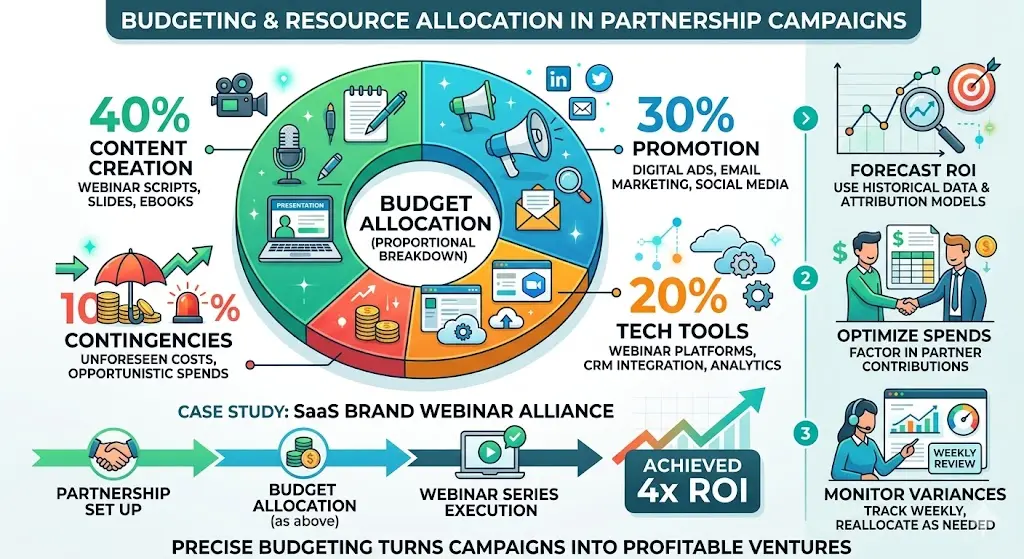
Allocate budgets proportionally: 40% content creation, 30% promotion, 20% tech tools, 10% contingencies. A SaaS brand budgeted this way for a webinar series alliance, achieving 4x ROI.
Forecast ROI using historical data and attribution models. Factor in partner contributions to optimize spends. Monitor variances weekly, reallocating as needed. Precise budgeting turns campaigns into profitable ventures.
Cost-Saving Tactics for Campaign Budgets
- Negotiate bundled services for 15-20% discounts.
- Leverage earned media from shares to stretch paid budgets.
- Use free tools like Canva for initial assets.
These tactics maximize efficiency without compromising quality.
Execution and Timeline Management for Campaigns
Launch with a phased rollout: soft launch for testing, full activation, and optimization loops. A consumer electronics brand executed a six-month campaign with quarterly pivots based on analytics, hitting 95% of KPIs.
Coordinate via shared project tools like Asana for real-time updates. Daily stand-ups prevent delays.
Scale successes mid-campaign, such as extending high-performing content. Flawless execution differentiates top campaigns. For foundational strategies, see Strategic Media Alliances for Brand Visibility.
Timeline Milestones to Follow
- Month 1: Planning and approvals.
- Month 2-4: Content production and testing.
- Month 5: Full launch and monitoring.
- Month 6: Analysis and reporting.
This structure ensures on-time delivery.
Measuring Success and Optimizing Future Campaigns
Track KPIs like reach, engagement, conversions, and ROI via integrated analytics. A beauty brand measured a campaign’s 22% lead growth, attributing it to targeted partnerships.
Conduct post-mortems to capture learnings. Compare against benchmarks to refine tactics.
Iterate for future efforts, building a campaign playbook. Explore Media Partnerships Solutions for advanced tracking frameworks. Decision-makers often review why brands choose Time Intelligence Media Group partnerships.
Key Metrics for Partnership Campaign ROI
- Impressions and reach for awareness.
- Click-through rates (>2%) for engagement.
- Cost per acquisition (<$50 benchmark).
- Lifetime value uplift for long-term impact.
Data-driven measurement closes the loop.
Overcoming Common Challenges in Media Campaigns
Address misalignment by establishing communication protocols early. Brands facing scope creep use change-order clauses successfully. Handle underperformance with contingency clauses and quick pivots. Adaptability preserved a travel brand’s campaign amid algorithm changes.
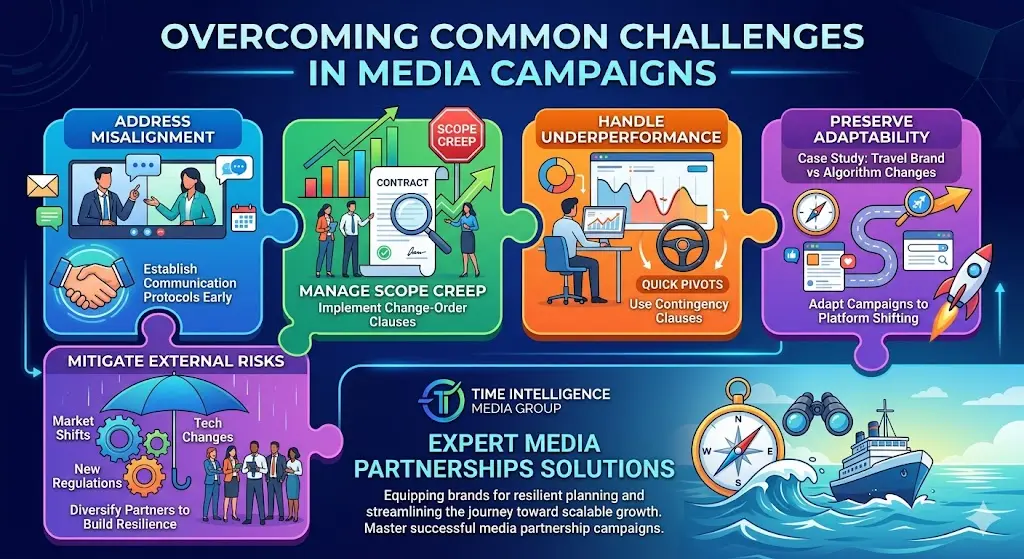
Mitigate external risks like market shifts through diversified partners. Time Intelligence Media Group aids with Media Partnerships Solutions, equipping brands for resilient planning.
Mastering how brands plan successful media partnership campaigns unlocks scalable growth. Time Intelligence Media Group offers expert Media Partnerships Solutions to streamline this journey.
