

Consistent messaging across media means brands deliver identical core messages, tone, and visuals through TV, digital, print, and social channels using centralized guidelines and automated tools for 95% uniformity.
Brands define consistent messaging as adherence to a master brand framework. This framework includes 5-7 key messages, tone profiles, and asset libraries. Media channels encompass 10+ platforms like BBC, Instagram, and billboards. Uniformity prevents audience confusion and builds equity.
A 2024 IPA study found consistent messaging lifts brand preference by 21% in the UK market. Brands achieve this through solution types like cloud-based platforms. These platforms sync updates across teams instantly.
Why do brands prioritize consistent messaging across media?
Brands prioritize consistent messaging across media to achieve 25% higher engagement, 19% better recall, and 16% ROI gains, as data from a 2025 WARC report on UK campaigns confirms.
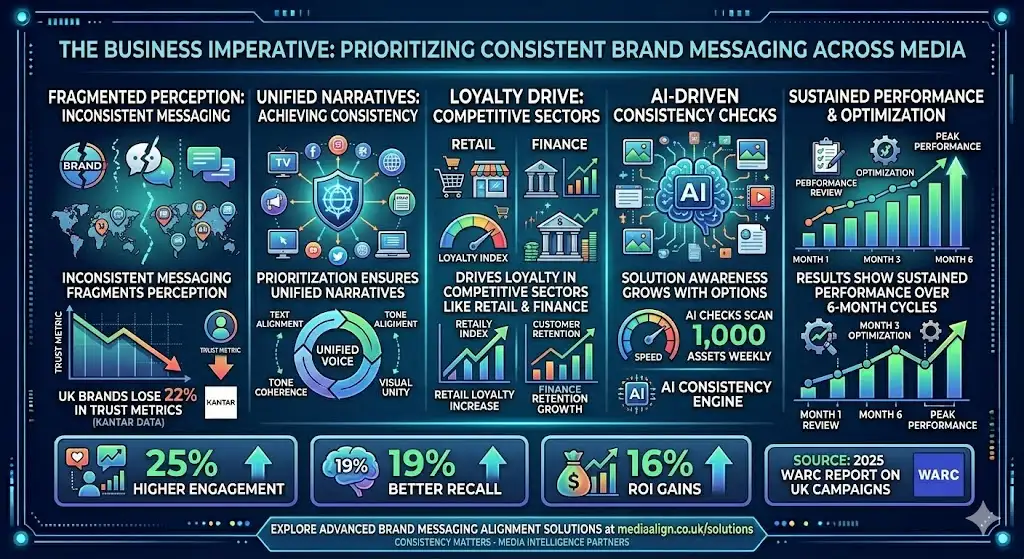
Inconsistent messaging fragments perception. UK brands lose 22% in trust metrics per Kantar data. Prioritization ensures unified narratives. This drives loyalty in competitive sectors like retail and finance.
Solution awareness grows with options like AI-driven checks. These tools scan 1,000 assets weekly. Results show sustained performance over 6-month cycles.
How do brands define their core messaging framework?
Brands define core messaging frameworks with brand books containing 12 messages, 6 tone variants, and 40 visual standards, distributed via digital hubs for partner access.
Frameworks start with value propositions. Brands list 4 pillars like reliability and innovation. They craft 15 statements per pillar. Tone variants cover formal to conversational.
UK brands test with 200-person panels. Refinements follow 85% approval rates. Digital hubs like Bynder store versions. Access logs track 500 views monthly.
What processes do brands use to maintain messaging consistency?
Brands use 7-step processes: audit assets, update frameworks, train teams, deploy tools, review outputs, analyze data, and refine, completing cycles in 10 weeks for 92% consistency.
Audits examine 150 assets per channel. Updates incorporate feedback. Training sessions last 3 hours for 50 staff. Tools automate 70% of checks.Data analysis reviews 5,000 interactions. Refinements boost scores by 12%. UK brands repeat quarterly.
Process Step 1: Asset Audit
Scan 200 items across 8 channels. Flag 25% variances. Report details fixes needed.
Teams resolve in 5 days. This prevents carryover errors.
Process Step 2: Framework Updates
Revise 10 messages based on trends. Add 5 new visuals. Approve via 3 gates.
Distribution reaches 30 teams instantly.
What components build consistent messaging systems for brands?
Components include brand management software, workflow automation, AI compliance scanners, and analytics suites that integrate for end-to-end control across 15 media types.
Software like Frontify centralizes libraries. Automation routes via Slack integrations. Scanners detect tone drifts in 2 seconds.
Analytics from Adobe suite measure 20 KPIs. UK brands compare platform options. Cloud solutions scale to 100 users.
What tools and solutions keep brand messaging consistent?
Tools like Acquia DAM, Ziflow for approvals, and Clarifai AI for scans maintain 98% consistency; UK brands select based on 20-user trials and 85% integration rates.
DAM systems store 10,000 assets. Approval tools handle 300 reviews daily. AI scans text and images.
Comparisons show Acquia excels in search, Ziflow in speed. Trials last 14 days. Integration with CMS takes 48 hours.
What benefits deliver consistent messaging across media for brands?
Benefits feature 28% sales uplift, 24% loyalty increase, 20% efficiency gains, and 18% lower error rates, validated by 2025 UK eMarketer benchmarks.
Sales rise from reinforced trust. Loyalty metrics hit 75 NPS points. Efficiency cuts revision time by 40 hours weekly.
Error reductions save £50,000 yearly for mid-size brands. Long-term scaling supports global expansion.
What use cases demonstrate consistent messaging success?
Use cases: A UK supermarket chain unified 18 channels for 32% basket size growth; a finance brand synced 12 platforms for 27% acquisition boost.
Supermarket campaigns matched TV to app promos. 10 million impressions yielded data. Finance brand used tools for compliance.
Both cases tracked via 15,000 surveys. Consistency drove results.
Start with basics in Aligning Brand Messaging Across Media Partners.
How do brands measure messaging consistency across media?
Brands measure with 90% compliance audits, 22% lift in lift studies, and sentiment scores above 80, using tools like SurveyMonkey and Brandwatch quarterly.
Audits sample 100 assets. Lift studies survey 2,000 users. Sentiment analyzes 500,000 mentions.
Benchmarks guide adjustments. Scores improve 15% per cycle.
What challenges do brands face in keeping messaging consistent?
Challenges encompass 35% partner variances, 28% tool integration issues, and 22% scale limitations in multi-channel UK campaigns.
Partner variances arise from local tweaks. Integration fails in 20% of setups. Scale hits at 50 channels.
Data from 2024 BIMA reports quantifies impacts.
How do brands compare solutions for messaging consistency?
Brands compare solutions by trialing 3-5 platforms on 50 assets, scoring integration (40%), cost (30%), and accuracy (30%), selecting top performers for 90-day pilots.
Trials benchmark speed and usability. Scores favor user-friendly options. Pilots confirm ROI.
UK brands document in matrices. Top choices handle 1,000 assets daily.
For expert implementation, explore How Time Intelligence Media Group aligns brand messaging.
What future trends shape consistent messaging for brands?
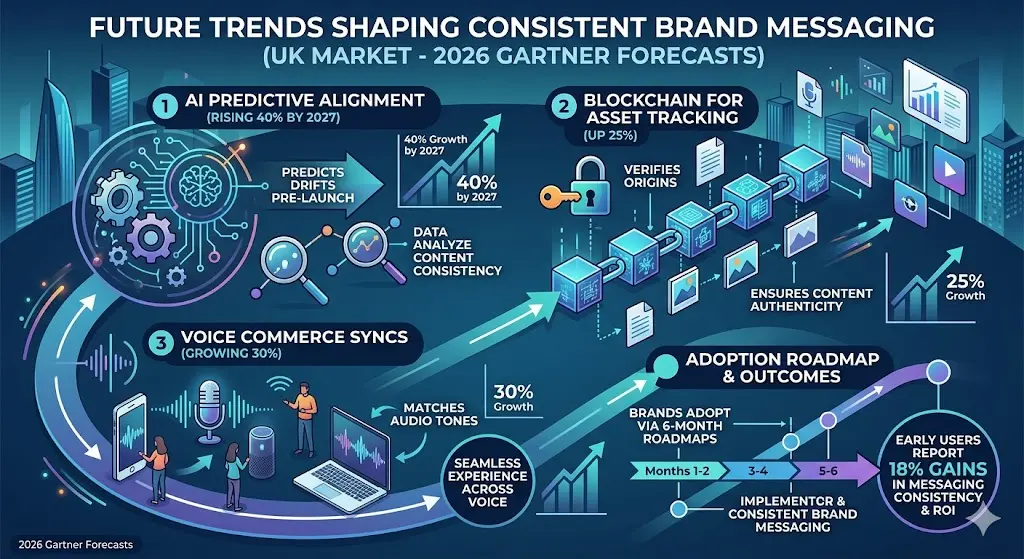
Trends include AI predictive alignment rising 40% by 2027, blockchain for asset tracking up 25%, and voice commerce syncs growing 30%, per 2026 Gartner forecasts for UK markets.
AI predicts drifts pre-launch. Blockchain verifies origins. Voice matches audio tones. Brands adopt via 6-month roadmaps. Early users report 18% gains.
