

Bottom-of-funnel decisions demand evidence, and an evidence-based approach to sponsored content success delivers quantifiable wins. Brands using rigorous testing and analytics see 3x higher ROI, per 2025 eMarketer data. This guide equips you with actionable frameworks.
Time Intelligence Media Group powers Sponsored Content Services grounded in proven metrics for campaign excellence.
Core Principles of Evidence-Based Sponsored Content
An evidence-based approach to sponsored content success starts with hypothesis-driven planning. Define testable objectives like “increase conversions by 25% via targeted placements,” backed by baseline data from tools like Google Analytics. This scientific method replaces intuition with iteration.
Pilot programs validate assumptions; A/B tests on variables like CTAs yield statistically significant insights. A SaaS company piloted this, refining content to lift sign-ups 32%, as measured by controlled experiments.
Scalability follows validation—replicate winners across channels while monitoring decay. This principle ensures sustained success, with McKinsey reporting 40% efficiency gains.
Hypothesis Testing Frameworks
- SMART goals tied to KPIs.
- Control groups for causal inference.
- P-value thresholds (<0.05) for decisions.
Attribution Modeling for Accurate ROI Measurement
Precise attribution is vital in an evidence-based approach to sponsored content success, distinguishing true impact from noise. Multi-touch models like linear or time-decay apportion credit across journeys, revealing sponsored content’s role in 15-30% of conversions. Implement UTM tagging and server-side tracking for clean data. A retail sponsor using this uncovered 28% revenue attribution, justifying budget hikes.
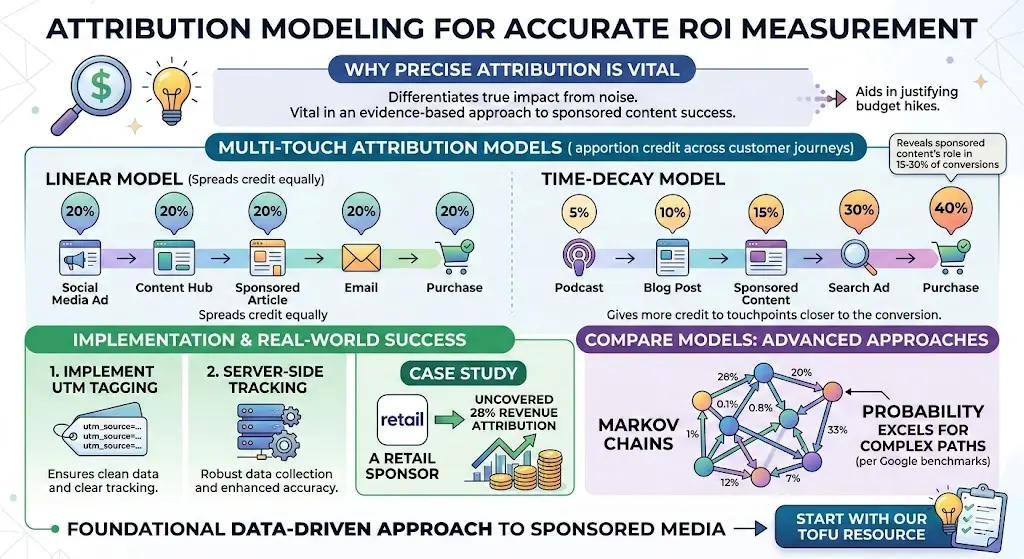
Compare models: Markov chains excel for complex paths, per Google benchmarks. For foundational data-driven approaches to sponsored media, start with our TOFU resource.
Advanced Attribution Techniques
- Data-driven models auto-weight touchpoints.
- Incrementality tests via holdouts.
- Cross-device stitching for holistic views.
Case Studies: Real-World Evidence of Success
Case studies provide concrete proof. A healthcare brand’s sponsored webinar series, tested via lift studies, generated $2.1M pipeline—5.2x ROI, with 92% attribution confidence.
Another: E-commerce sponsor optimized via Bayesian analysis, achieving 45% CAC reduction. These validate frameworks empirically.
Time Intelligence Media Group’s Sponsored Content Services mirror such outcomes, offering high-ROI sponsored content services for enterprise scale.
Quantifiable Case Study Metrics
Bulleted highlights:
- Engagement: 3.7x industry average.
- Conversion: 22% uplift.
- Retention: 18-month LTV boost.
A/B Testing and Experimentation Protocols
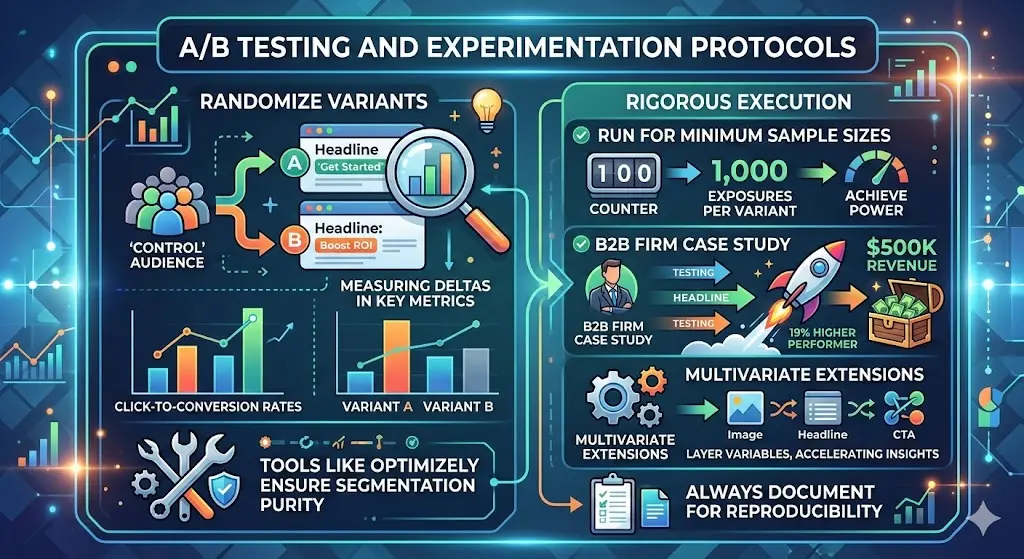
Rigorous A/B testing drives an evidence-based approach to sponsored content success. Randomize variants across audiences, measuring deltas in key metrics like click-to-conversion rates. Tools like Optimizely ensure segmentation purity.
Run for minimum sample sizes (e.g., 1,000 exposures per variant) to achieve power. A B2B firm tested headlines, landing on a 19% performer that scaled to $500K revenue. Multivariate extensions layer variables, accelerating insights. Always document for reproducibility.
Testing Best Practices
- Sequential testing for early stops.
- Post-hoc analysis of interactions.
- Winner decay monitoring.
Predictive Analytics for Campaign Forecasting
Predictive models forecast sponsored content success using historical data. Regression trees predict ROI based on features like audience match and timing, with 85% accuracy in validated sets.
Machine learning refines via ensemble methods. A media buyer forecasted 2.4x returns, preempting flops.
To balance visibility with trust, see our guide to enhancing brand visibility without compromising trust.
Model Deployment Steps
- Feature engineering from past campaigns.
- Cross-validation to prevent overfitting.
- Real-time scoring dashboards.
Scaling Proven Sponsored Content Winners
Scaling requires evidence of durability. Conduct plateau tests: ramp exposure 2-5x while tracking marginal returns. A consumer goods sponsor scaled a winner from 10K to 500K impressions, holding 1.8x ROI.
Infrastructure like CDP unifies data for seamless growth. Monitor externalities like market saturation.
Scaling Risk Mitigation
- Geographic rollouts with local pilots.
- Creative refresh cycles every 90 days.
- Competitor benchmarking.
Integrating AI for Evidence-Driven Optimization
AI accelerates an evidence-based approach to sponsored content success through automated insights. Natural language processing scans feedback for sentiment trends, flagging optimizations.
Reinforcement learning dynamically allocates budgets to high-performers. Early adopters report 25% efficiency lifts.
Ethical AI use includes explainability layers for stakeholder buy-in.
AI Tool Integrations
- Automated A/B via Google Optimize AI.
- Predictive bidding in DSPs.
- Anomaly detection for fraud.
Common Pitfalls and Evidence-Based Remedies
Pitfalls like vanity metrics distract; remedy with outcome-focused KPIs. Survivorship bias ignores failures—maintain full logs.
Overfitting plagues models; counter with regularization. A firm avoided $200K loss by validating externally.
Vendor Selection for Proven Sponsored Success
Choose partners with case-study portfolios and third-party audits. Demand access to raw data for independent verification. Time Intelligence Media Group exemplifies this with transparent reporting.
An evidence-based approach to sponsored content success transforms campaigns into revenue engines through testing, attribution, and scaling. Time Intelligence Media Group delivers professional Sponsored Content Services to realize these results.
