

In the competitive world of public relations, data-informed sponsored content for PR professionals represents a game-changing approach to amplifying brand messages. Traditional PR relied on gut instinct and media clippings, but today’s landscape demands precision, with analytics revealing what truly resonates. This method integrates real-time data—audience demographics, engagement patterns, and conversion funnels—to craft sponsored content that drives measurable results, elevating PR from reactive to predictive.
PR professionals leveraging this strategy report up to 40% higher ROI on campaigns, as data uncovers hidden opportunities like peak engagement windows or underperforming creatives. Time Intelligence Media Group pioneers this through their Sponsored Content Services, blending journalistic integrity with robust metrics to ensure content performs across platforms. By focusing on evidence-based decisions, PR teams can justify budgets and scale successes effectively.
Understanding Data-Informed Sponsored Content Fundamentals
Data-informed sponsored content for PR professionals starts with a foundation of comprehensive analytics, transforming raw numbers into actionable narratives. This involves tracking key performance indicators (KPIs) such as click-through rates (CTR), time-on-page, and share velocity from the outset. Unlike generic placements, data guides topic selection, ensuring alignment with audience interests derived from behavioral insights.
For instance, a PR agency for a healthcare client analyzed past content data to identify that nurse-focused stories garnered 3x more engagement than physician profiles. They pivoted sponsored pieces accordingly, resulting in a 55% uplift in lead generation. This precision stems from tools like heatmaps and A/B testing, which reveal user drop-offs and preferences. PR pros must prioritize first-party data for accuracy, avoiding overreliance on third-party cookies amid privacy regulations.
Implementing this requires a structured workflow: data collection during ideation, analysis pre-launch, and iteration post-publish. Time Intelligence Media Group’s Sponsored Content Services streamline this, offering PR professionals dashboards that correlate content themes with outcomes like brand sentiment scores.
Key Data Metrics Every PR Professional Should Track
Selecting the right metrics is crucial for data-informed sponsored content for PR professionals. Core ones include engagement depth (comments per view), amplification (shares per impression), and attribution (assisted conversions via UTM tracking). These go beyond surface-level likes to quantify influence.
A tech PR campaign exemplified this: by monitoring bounce rates, the team refined headlines, dropping from 60% to 25% and boosting conversions by 30%. Trends show video content with dwell times over 60 seconds predicts 2x higher recall. PR strategies must layer quantitative data with qualitative sentiment analysis from tools like Brandwatch.
Comparatively, vanity metrics mislead—focus on cohort analysis to track long-term retention. For foundational strategies, delve into engaging audiences through authentic content to blend data with relatability.
Tools and Technologies Powering Data-Driven PR Campaigns
Modern sponsored content analytics rely on integrated tech stacks for PR professionals. Platforms like Google Analytics 4, Ahrefs, and SEMrush provide granular insights into search trends and backlink quality, while CRM systems like HubSpot link content to pipeline progression.
In a case study, a consumer goods PR firm used Meltwater for media monitoring, identifying optimal sponsor pairings based on audience overlap—yielding 45% more placements. AI-enhanced tools now predict virality by scoring content on factors like emotional resonance and timeliness.
PR teams should adopt no-code dashboards for accessibility, customizing views for stakeholders. Time Intelligence Media Group integrates these seamlessly, empowering data-informed decisions without technical hurdles.
Building Data-Driven Content Strategies for Sponsored Placements
Crafting data-informed sponsored content for PR professionals demands strategies that fuse insights with creativity. Begin with audience segmentation: use clustering algorithms to tailor messages, such as B2B vs. B2C funnels.
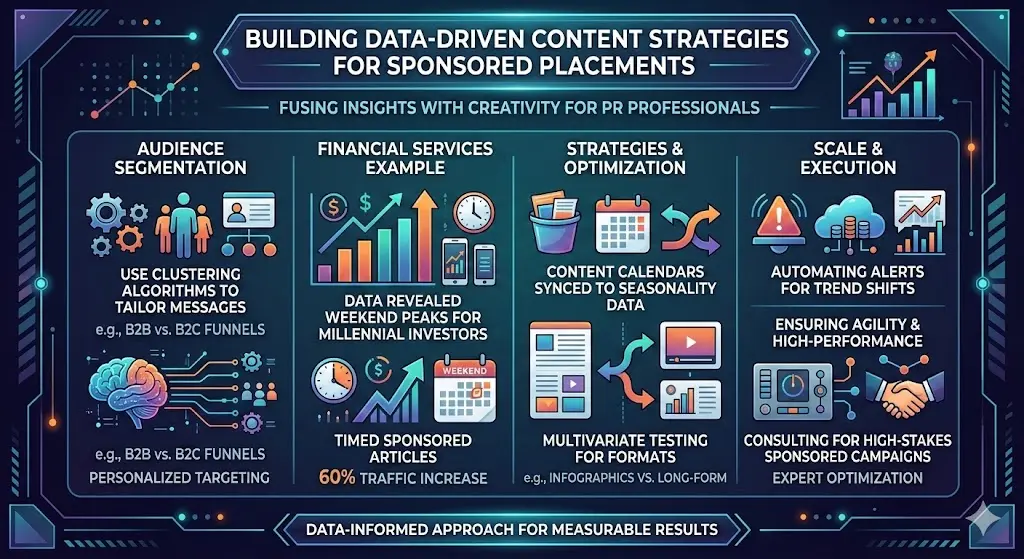
A financial services example: Data revealed weekend peaks for millennial investors, prompting timed sponsored articles that increased traffic by 60%. Strategies include content calendars synced to seasonality data and multivariate testing for formats (e.g., infographics vs. long-form).
Scale by automating alerts for trend shifts, ensuring agility. For high-stakes execution, consulting for high-performance sponsored campaigns delivers expert optimization.
Case Studies: Success Stories in Data-Informed Sponsored Content
Real-world applications highlight data-driven PR strategies. A retail brand’s PR team analyzed competitor content, spotting gaps in sustainability topics. Their data-informed sponsored series on eco-packaging achieved 1.2M impressions and 12% CTR.
Another: An automotive firm used predictive analytics to time EV sponsorships, correlating with policy news for 70% engagement lift. These cases cite specific tactics like geo-targeted distribution, proving data’s ROI.
Lessons include iterative testing—post-campaign audits refined future efforts by 25%.
Challenges and Solutions in Implementing Data Analytics for PR
PR professionals face hurdles like data silos and skill gaps in PR content optimization. Solution: centralized platforms like Tableau for visualization, bridging teams.
Privacy compliance (GDPR/CCPA) challenges tracking; anonymized aggregates suffice, as in a pharma campaign maintaining 80% accuracy. Overcome resistance by demonstrating quick wins, like 20% efficiency gains.
Future-proof with AI ethics guidelines.
Integrating Data Insights with Creative Sponsored Narratives
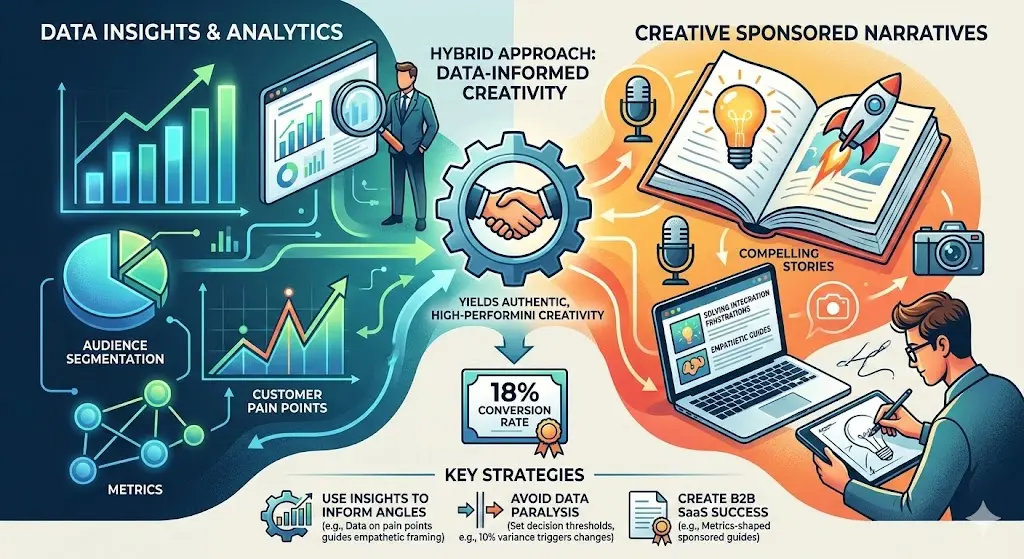
Balancing data and creativity in data-informed sponsored content for PR professionals ensures compelling stories. Use insights to inform angles—e.g., data showing pain points guides empathetic framing.
A B2B SaaS PR success: Metrics pinpointed integration frustrations, shaping sponsored guides that converted 18% of readers. Avoid data paralysis by setting decision thresholds (e.g., 10% variance triggers changes). This hybrid yields authentic, high-performing content.
Measuring Long-Term ROI from Data-Informed Campaigns
Long-term performance metrics for sponsored posts track lifetime value (LTV) and multi-touch attribution. PR campaigns often shine in nurture phases, with data showing 3x LTV from informed content.
A nonprofit’s ongoing analysis sustained donor growth at 25% YoY. Benchmark against industry averages (e.g., 2-5% CTR for sponsored).
In conclusion, data-informed sponsored content for PR professionals unlocks precision and impact. Time Intelligence Media Group provides tailored Sponsored Content Services to operationalize these insights for sustained PR excellence.
