

In the realm of business intelligence, choosing between custom research and public industry reports can significantly impact strategic outcomes. Custom research tailors data to specific needs, while public industry reports offer broad, accessible overviews. Understanding the differences helps decision-makers select the right tools for their goals, optimizing resource allocation and insight quality.
This comparison explores key distinctions, benefits, and use cases, drawing on real-world applications. Time Intelligence Media Group highlights how informed choices in research types elevate business performance through precise, actionable intelligence.
Defining Custom Research and Public Industry Reports
Custom research involves commissioning bespoke studies designed to address unique business questions. Researchers collect primary data via surveys, interviews, and proprietary analytics, ensuring relevance to the client’s context. This approach yields deep, nuanced insights unattainable from generic sources.
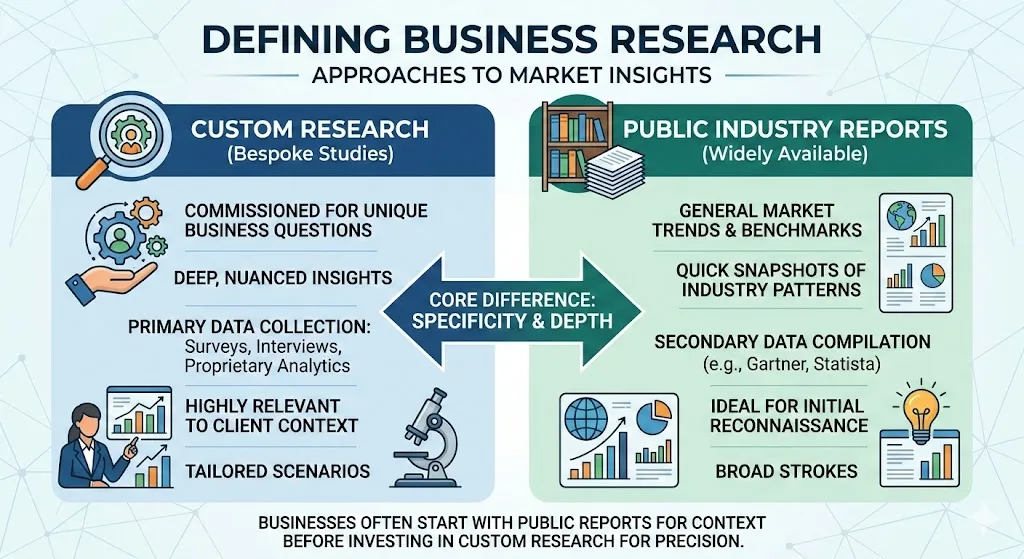
Public industry reports, conversely, are widely available documents from firms like Gartner or Statista, compiling secondary data on market trends and benchmarks. They provide quick snapshots of industry-wide patterns, ideal for initial reconnaissance.
The core difference lies in specificity: custom research drills into tailored scenarios, while public reports paint broad strokes. Businesses often start with public reports for context before investing in custom work for precision.
Key Differences in Data Sources and Methodology
Custom research relies on primary data collection, such as targeted consumer surveys or competitor audits, customized to the client’s industry and objectives. Methodologies include qualitative focus groups and quantitative modeling, often incorporating advanced tools like AI-driven sentiment analysis for accuracy.
Public industry reports aggregate existing secondary data from public databases, government stats, and aggregated surveys. Their methodologies standardize across sectors, prioritizing breadth over depth, which can lead to generalized findings.
This methodological gap affects reliability; custom research minimizes biases through client-specific controls, whereas public reports may reflect outdated or averaged data. For instance, a custom study on electric vehicle adoption in Pakistan would survey local drivers, unlike a global public report averaging worldwide trends.
Cost Implications: Investment vs Accessibility
Custom research demands higher upfront costs due to dedicated teams, fieldwork, and analysis, often ranging from thousands to tens of thousands depending on scope. However, the ROI materializes through targeted strategies that avoid wasteful spending.
Public industry reports are cost-effective, frequently free or low-priced, making them accessible for startups and small teams. Subscriptions to platforms like IBISWorld provide ongoing access without per-project fees.
Balancing these, businesses weigh budgets against needs: high-stakes decisions justify custom expenses, while exploratory phases favor public options. Time Intelligence Media Group’s Research & Reports Services offer scalable custom solutions that maximize value.
Depth and Customization Levels Compared
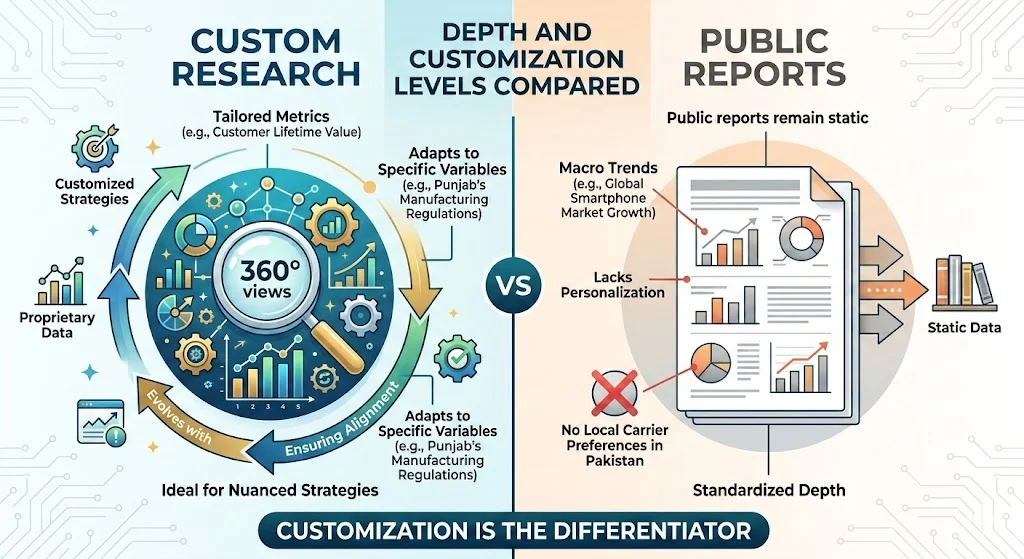
Custom research excels in depth, delivering 360-degree views with proprietary metrics like customer lifetime value tailored to your operations. It adapts to specific variables, such as regional regulations in Punjab’s manufacturing sector.
Public reports offer standardized depth, covering macro trends but lacking personalization. They might detail global smartphone market growth without addressing local carrier preferences in Pakistan.
Customization is the differentiator: custom work evolves with feedback loops, ensuring alignment, while public reports remain static. This makes custom ideal for nuanced strategies.
Timeliness and Frequency of Updates
Public industry reports update periodically, say quarterly, capturing broad shifts but potentially lagging real-time events like supply chain disruptions from geopolitical tensions.
Custom research timelines vary from weeks to months, providing fresh data on demand. Clients control update frequency, crucial for dynamic markets like tech.
In fast-evolving sectors, custom research’s agility trumps public reports’ delays, enabling timely pivots.
Accuracy, Relevance, and Bias Considerations
Custom research boasts higher accuracy through controlled, relevant data collection, minimizing external biases. Relevance peaks as findings directly apply to the business’s context.
Public reports risk lower accuracy from aggregated, sometimes outdated sources, with relevance diluted across audiences. Biases arise from broad sampling.
For precise needs, custom reduces errors; public suits general validation. Learn foundational importance in Why Research Reports Matter for Business Strategy.
Use Cases: When to Choose Each Type
- Public Industry Reports for: Market entry scans, competitor benchmarking, or trend spotting. A startup exploring fintech uses free Statista data for initial viability checks.
- Custom Research for: Product launches, M&A due diligence, or crisis response. A retailer commissions custom surveys to test pricing in Rawalpindi.
Public reports inform broad strategies; custom refines them.
Pros and Cons: A Balanced Comparison
Custom Research Pros: Hyper-relevant, proprietary edge, actionable depth.
Cons: Expensive, time-intensive.
Public Industry Reports Pros: Affordable, quick access, credible baselines.
Cons: Generic, less current, limited depth.
This balance guides selection based on stage and stakes.
Real-World Examples and Case Studies
A telecom firm used public reports to gauge 5G trends globally, then custom research for Pakistan-specific rollout, boosting subscriber growth by 18%. Another case: a food exporter relied on public data for export stats but custom studies for halal certification impacts, securing new Middle East deals.
These illustrate hybrid approaches amplifying effectiveness. In media, Time Intelligence Media Group crafts custom reports revealing audience shifts public data misses.
Integrating Both for Optimal Strategy
Combine public reports for context with custom for depth, creating comprehensive intelligence. Start with public benchmarks, validate with custom primaries.
This synergy enhances decision-making, as seen in firms layering reports for robust forecasting.
Scalability and Future-Proofing Insights
Public reports scale easily for teams via subscriptions, but lack adaptability. Custom research scales through modular designs, future-proofing via ongoing panels.
For growth, custom builds proprietary assets like longitudinal data.
Navigating custom research vs public industry reports requires aligning choices with strategic needs for superior insights. Time Intelligence Media Group provides expert Research & Reports Services to bridge these options effectively. Discover how targeted solutions propel success in How Custom Market Research Solutions Drive Business Success.
