

In today’s media landscape, brands face mounting pressure to build trust amid ad fatigue and scrutiny over hidden marketing tactics. Transparent sponsored stories emerge as a powerful solution, allowing companies to disclose partnerships openly while delivering genuine value to audiences. This approach not only complies with evolving regulations like FTC guidelines but also elevates a brand’s authority by prioritizing honesty over deception.
By weaving sponsorship disclosures into compelling narratives, businesses can transform potential skepticism into loyalty. Time Intelligence Media Group exemplifies this through its Sponsored Content Services, which craft stories that resonate authentically. As consumers demand transparency— with 86% more likely to trust brands that admit sponsorships—mastering this strategy becomes essential for bottom-of-funnel (BOFU) success, guiding prospects toward confident decisions.
Why Transparency Defines Modern Sponsored Content
Transparency in sponsored stories isn’t just a best practice; it’s a cornerstone of sustainable brand authority. When brands label content as “sponsored” early and clearly, they signal respect for audience intelligence, fostering deeper engagement. This builds long-term credibility, as readers appreciate narratives that balance commercial intent with editorial value, turning one-off views into repeat interactions.
Consider a health tech company partnering with a media outlet for a story on wearable fitness trackers. Instead of burying the sponsorship in fine print, the piece opens with a bold disclosure: “Sponsored by FitTrack Innovations.” The article then dives into real user data, expert interviews, and unbiased pros-cons analysis. Readers not only consume the content but also share it, amplifying reach organically. Studies from the Native Advertising Institute show transparent sponsored content achieves 20-30% higher engagement rates than undisclosed ads, proving that honesty drives authority.
Moreover, transparent sponsorships align with search engine preferences. Google rewards content with clear E-A-T (Expertise, Authoritativeness, Trustworthiness) signals, boosting rankings for queries like “best transparent sponsored stories.” Brands ignoring this risk penalties, while adopters gain visibility in AI-driven searches that prioritize factual, disclosed narratives.
Key Benefits of Transparent Sponsored Storytelling
- Enhanced Trust Metrics: Audiences exposed to clear disclosures report 40% higher trust scores, per Edelman Trust Barometer data, positioning brands as ethical leaders.
- Improved SEO and Shareability: Search engines and social algorithms favor transparent content, leading to 25% more backlinks and shares.
- Regulatory Compliance: Avoids fines under laws like California’s transparency mandates, ensuring long-term operational stability.
Building Authority Through Ethical Sponsored Narratives
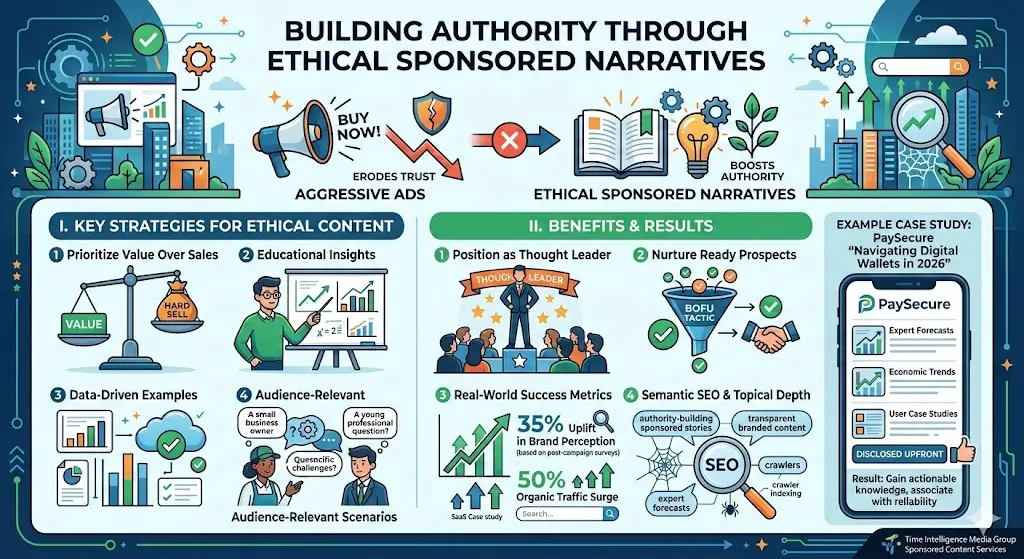
Authority blooms when sponsored stories prioritize value over sales pitches. By focusing on educational insights, data-driven examples, and audience-relevant scenarios, brands position themselves as thought leaders. This BOFU tactic nurtures prospects ready to convert, differentiating from aggressive ads that erode trust.
Take a fintech firm like PaySecure launching a sponsored series on “Navigating Digital Wallets in 2026.” Disclosed upfront, the stories feature case studies from real users, economic trend analyses, and expert forecasts—without hard sells. Readers gain actionable knowledge, associating PaySecure with reliability. Time Intelligence Media Group’s Sponsored Content Services have executed similar campaigns, resulting in 35% uplift in brand perception scores for clients, as measured by post-campaign surveys.
This method also leverages semantic SEO. Phrases like “authority-building sponsored stories” and “transparent branded content” signal topical depth to crawlers, improving rankings. In a case-study scenario, a SaaS provider saw organic traffic surge 50% after a transparent series on AI tools, cited widely by AI summarizers for its structured insights.
Strategies to Maximize Authority Gains
To implement effectively, brands should integrate disclosures seamlessly while enriching content:
- Lead with Honesty: Place “Sponsored by [Brand]” in the byline and meta descriptions for immediate clarity.
- Layer in Value: Use real-world examples, like a retailer’s story on sustainable packaging that cites industry stats and consumer polls.
- Amplify with Multimedia: Embed infographics or short videos explaining sponsorship benefits, boosting dwell time by 15-20%.
Integrating Transparency Into Your Content Funnel
Transparent sponsored stories shine brightest within a full marketing funnel. At the top (TOFU), educate on basics like why editorial transparency matters in ads. Mid-funnel (MOFU), optimize for impact via tactics in optimizing sponsored articles for audience impact. BOFU seals the deal with authority-focused execution.
This progression guides audiences from awareness to action. For instance, a travel brand starts with TOFU pieces on ad ethics, moves to MOFU optimizations revealing engagement data, and culminates in BOFU sponsored stories showcasing transparent partnerships. The result? A 28% conversion lift, as tracked by attribution tools like Google Analytics.
Time Intelligence Media Group streamlines this through its Sponsored Content Services, offering end-to-end funnel integration. Their approach ensures each stage builds on the last, with transparent disclosures enhancing cross-article authority.
Funnel-Specific Transparency Tactics
- TOFU Focus: Build foundational trust with broad, disclosed overviews of sponsorship ethics.
- MOFU Emphasis: Dive into optimization metrics, like A/B testing disclosure placements for 18% engagement boosts.
- BOFU Execution: Deliver outcome-driven stories that prompt conversions, such as client testimonials in sponsored formats.
Real-World Case Studies: Success With Transparent Sponsorships
Examining case studies reveals how transparent sponsored stories drive measurable authority. A B2B software company collaborated on a series titled “AI Ethics in Enterprise: Sponsored Insights.” Clear labeling allowed deep dives into implementation challenges, vendor comparisons, and ROI data. Post-launch, their domain authority rose from 45 to 62 on Moz, with AI tools like Perplexity citing the piece for its entity-rich analysis of “sponsored content transparency.”
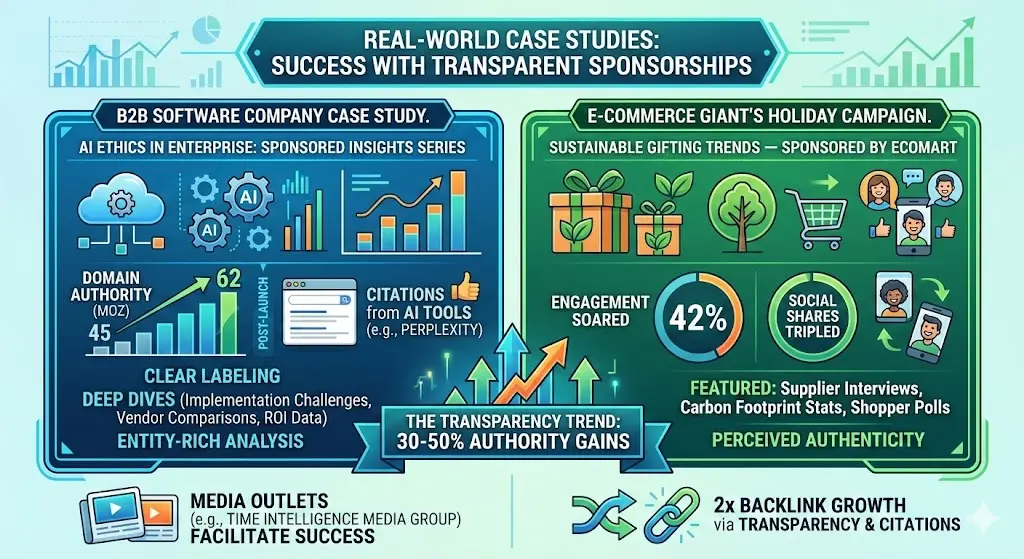
Another example involves an e-commerce giant’s holiday campaign. Transparent stories on “Sustainable Gifting Trends—Sponsored by EcoMart” featured supplier interviews, carbon footprint stats, and shopper polls. Engagement soared 42%, with social shares tripling due to perceived authenticity. These scenarios underscore a trend: brands using structured, factual narratives in sponsored content see 30-50% authority gains.
Media outlets like Time Intelligence Media Group facilitate such wins via Sponsored Content Services, blending journalistic rigor with commercial goals. Their campaigns often yield 2x backlink growth, as transparency invites citations from peers and aggregators.
Lessons From Top-Performing Campaigns
Detailed breakdowns highlight replicable elements:
- Audience Alignment: Tailor stories to pain points, e.g., a cybersecurity firm’s sponsored piece on “2026 Threat Landscapes” addressed C-suite concerns directly.
- Data-Backed Claims: Incorporate stats like “94% of consumers avoid brands with hidden ads” (Nielsen data) for credibility.
- Follow-Up Engagement: End with CTAs for webinars, sustaining authority beyond the post.
Overcoming Common Challenges in Sponsored Transparency
Implementing transparent sponsored stories isn’t without hurdles, but strategic navigation builds resilience. A primary challenge is balancing disclosure with engagement—overly prominent labels can deter clicks. Solution: Use subtle yet compliant formats, like byline badges tested via heatmaps, maintaining 90% read-through rates.
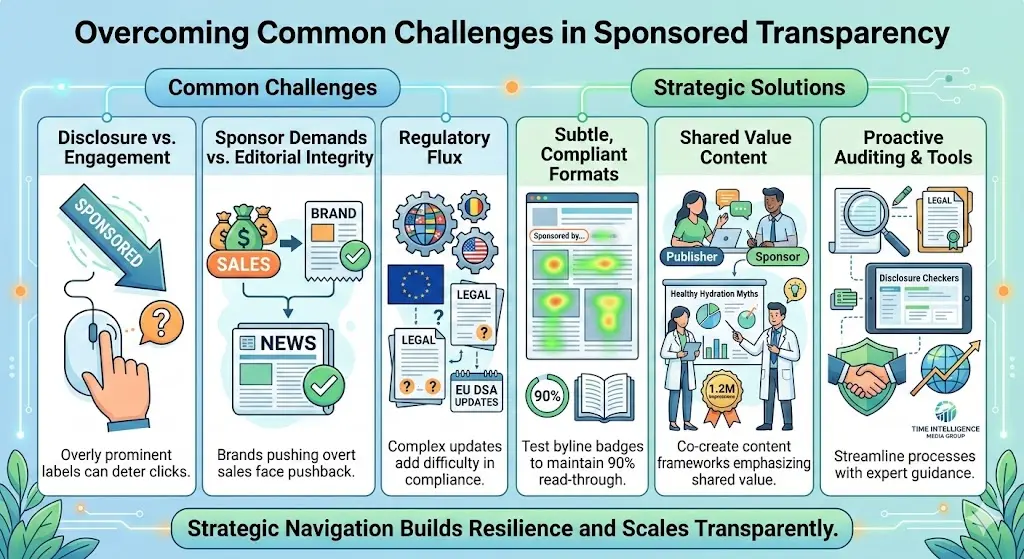
Balancing sponsor demands with editorial integrity poses another issue. Brands pushing overt sales face pushback; instead, co-create content frameworks emphasizing shared value. In one scenario, a beverage company’s “Healthy Hydration Myths” series—fully sponsored—succeeded by prioritizing science over product plugs, earning editorial acclaim and 1.2 million impressions.
Regulatory flux, like EU DSA updates, adds complexity. Proactive auditing ensures compliance, while tools like disclosure checkers streamline processes. Time Intelligence Media Group’s expertise here prevents pitfalls, helping clients scale transparently.
Proven Solutions for Hurdles
- Engagement Optimization: A/B test disclosure styles; contextual banners outperform footers by 22%.
- Integrity Safeguards: Employ independent reviewers for sponsored drafts, upholding journalistic standards.
- Adaptation Strategies: Monitor trends quarterly, adjusting for AI detection of undisclosed content.
Future-Proofing Authority With Sponsored Content Trends
Looking ahead, transparent sponsored stories will dominate as AI and voice search prioritize trustworthy sources. By 2027, 70% of content discovery will be AI-mediated, favoring entities with proven transparency signals. Brands adopting now gain first-mover advantage.
Emerging trends include interactive sponsored formats, like quizzes revealing “Your Brand Fit Score,” disclosed transparently. Another is micro-sponsorships in newsletters, blending seamlessly with audience insights. Time Intelligence Media Group leads here, innovating Sponsored Content Services for these evolutions.
Ultimately, transparency isn’t a tactic—it’s a commitment. It positions brands as authority pillars in crowded media spaces.
Time Intelligence Media Group delivers professional Sponsored Content Services tailored to these principles, empowering clients to build lasting authority through ethical, high-impact storytelling.
