

In today’s fast-evolving digital landscape, publishers face unprecedented challenges in capturing and retaining audience attention. Reader behavior has shifted dramatically with the rise of mobile browsing, personalized content feeds, and short-form video platforms. Understanding these patterns through data-driven approaches is essential for survival. This article explores how publishers leverage reader behavior analysis to boost engagement, refine content strategies, and drive sustainable growth. By examining key trends, tools, and real-world applications, we reveal actionable insights for media companies navigating the digital age.
The Evolution of Reader Behavior in Digital Publishing
Digital transformation has redefined how audiences interact with content. Gone are the days of passive print readership; today’s readers demand instant relevance and seamless experiences across devices.
From Print to Pixels: Key Shifts in Consumption Habits
Publishers once relied on circulation metrics and anecdotal feedback to gauge interest. Now, digital reader analytics provide granular data on dwell time, scroll depth, and bounce rates. For instance, a 2024 Pew Research study found that 59% of U.S. adults prefer news via mobile apps, with average session times dropping to under 90 seconds for non-personalized content.
This shift emphasizes the need for behavioral insights. Publishers track metrics like page views per session (typically 1.5-2.5 for engaged users) and time-on-page (optimal at 2-3 minutes for articles). These reader engagement metrics help identify content that resonates, such as listicles outperforming long-form essays by 40% in completion rates on platforms like BuzzFeed.
Impact of Social Media and Algorithms on Reader Paths
Social algorithms from platforms like TikTok and Instagram Reels fragment attention spans. Readers now follow non-linear paths: 70% discover content via shares or recommendations, per a 2025 Reuters Institute report. Publishers must analyze referral traffic and click-through rates to map these journeys, adapting with teaser headlines and vertical video embeds to mimic native formats.
Essential Tools and Metrics for Analyzing Reader Behavior
To truly understand reader behavior, publishers deploy sophisticated digital reader analytics tools. These platforms aggregate data from heatmaps, session recordings, and A/B tests, turning raw interactions into strategic intelligence.

Core Reader Engagement Metrics Publishers Track
Effective analysis starts with foundational metrics. Here’s a breakdown of the most critical ones:
- Bounce Rate: Measures single-page visits; under 40% indicates strong content hooks.
- Dwell Time: Tracks total engagement per visit; benchmarks hover at 3-5 minutes for news sites.
- Scroll Depth: Reveals drop-off points; 70% depth signals compelling narratives.
- Conversion Paths: Follows readers from entry to newsletter sign-ups or shares.
Time Intelligence Media Group exemplifies this with their Audience Insights Services, which analyze reader behavior to improve engagement by integrating these metrics into customizable dashboards.
Advanced Technologies Powering Behavioral Insights
AI-driven tools like Google Analytics 4 and heatmapping software (e.g., Hotjar) visualize user flows. Eye-tracking simulations predict attention hotspots, while machine learning models segment audiences by behavior clusters—e.g., “skimmers” vs. “deep divers.” A case study from The Guardian showed a 25% uplift in retention after using predictive analytics to personalize article recommendations based on past scroll patterns.
Real-World Strategies: How Publishers Apply Behavioral Data
Armed with publisher audience data, savvy media outlets transform insights into action. These strategies bridge the gap between observation and optimization.
Personalization at Scale: Tailoring Content to Individual Habits
Netflix-style recommendations dominate publishing. The New York Times uses reader behavior analysis to suggest articles, achieving a 20% increase in session depth. Publishers segment users by demographics and psychographics: urban millennials favor quick reads on sustainability, while boomers engage longer with in-depth investigations.
By clustering behaviors—e.g., high mobile scrollers receiving AMP-optimized pages—outlets reduce churn. This data fuels dynamic paywalls, offering free access to high-engagement users to nurture loyalty.
Optimizing Content Calendars with Trend Detection
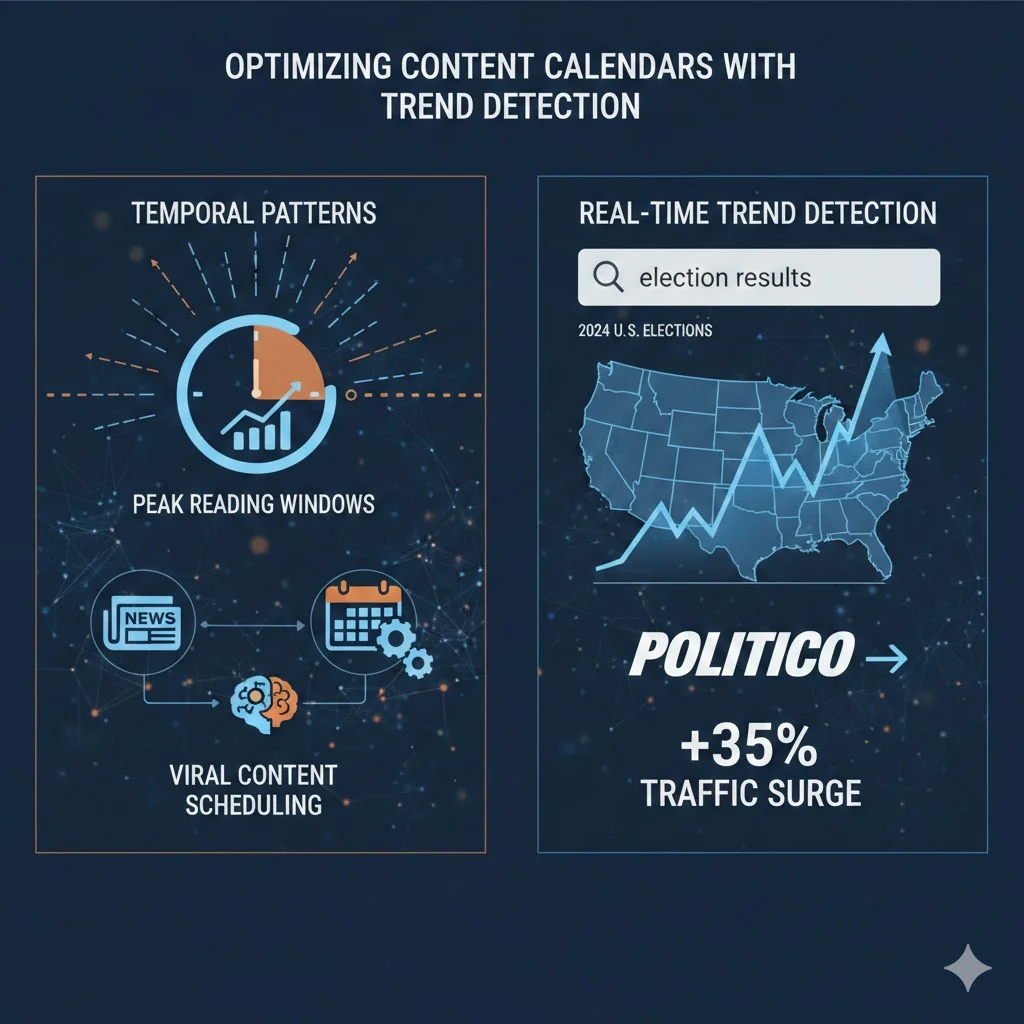
Behavioral insights reveal temporal patterns. Publishers note peak reading windows (e.g., 7-9 AM weekdays) and topic affinities, scheduling viral content accordingly. During the 2024 U.S. elections, Politico adjusted real-time based on surge queries for “election results,” spiking traffic by 35%.
For deeper dives into how these insights directly fuel revenue streams, explore how audience insights drive advertising revenue.
A/B Testing and Iterative Improvements
No strategy is set-it-and-forget-it. Publishers run multivariate tests on headlines, images, and layouts. Example: BBC News tested emoji-infused titles, boosting click-throughs by 15% among 18-24-year-olds. Session replay tools uncover friction, like intrusive ads causing 50% abandonment, prompting redesigns.
Challenges in Decoding Digital Reader Behavior
Despite advancements, hurdles persist. Privacy regulations like GDPR and CCPA limit cookie tracking, pushing publishers toward first-party data. Ad blockers obscure 30-40% of interactions, skewing metrics.
Navigating Data Overload and Fragmentation
Publishers grapple with siloed data across CMS, email platforms, and apps. Unified publisher audience data platforms aggregate these, using AI to filter noise. A 2025 Gartner forecast predicts 80% of media firms will adopt zero-party data (reader-submitted preferences) by 2027 for accurate behavioral insights.
Ethical Considerations in Reader Tracking
Transparency builds trust. Overly invasive tracking erodes loyalty; 62% of readers abandon sites post-cookie banners, per a Forrester survey. Publishers balance insights with consent, anonymizing data and offering opt-outs.
Case Studies: Success Stories in Reader Behavior Mastery
Real examples illustrate impact. Condé Nast’s Wired magazine integrated behavioral analytics, identifying that interactive graphics extended dwell time by 45%. They refined newsletters, segmenting by engagement history for 28% higher open rates.
Similarly, Vox Media’s behavioral insights dashboard correlated reader paths with video completions, optimizing embed placements and lifting ad views by 22%. These wins underscore how professional audience research translates data into ROI—learn more in our guide on how professional audience research improves media ROI.
Leveraging Audience Insights Services for Competitive Edge
Specialized solutions elevate analysis. Time Intelligence Media Group’s Audience Insights Services deliver turnkey reader behavior analysis, combining proprietary AI with expert consulting to uncover hidden patterns and prescribe strategies. Clients report 30-50% gains in engagement metrics within quarters.
Future-Proofing Publishing with Behavioral Intelligence
As algorithms evolve and attention fragments further, mastering reader behavior remains pivotal. Publishers who harness digital reader analytics not only survive but thrive, fostering loyal audiences amid competition. Time Intelligence Media Group offers proven Audience Insights Services to help media leaders decode these dynamics professionally, ensuring data-driven decisions shape the digital age.
