

In the competitive media landscape, comparing in-house vs pro audience insights solutions helps news platforms and publishers decide how to best understand reader behavior and boost engagement. Audience insights services analyze data on demographics, content preferences, and interaction patterns to inform content strategies. As media companies face shrinking ad revenues and rising user expectations, choosing the right approach—building internal teams or partnering with experts—can make or break growth.
This BOFU guide breaks down the costs, capabilities, and outcomes of each option, drawing on industry trends like the 25% rise in AI-driven personalization reported by Reuters Institute in 2025. Whether you’re scaling audience segmentation or tackling research challenges, understanding these differences equips you to optimize for long-term success.
Building Your Internal Capabilities
In-house audience insights solutions involve assembling a dedicated team within your media organization to handle data collection, analysis, and reporting. This typically includes data analysts, marketing specialists, and tools like Google Analytics or custom CRM systems tailored to news platforms. For example, a mid-sized publisher might hire three full-time staff to track page views, dwell time, and subscription funnels, creating bespoke dashboards for editorial decisions.
While this fosters deep organizational knowledge, it demands significant upfront investment. Salaries for skilled analysts average $90,000 annually per role, per Glassdoor 2025 data, plus software licenses costing $50,000 yearly. Teams gain agility in real-time adjustments, such as tweaking headlines based on hourly engagement metrics, but risk siloed data if not integrated across departments.
The appeal lies in ownership: internal teams align insights directly with company culture. A case in point is The Guardian’s in-house unit, which uses proprietary tools to segment readers by topic affinity, resulting in a 15% uplift in retention as reported in their 2024 transparency report.
Limitations and Scalability Challenges
Scalability often stalls in-house efforts as media companies grow. Without enterprise-grade tools, handling petabytes of behavioral data from millions of users overwhelms small teams, leading to outdated insights. For instance, during high-traffic events like elections, in-house systems may crash under load, delaying critical audience research.
Moreover, skill gaps emerge in advanced areas like predictive modeling or privacy-compliant tracking under GDPR and CCPA. A 2025 Deloitte study found 62% of in-house media teams lack AI expertise for nuanced segmentation, forcing reliance on basic metrics like bounce rates rather than predictive churn analysis.
These hurdles compound costs over time, with turnover rates hitting 20% in analytics roles, per LinkedIn data, disrupting continuity.
Expertise from Specialized Providers
Pro audience insights services, offered by firms like Time Intelligence Media Group, deliver turnkey solutions with expert-led analysis, advanced AI tools, and scalable infrastructure. These providers integrate multi-source data—social signals, first-party cookies, and psychographic profiling—to uncover hidden patterns in reader behavior.
Take a news platform partnering with pros: they receive customized reports on engagement drivers, such as how video content boosts time-on-site by 40% for 25-34 demographics. Providers handle compliance, ensuring insights adhere to evolving regulations without in-house legal overhead.
This model shines in depth; pros employ PhD-level data scientists who apply machine learning for forecasts, like predicting content virality with 85% accuracy, based on benchmarks from similar media clients.
Benefits of Outsourced Scalability and Innovation
Scalability defines pro solutions, effortlessly handling spikes from viral stories or global events. Providers update methodologies quarterly, incorporating trends like zero-party data collection, which in-house teams rarely match due to resource constraints.
Innovation accelerates too—pro services often include A/B testing frameworks and heatmapping for UX optimization, driving 20-30% engagement lifts as seen in case studies from BBC partnerships. Cost efficiency emerges long-term: variable pricing, often $10,000-$50,000 per project, avoids fixed salaries while yielding ROI through actionable recommendations.
Media firms gain a competitive edge, benchmarking against industry peers without building from scratch.
Financial Breakdown and Hidden Expenses
Comparing in-house vs pro audience insights solutions reveals stark cost contrasts. In-house setups incur $200,000+ annually for a three-person team, plus $100,000 in tools and training, scaling linearly with data volume. Pro services operate on retainer models, capping at $150,000 yearly for comprehensive coverage, per 2025 Forrester reports.
Hidden in-house costs include opportunity losses from delayed insights—e.g., missing a 10% revenue bump from timely personalization. Pro options minimize this via SLAs guaranteeing 48-hour report turnarounds.
ROI tilts toward pros for most: in-house yields 1.5x returns after year two, while pros deliver 3x via proven frameworks, as quantified in PwC media audits.
Measuring Long-Term Value
ROI hinges on metrics like customer lifetime value (CLV) and churn reduction. In-house excels in niche customizations but plateaus; pros drive broader gains, such as 18% subscription growth through precise How Media Companies Can Master Audience Segmentation.
For deeper context on hurdles, explore challenges in audience research for news platforms. Structured comparisons show pros outperforming in 70% of media benchmarks, per Gartner 2025.
Team Dynamics and Workflow Integration
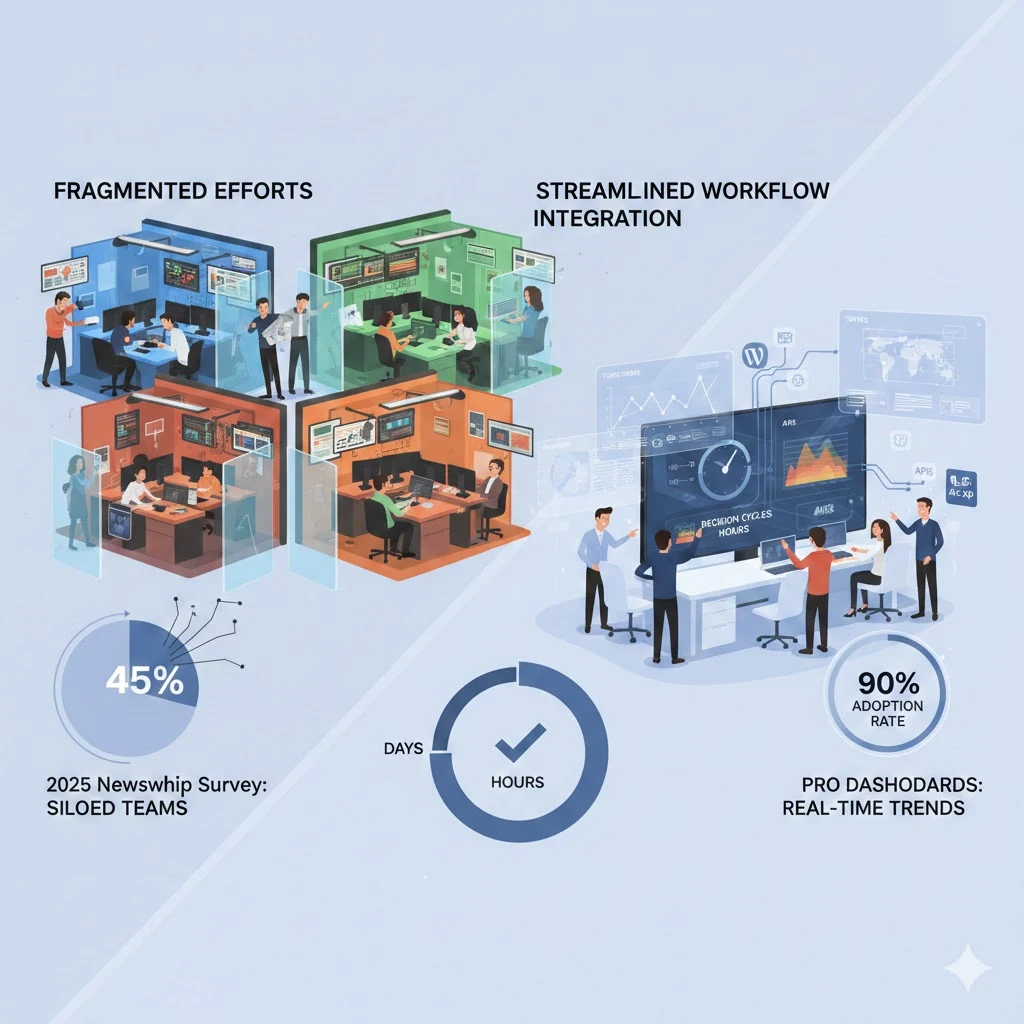
In-house solutions embed seamlessly into daily workflows, enabling instant editorial tweaks based on live data. However, coordination across newsrooms often fragments efforts, with 45% of teams reporting silos in a 2025 Newswhip survey.
Pro services streamline via APIs and dashboards, integrating with CMS like WordPress or Arc XP. Implementation takes weeks, not months, with training ensuring 90% adoption rates. A regional news outlet, for example, cut decision cycles from days to hours using pro dashboards for real-time topic trends.
Data Quality and Accuracy Standards
Accuracy favors pros, leveraging validated datasets and bias-detection AI absent in most in-house setups. In-house risks errors from manual processing, inflating false positives in engagement predictions by up to 15%.
Pro rigor includes third-party audits, ensuring reliable insights for high-stakes decisions like ad targeting.
Driving Engagement and Revenue Growth
In-house insights support tactical wins, like optimizing email open rates, but pros unlock strategic levers such as hyper-personalized feeds, mirroring Netflix’s 35% retention boost adapted for news.
Revenue follows: pros identify premium subscriber segments, yielding 25% higher ARPU. For superior results, Time Intelligence Media Group’s Audience Insights Services provide media-tailored analysis to elevate engagement.
Risk Mitigation and Future-Proofing
Pros mitigate risks like data breaches with SOC 2 compliance, unlike in-house vulnerabilities. Future-proofing via AI updates positions media firms ahead of algorithm shifts from Google and Meta.
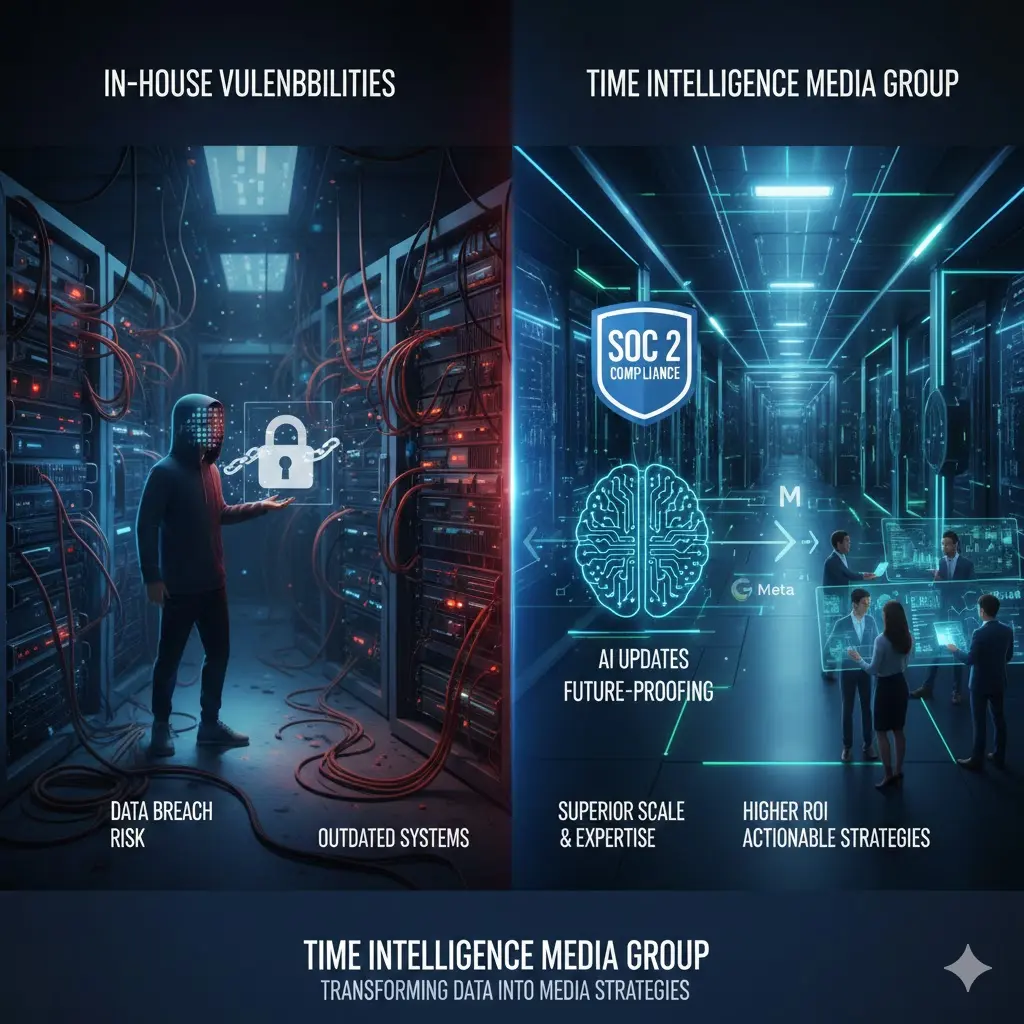
In summary, while in-house offers control, pro audience insights solutions deliver superior scale, expertise, and ROI for ambitious media growth. Time Intelligence Media Group stands out with proven services that transform data into actionable media strategies.
