

In today’s data-driven marketplace, understanding what drives customer decisions has become a cornerstone of sustainable growth. Consumer insights reveal the hidden motivations, preferences, and pain points that shape purchasing behavior, allowing businesses to move beyond guesswork and into precision-targeted strategies. These insights, derived from robust consumer behavior analysis and market research insights, empower companies to anticipate trends, refine offerings, and build lasting loyalty.
The importance of consumer insights cannot be overstated, especially as global markets grow more fragmented and competitive. Businesses that harness customer data strategies effectively see measurable uplifts in revenue, customer retention, and operational efficiency. By integrating audience insights services into their core operations, organizations transform raw data into actionable intelligence that informs everything from product development to marketing campaigns.
Defining Consumer Insights and Their Core Components
Consumer insights go beyond surface-level data like sales figures or demographics; they delve into the ‘why’ behind customer actions. At its essence, consumer insight is the deep understanding of customer needs, desires, and behaviors uncovered through systematic research methods such as surveys, focus groups, and behavioral analytics. For instance, a retail brand might discover that price sensitivity isn’t just about affordability but ties into perceived value during economic uncertainty, a nuance revealed only through targeted consumer behavior analysis.
This process involves layering quantitative data—like purchase histories and website interactions—with qualitative narratives from customer interviews. Businesses that prioritize these insights create profiles that predict future actions with high accuracy. Consider how streaming services use viewing patterns to recommend content; this isn’t random but stems from granular insights into user preferences, demonstrating how market research insights turn data into personalized experiences that boost engagement by up to 30%, according to industry benchmarks.
In practice, defining consumer insights requires a blend of technology and human interpretation. Tools like sentiment analysis software parse social media chatter, while ethnographic studies observe real-world usage. The result? A holistic view that helps businesses avoid costly missteps, such as launching products that miss cultural nuances, ensuring every decision aligns with authentic customer realities.
The Evolution of Consumer Insights in the Digital Age
The digital era has supercharged the accessibility and depth of consumer insights, shifting from annual reports to real-time data streams. With the rise of big data and AI-powered analytics, companies now track everything from mobile app interactions to voice search queries, painting a dynamic picture of evolving preferences. This evolution means traditional market research insights have merged with predictive modeling, allowing firms to forecast trends like the surge in sustainable packaging demands post-pandemic.
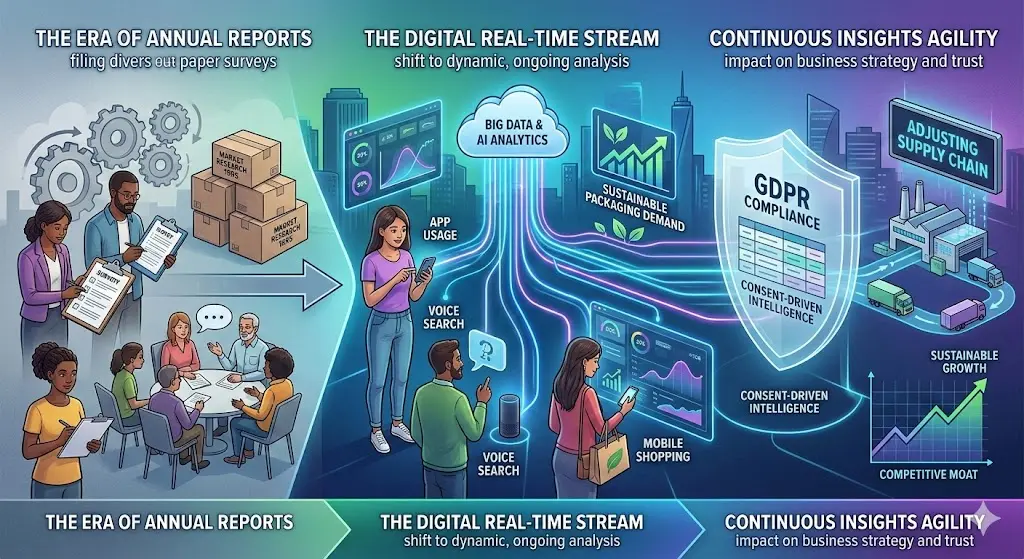
Take the fashion industry as an example: brands like Patagonia leverage ongoing consumer behavior analysis to track shifting attitudes toward eco-friendliness, adjusting supply chains accordingly. This agility stems from continuous insight gathering, which reveals micro-trends—such as Gen Z’s preference for resale platforms—before they dominate headlines. Without this, businesses risk obsolescence in fast-moving sectors.
Moreover, regulatory changes like GDPR have refined how insights are collected, emphasizing ethical data use and privacy. This has led to more trustworthy datasets, where customer data strategies focus on consent-driven intelligence. As a result, companies embedding these practices not only comply with laws but also build trust, turning insights into a competitive moat that sustains long-term growth.
Driving Product Innovation and Market Fit
Consumer insights are pivotal in steering product development toward what customers truly want, minimizing the risk of flops. By analyzing feedback loops from prototypes and usage data, businesses identify gaps—like a software tool’s unintuitive interface—and iterate swiftly. For example, a food company might use market research insights to pivot from sugary snacks to protein-enriched alternatives after uncovering health-conscious trends among millennials, resulting in a 25% sales increase.
This benefit extends to market fit, where insights validate demand before full-scale launches. Structured consumer behavior analysis helps segment audiences, revealing underserved niches such as remote workers needing ergonomic home office gear. Companies that act on these findings achieve higher adoption rates, as products resonate authentically rather than generically.
Ultimately, integrating audience insights services fosters a feedback-rich environment. Teams collaborate across departments, using insight dashboards to align R&D with real voices, ensuring innovations aren’t just novel but necessary. This approach has propelled brands like Netflix to dominate by constantly refining content based on viewer data.
Enhancing Marketing ROI and Customer Engagement
Marketing without consumer insights is like shooting in the dark—ineffective and wasteful. These insights optimize campaigns by pinpointing the right channels, messaging, and timing. A beauty brand, for instance, might learn via customer data strategies that Instagram Reels outperform static posts for 18-24-year-olds, reallocating budgets for a 40% engagement lift.
Engagement deepens as insights personalize interactions, from tailored email nurtures to dynamic ad retargeting. Here’s where numbered lists highlight tactical wins:
- Segmentation Precision: Divide audiences by behavior for hyper-relevant content.
- Content Optimization: Craft narratives that echo customer language from surveys.
- A/B Testing Rigor: Use insights to hypothesize variants that convert best.
Such strategies amplify ROI, with studies showing insight-led campaigns yielding 2-3x better returns. Businesses also nurture loyalty, turning one-time buyers into advocates through resonant experiences.
Reducing Risks and Boosting Retention Rates
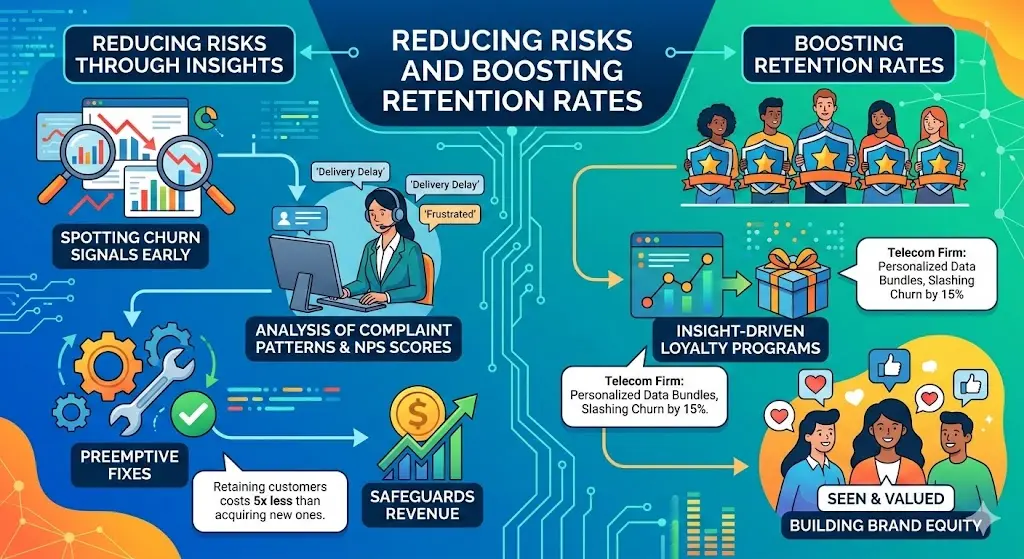
Risk mitigation is a silent superpower of consumer insights, spotting churn signals early. Analysis of complaint patterns or NPS scores reveals issues like delivery delays frustrating e-commerce users, prompting preemptive fixes. This proactive stance safeguards revenue, as retaining customers costs five times less than acquiring new ones.
Retention thrives on insight-driven loyalty programs. A telecom firm could use consumer behavior analysis to offer personalized data bundles, slashing churn by 15%. Long-term, these efforts build brand equity, where customers feel seen and valued.
Success Stories from Diverse Industries
Consumer insights shine in action across sectors. In automotive, Ford’s use of market research insights uncovered EV hesitations tied to range anxiety, leading to targeted battery tech investments and market share gains. Similarly, Starbucks refined its app based on behavior data, boosting mobile orders by 20%.
In tech, Spotify’s Wrapped campaign draws from annual listening insights, creating shareable personalization that virally engages users. These cases prove insights’ versatility, from B2B SaaS firms optimizing demos via win/loss analysis to healthcare brands tailoring wellness apps.
Integrating Insights with Advanced Research Services
To unlock these applications, businesses turn to specialized providers. For comprehensive consumer behavior analysis, explore Research & Reports Services that deliver tailored, outcome-driven intelligence for strategic decisions.
Delve deeper into practical tactics with How Companies Leverage Market Studies, an informational guide on deploying studies effectively. Ready to invest? Check Time Intelligence Media Group’s Research & Reports Services for proven, decision-ready solutions.
Common Pitfalls and Data Quality Issues
Gathering insights isn’t flawless; biases like sampling errors skew results, leading to misguided strategies. Overreliance on self-reported surveys ignores actual behaviors, as customers often misstate habits—think gym memberships bought with good intentions but rarely used.
Overcoming this demands diverse sources: blend online panels with in-person ethnographies for balanced views. Time Intelligence Media Group’s Research & Reports Services exemplify this, ensuring high-fidelity data through rigorous methodologies.
Scaling Insights for Enterprise Needs
Scaling poses hurdles as data volumes explode. Legacy tools falter, but AI integration streamlines analysis, automating anomaly detection. Enterprises succeed by building insight-centric cultures, training teams on interpretation.
Prioritize:
- Cross-functional dashboards for accessibility.
- Regular audits to maintain relevance.
- Partnerships with experts for depth.
This scalability turns insights into enterprise-wide assets.
Consumer insights remain indispensable for navigating modern business complexities, fueling innovation, efficiency, and customer-centricity. Time Intelligence Media Group offers professional Research & Reports Services to help organizations harness these insights effectively, delivering the clarity needed for informed growth.
