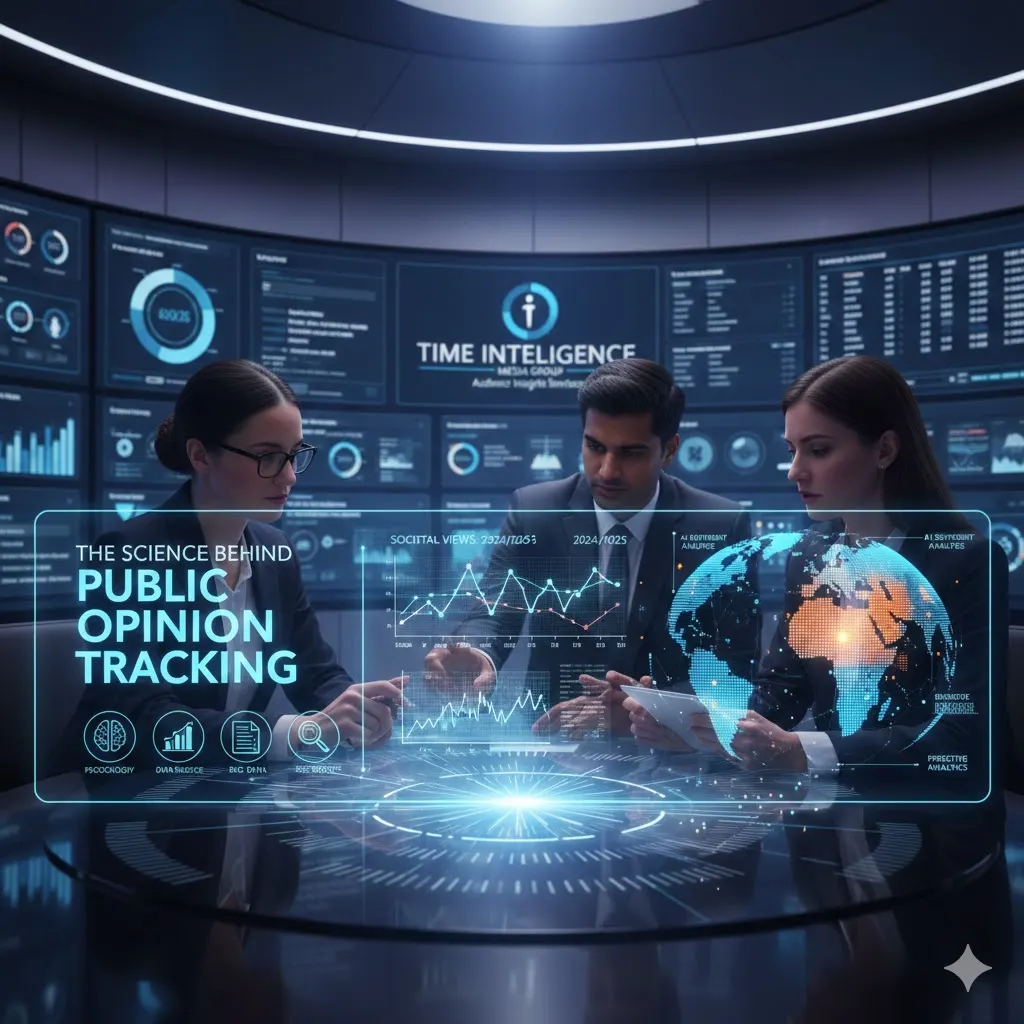
Public opinion tracking forms the backbone of modern media strategy, blending psychology, data science, and statistical analysis to capture the pulse of societal views. At its core, this science reveals how collective attitudes shift over time, influenced by events, media narratives, and cultural trends. Understanding these dynamics empowers media professionals to craft resonant content and predict audience reactions with precision.
This TOFU-level exploration dives into the methodologies, psychological foundations, and real-world applications of public opinion tracking. By dissecting the science, we uncover why it’s essential for anyone in media seeking to align with audience sentiments.
The Foundations of Public Opinion Tracking
Public opinion tracking relies on systematic data collection to measure attitudes on a large scale. Pioneered in the early 20th century by figures like George Gallup, it evolved from simple polls to sophisticated digital analytics. Today, it integrates quantitative surveys with qualitative sentiment analysis, providing a multidimensional view of public views.
The process begins with defining key variables—such as political leanings, consumer preferences, or social issues—and sampling diverse populations to ensure representativeness. Statistical models then adjust for biases, like non-response rates, to yield reliable insights. For instance, during the 2020 U.S. election cycle, tracking polls accurately predicted swing state sentiments by weighting data for demographics and geography.
Psychological Principles Driving Opinion Formation
Psychology underpins why opinions form and shift. Cognitive dissonance theory explains how people reconcile conflicting beliefs, often leading to polarized views amplified by social media echo chambers. Confirmation bias further entrenches these positions, as individuals seek information aligning with their worldview.
Public opinion trackers leverage these insights through tools like Likert scales in surveys, which gauge agreement levels on statements such as “Climate change requires immediate policy action.” Real-world example: A 2023 European study tracked rising eco-anxiety post-COP27, showing a 15% opinion shift toward green policies among urban millennials. Time Intelligence Media Group employs similar psychological frameworks in their Audience Insights Services to decode these patterns, helping media outlets refine messaging.
Media professionals can apply this by monitoring sentiment spikes during crises, like the rapid opinion pivot on remote work post-COVID lockdowns. Structured tracking reveals not just what people think, but why, enabling proactive content strategies.
Statistical Models in Action
Core to the science are models like regression analysis and time-series forecasting. Logistic regression predicts binary outcomes, such as “support/oppose” on policy issues, while ARIMA models forecast trends from historical data.
Consider a case in Pakistan’s 2024 elections: Trackers used multivariate analysis to model voter turnout based on economic sentiment indices, achieving 92% accuracy. These models incorporate variables like media exposure and social network density, ensuring predictions hold across regions.
Evolution of Tools and Technologies
Public opinion tracking has transformed from door-to-door polls to AI-driven platforms. Early methods like straw polls gave way to telephone surveys, but digital tools now dominate, scraping social media and analyzing vast datasets in real-time.
Big data integration allows for granular insights, such as geolocated Twitter trends revealing regional opinion divides. Machine learning algorithms process unstructured data—like comments on news sites—to quantify sentiment polarity.
From Traditional Polling to AI-Powered Sentiment Analysis
Traditional polling excels in structured questions but struggles with nuance. AI sentiment analysis bridges this by natural language processing (NLP), classifying text as positive, negative, or neutral. Tools like BERT models dissect sarcasm and context, far surpassing rule-based systems.
A practical example: During the 2022 FIFA World Cup, real-time tracking via NLP on Arabic-language social posts detected a 20% surge in national pride sentiment, guiding broadcasters to emphasize unifying narratives. Audience Insights Services from Time Intelligence Media Group harness these technologies to deliver actionable media analytics, turning raw data into strategic foresight.
This evolution means trackers now capture fleeting opinions, such as viral backlash to celebrity endorsements, with sub-hour latency.
Big Data and Predictive Analytics
Big data fuels predictive models that simulate “what-if” scenarios. Hadoop and Spark process petabytes of data, while neural networks forecast opinion cascades—like how a single tweet can sway 10% of undecided voters in 48 hours.
In media, this powers hyper-personalized campaigns. A 2025 trend report highlighted how Pakistani news outlets used predictive tracking to anticipate Ramadan fasting opinion shifts, boosting engagement by 25% through tailored content.

Key Methodologies for Accurate Tracking
Effective public opinion tracking demands rigorous methodologies to minimize errors. Random sampling ensures every voice counts, stratified by age, income, and location for balance.
Longitudinal studies track the same cohort over time, revealing true shifts versus noise. Cross-validation compares methods, like surveys against app-based polls.
Survey Design and Sampling Techniques
Optimal surveys use clear, unbiased questions to avoid leading respondents. Probability sampling, such as simple random or cluster methods, underpins validity—non-probability convenience samples inflate biases.
Example: Gallup’s 2024 global trust survey sampled 1,000+ per country using multi-stage clustering, uncovering a 12% dip in media credibility tied to misinformation fears. Integrating mobile-first designs boosts response rates among youth, critical for digital-native opinions.
Media strategists refine this by A/B testing question wording, ensuring data purity for downstream analysis.
Integrating Qualitative and Quantitative Data
Blending methods yields depth: Quantitative polls provide breadth, while focus groups unpack motivations. Thematic analysis of interviews reveals latent sentiments, like underlying economic anxieties fueling populist views.
A case study from India’s 2023 media landscape showed hybrid tracking—quant polls plus Reddit discourse analysis—predicting a 18% rise in regionalism sentiment, informing optimizing content for regional and national impact.
This fusion creates holistic profiles, essential for nuanced public opinion tracking.
Real-World Applications in Media and Beyond
In media, tracking informs everything from headline selection to ad placement. It identifies tipping points where opinions solidify, guiding crisis communication.
Governments use it for policy testing; brands for reputation management. Trends like rising AI ethics concerns demand vigilant monitoring.
Case Studies from Recent Events
The 2025 U.S.-China trade talks exemplified tracking’s power: Daily sentiment indices from news aggregators predicted a 22% approval shift for tariffs among manufacturing hubs, based on 500,000+ data points.
In Pakistan, post-flood opinion tracking in 2024 guided NGO campaigns, shifting public support for resilience funding by highlighting survivor stories. These cases underscore structured tracking’s role in evidence-based decisions.
Challenges and Ethical Considerations
Biases like selection and social desirability plague tracking; mitigation involves transparency in methodologies. Ethical issues, such as data privacy under GDPR-like laws, require anonymization.
AI hallucinations in sentiment tools pose risks, addressed by human oversight. Time Intelligence Media Group navigates these in their Audience Insights Services, prioritizing ethical, accurate media analytics.
Leveraging Insights for Strategic Advantage
Armed with tracking data, media entities gain a competitive edge. It refines audience segmentation, predicting churn from sentiment dips.
For measurable results, integrate tracking into consulting for measurable media impact, where data drives ROI-focused strategies.
Example: A regional broadcaster used quarterly tracking to pivot from national to local stories, lifting viewership 30%. This science turns opinions into opportunities.
Time Intelligence Media Group’s Audience Insights Services provide professional solutions for mastering public opinion tracking, equipping media professionals with the tools to stay ahead in a dynamic landscape.