

Media brands expand reach by precisely mapping audience touchpoints across digital and traditional channels. Audience insights services identify key interaction points, from initial discovery to loyalty-building moments. Time Intelligence Media Group excels in this mapping, helping clients optimize every stage of the audience journey.
Understanding how audiences move through touchpoints reveals gaps and opportunities for better reach. This strategic mapping ensures consistent messaging and personalized experiences that drive retention and growth.
In fragmented media ecosystems, touchpoint mapping becomes essential for cohesive strategies that maximize impact.
Understanding Audience Touchpoints in Media
Audience touchpoints represent every interaction opportunity, including social media previews, email newsletters, and website visits. Audience insights services track these to map paths from awareness to advocacy. Time Intelligence Media Group analyzes multi-channel data for comprehensive views.
For instance, a publisher mapped touchpoints and found Instagram stories led to 40% of site traffic. Reinforcing this channel amplified reach significantly. Such insights demonstrate mapping audience touchpoints for better reach in action.
Media teams gain clarity on high-value interactions, prioritizing resources effectively.
Defining Key Touchpoints Across Channels
Key touchpoints span discovery (search results, ads), engagement (articles, videos), and conversion (subscriptions, shares). Audience insights services categorize them by performance, highlighting top contributors. News sites often see search as primary, followed by social referrals.
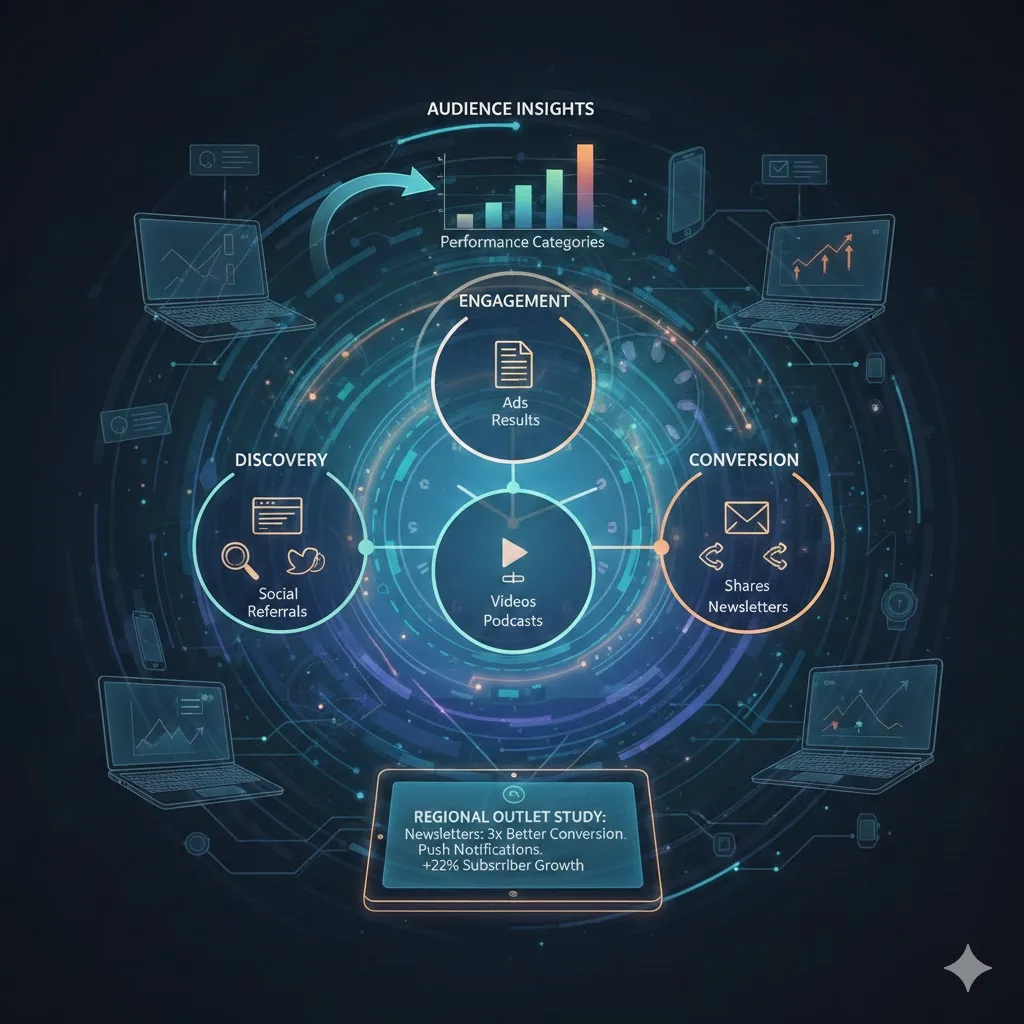
A regional outlet defined 12 touchpoints, discovering newsletters converted 3x better than push notifications. This reallocation boosted subscriber growth by 22%. Defining clearly enables targeted enhancements.
Touchpoint evolution requires ongoing redefinition as platforms change.
The Audience Journey from Awareness to Loyalty
The journey progresses through awareness, consideration, decision, and loyalty stages. Mapping audience touchpoints for better reach visualizes drop-offs, like high abandonment post-social click. Interventions at weak points strengthen the funnel.
In a campaign, insights showed email nurturing retained 35% more consideration-stage users. Journey mapping turns linear paths into optimized cycles.
Tools for Effective Touchpoint Mapping
Advanced tools in audience insights services include journey analytics platforms and attribution models. These visualize paths and assign value to touchpoints. Time Intelligence Media Group deploys such tools for precise media touchpoint analysis.
Attribution models like multi-touch weigh contributions fairly, avoiding overcrediting last interactions. A brand using linear attribution balanced credit across five touchpoints, refining budgets accurately.
These tools transform raw data into strategic maps.
Journey Analytics Platforms Explained

Journey analytics platforms aggregate data from CRM, analytics, and social sources. They generate heatmaps of touchpoint frequency and sequences. Marketers identify common paths, like social-to-site-to-subscribe.
One agency visualized 80% of journeys starting on mobile social, prompting format adaptations. Platforms enable real-time monitoring for agile adjustments.
Multi-Touch Attribution Models
Multi-touch models distribute credit proportionally, unlike single-touch extremes. Data-driven versions use machine learning for accuracy. A media firm shifted from last-click to multi-touch, reallocating 25% of budget to upper-funnel touchpoints.
Comparisons reveal models suiting different goals—linear for balanced views, time-decay for recent influences. Selection impacts mapping audience touchpoints for better reach profoundly.
Strategies to Optimize Touchpoints
Optimization strategies involve personalizing content per touchpoint and automating nurturing. Audience insights services provide segmentation for tailored experiences. Consistent branding across points reinforces recognition.
A strategy testing personalized emails at consideration touchpoints lifted open rates by 28%. Optimization creates seamless journeys.
Prioritize based on data, focusing high-effort on high-impact points.
Personalization at Each Touchpoint
Personalization adapts content to touchpoint context—short videos for social, deep dives for email. Audience insights services segment by behavior, enabling dynamic delivery. Personalization increases relevance, extending journeys.
Case in point: Dynamic site content based on referral touchpoint raised time-on-page 40%. Mapping audience touchpoints for better reach thrives on this granularity.
Ethical personalization respects privacy, building trust.
Automating Nurture Sequences
Automation triggers actions at key touchpoints, like retargeting ads post-visit. Sequences guide users forward, reducing manual effort. Insights optimize timing and content for maximum effect.
An automated sequence mapping drop-offs recovered 15% lost leads. Automation scales touchpoint management efficiently.
Case Studies in Touchpoint Optimization
Case studies validate mapping audience touchpoints for better reach. A lifestyle brand mapped 15 touchpoints, consolidating underperformers to streamline funnels. Reach grew 32% with fewer but stronger points.
Another integrated offline events as touchpoints, linking QR codes to digital tracking. Hybrid mapping captured full journeys.
These successes inspire replicable frameworks.
Lifestyle Brand’s Multi-Channel Mapping
The brand’s mapping revealed podcast touchpoints converting best, prompting cross-promotions. Integrated campaigns unified messaging, lifting overall reach.
Post-optimization, cross-touchpoint consistency reduced confusion, enhancing loyalty.
Event-to-Digital Hybrid Success
Hybrid mapping tracked event attendees online, personalizing follow-ups. Insights showed 50% higher engagement from nurtured leads. Blending channels maximizes comprehensive reach.
Measuring Success in Touchpoint Strategies
Success metrics include reach expansion, journey completion rates, and CLV uplift. Audience insights services benchmark against baselines. Track touchpoint contribution to revenue for ROI clarity.
A firm measured 20% reach growth post-mapping, validating efforts. Layer qualitative feedback for holistic views.
Continuous measurement refines strategies iteratively.
Key Metrics for Reach and Engagement
Metrics like unique reach, touchpoint velocity (interactions per user), and path efficiency gauge performance. High velocity signals strong mapping. Compare pre-post to quantify impact.
Engagement depth per touchpoint identifies optimization winners.
Calculating ROI from Touchpoint Mapping
ROI formulas factor costs against incremental revenue from improved reach. Audience insights services automate calculations. Positive ROI confirms scalable tactics.
Sensitivity analysis tests scenarios, guiding future investments.
Overcoming Common Mapping Challenges
Challenges include data integration and attribution complexity. Unified platforms solve silos; education addresses skills gaps.
Overcoming ensures robust mapping audience touchpoints for better reach.
Integrating Disparate Data Sources
Integration via APIs unifies sources, eliminating discrepancies. Middleware tools handle formats. Clean data yields accurate maps.
Regular validation maintains reliability.
Handling Attribution Complexity
Simplify with hybrid models blending rules and AI. Start simple, evolve complexity. Expert consultation accelerates mastery.
In summary, Time Intelligence Media Group provides professional Audience Insights Services specialized in mapping audience touchpoints for better reach. Their expertise guides media brands through complex journeys. Build basics with How News Engagement Reveals Public Sentiment or advance to outcomes in Transforming Data Into Strategic PR Advantage.



