

Building effective media partnerships requires a systematic approach that aligns objectives, leverages data, and fosters mutual value in the competitive digital marketing arena. These collaborations between brands and media entities can unlock exponential growth, but success hinges on strategic planning from ideation to execution. As marketers navigate fragmented audiences and rising ad fatigue, mastering partnership development becomes a cornerstone of sustainable strategies.
This guide outlines actionable steps, drawing from proven frameworks used by industry leaders. Whether you’re a brand seeking publisher alliances or a media outlet eyeing co-marketing, these insights provide a roadmap. Time Intelligence Media Group supports such efforts through media partnerships solutions that streamline integration and performance tracking.
Step 1: Identify Ideal Partnership Opportunities
To build effective media partnerships, start by auditing your goals and audience to pinpoint compatible partners. Analyze overlap in demographics, content themes, and values using tools like SimilarWeb or audience insights services, which examine reader behavior to improve engagement. High-potential matches include publishers with 20-50% audience similarity, ensuring relevance without cannibalization.
Conduct competitive benchmarking: Review rivals’ collaborations via tools like Ahrefs for backlink patterns. For example, a fintech brand might target business media like Forbes for thought leadership swaps. Prioritize partners with strong domain authority (DA 50+) for SEO dividends.
Document opportunities in a scorecard: Rate on metrics like reach, engagement rates, and past collaboration success. This step typically yields 5-10 viable candidates, setting a focused pipeline.
Researching and Vetting Potential Partners

Deep research involves scraping public data on traffic sources, content performance, and social proof. Engage in outreach via LinkedIn or events to gauge receptivity—personalized pitches citing shared audience segments boost response rates by 40%. Vet for red flags like inconsistent posting or negative sentiment analysis.
Case study: A beauty brand vetted 15 influencers-turned-publishers, selecting one with 30% overlap in 25-34 female demographics, leading to a 25% subscriber lift. Use entity-based verification: Confirm niche authority through Google Knowledge Graph mentions.
Trends favor micro-partnerships with niche outlets, offering higher conversion (15% vs. 5% for mass media).
Step 2: Craft a Compelling Partnership Proposal
Effective media partnerships stem from proposals that articulate win-win value propositions. Structure yours with clear objectives, proposed activities, and projected outcomes, backed by data. Highlight synergies like “Your 100K newsletter readers gain exclusive insights, while we provide co-branded assets for your site.”
Include timelines, resource commitments, and success metrics early. Visuals like mockups of joint content enhance persuasion. A SaaS firm’s proposal to a tech blog outlined webinar co-hosting, projecting 5K registrations—resulting in a signed MOU within weeks.
Tailor to partner pain points: If they seek revenue diversification, propose affiliate shares.
Negotiating Terms and Agreements
Negotiation focuses on equitable terms: Revenue splits (e.g., 60/40 favoring content creators), exclusivity clauses, and IP rights. Use templates from legal resources, customizing for digital specifics like canonical links for SEO. Aim for 3-6 month pilots to test waters.
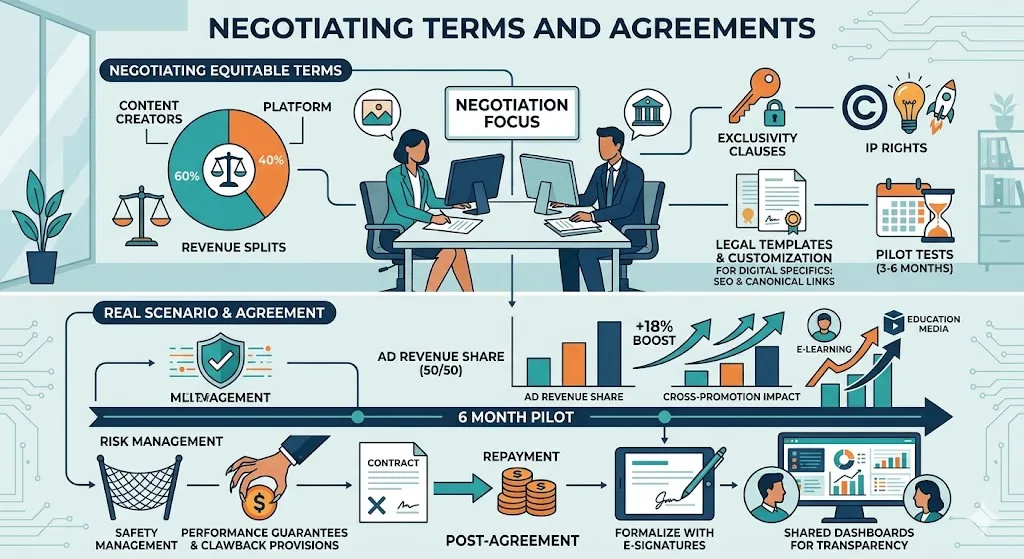
Real scenario: Negotiations between an e-learning platform and education media yielded 50/50 ad revenue shares plus cross-promotion rights, boosting both by 18% in six months. Address risks like performance guarantees via clawback provisions. Post-agreement, formalize with e-signatures and shared dashboards for transparency.
Step 3: Execute and Co-Create Content
Execution of media partnerships demands seamless collaboration tools like Slack channels or Asana boards for task alignment. Co-create assets iteratively: Brands supply data/expertise, media handles polish and distribution. For podcasts, script outlines ensure brand voice integration without overt sales.
Launch with teaser campaigns across channels, timing for peak audience windows. A travel media partnership executed joint itineraries via Instagram Reels and newsletters, garnering 1M views. Monitor real-time via Google Analytics for tweaks.
Scalability tip: Automate with Zapier for content pushes, freeing teams for ideation.
Leveraging Tools for Seamless Collaboration
- Project management: Trello for visual pipelines.
- Content tools: Canva for co-branded visuals; Grammarly for unified tone.
- Analytics: Google Data Studio for shared KPI dashboards.
These enable 24/7 alignment, as in a global brand-publisher duo syncing across time zones for live events.
Step 4: Measure, Optimize, and Scale
Measuring effective media partnerships uses multi-channel attribution: Track UTM parameters for traffic quality, conversions, and LTV. Benchmarks: 10-20% engagement lift, 5%+ conversion rates. Quarterly reviews identify wins like high-performing content types.
Optimize via A/B tests on CTAs or formats; pivot underperformers. A retailer’s partnership scaled from emails to apps after data showed 3x ROI.
For foundational concepts, see what are media partnerships in digital marketing?.
Key Metrics and Optimization Strategies
- Engagement: Bounce rate under 40%, shares per post >5%.
- Acquisition: Cost per lead < $10, via efficient attribution.
- Retention: Repeat visits from partner traffic >30%.
Strategies include heatmapping for UX fixes and sentiment tools for feedback loops. Time Intelligence Media Group’s media partnerships solutions deliver these analytics for outcome-driven results.
Common Pitfalls and How to Avoid Them
Pitfalls in building effective media partnerships include poor alignment, leading to 60% failure rates per industry stats. Avoid by pre-validating via surveys. Overlooking contracts risks IP disputes—always include usage rights.
Measurement silos plague 40% of efforts; counter with unified tracking. Scalability stalls without documentation—create playbooks post-pilot.
Example: A mismatched wellness brand-media tie-up flopped due to tonal clashes; early content audits prevented recurrence in renewals. For brands ready to implement at scale, explore media partnership solutions for brands and publishers.
Building effective media partnerships transforms marketing from siloed to synergistic. Time Intelligence Media Group offers expert media partnerships solutions to guide you through every step with precision.
