

The media landscape has undergone a dramatic transformation over the past decade. Traditional metrics like circulation numbers and Nielsen ratings no longer tell the complete story of audience behavior. Today’s media companies operate in an environment where understanding granular audience preferences, consumption patterns, and engagement signals has become essential for survival and growth.
Audience intelligence represents a fundamental shift in how media organizations approach their readers, viewers, and listeners. Rather than relying on demographic assumptions or broad-brush analytics, modern audience intelligence systems aggregate behavioral data, sentiment analysis, content performance metrics, and engagement patterns to create actionable insights that drive editorial strategy, advertising effectiveness, and revenue growth.
Understanding Audience Intelligence in the Media Context
Audience intelligence is the systematic collection, analysis, and application of data about content consumers to improve decision-making across editorial, commercial, and product teams. For media companies, this goes far beyond basic web analytics or social media follower counts.
A comprehensive audience intelligence approach examines how individuals interact with content across multiple touchpoints. This includes which articles generate the most engagement, what time of day specific audience segments are most active, which topics drive subscription conversions, and how different content formats perform with various demographic groups.
Media organizations implementing audience intelligence typically discover patterns invisible to traditional analytics. For example, an article with modest traffic numbers might have exceptional read-through rates and social sharing among high-value audience segments. These nuanced insights enable editors to understand not just what content attracts clicks, but what truly resonates with audiences worth cultivating.
The distinction between basic analytics and true audience intelligence lies in depth and actionability. While standard metrics tell you that 10,000 people visited an article, audience intelligence reveals which of those visitors represent your target demographic, how they arrived at the content, what they did next, and whether their behavior indicates future subscription potential or advertiser value.
Core Components of Effective Audience Intelligence
Behavioral tracking forms the foundation of audience intelligence systems. This involves monitoring how users navigate through content, what they choose to read or watch, how long they engage, and when they abandon content. Time Intelligence Media Group has observed that behavioral patterns often contradict surface-level assumptions about audience preferences.
Demographic and psychographic profiling adds essential context to behavioral data. Understanding not just who your audience is in terms of age and location, but their interests, values, and content consumption habits allows media companies to segment audiences into meaningful groups for targeted content strategies.
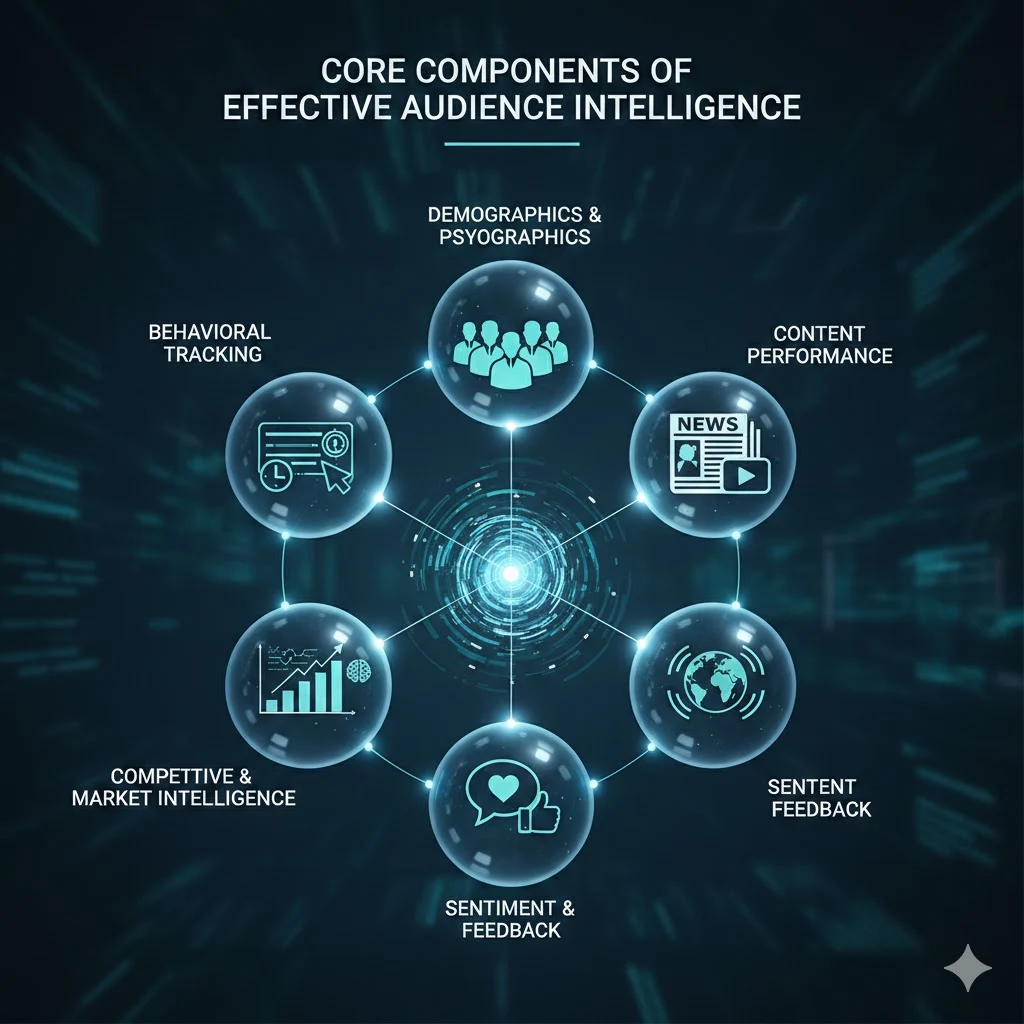
Content performance analysis connects audience behavior with specific editorial choices. Which headlines drive clicks? What article length performs best for different topics? Do multimedia elements increase or decrease engagement for particular audience segments? These insights directly inform editorial decision-making.
Sentiment and feedback analysis captures qualitative signals about how audiences respond emotionally to content. Comments, social media reactions, survey responses, and direct feedback provide texture that pure behavioral data cannot reveal.
Competitive and market intelligence rounds out the picture by contextualizing your audience data within the broader media landscape. How does your audience engagement compare to industry benchmarks? What content gaps exist in your market that audience data suggests you could fill?
Why Media Companies Cannot Ignore Audience Intelligence
The economics of modern media have made audience intelligence non-negotiable. Advertising revenue models increasingly depend on proving audience quality and engagement to brands demanding measurable ROI. Publishers who cannot demonstrate deep audience understanding lose pricing power and advertiser confidence.
Subscription and membership models require even more sophisticated audience intelligence. Media companies must identify which content drives conversions, understand why subscribers cancel, and recognize early warning signs of churn. Without these insights, subscription businesses operate blindly, unable to optimize the most critical conversion points.
Editorial resource allocation represents another compelling reason for audience intelligence adoption. Newsrooms operate with constrained budgets and limited journalists. Data showing which topics, formats, and approaches generate meaningful engagement allows editors to deploy resources where they create the most value rather than relying on institutional assumptions about what audiences want.
Personalization expectations from audiences have risen dramatically. Readers now expect content recommendations tailored to their interests, email newsletters customized to their preferences, and user experiences that adapt to their behavior. Delivering on these expectations requires sophisticated audience intelligence infrastructure.
The competitive advantage of knowing your audience better than competitors cannot be overstated. Media companies with superior audience intelligence can spot emerging trends earlier, understand niche audience needs competitors miss, and make strategic pivots with confidence based on data rather than intuition.
Common Challenges in Implementing Audience Intelligence
Data fragmentation poses the first major obstacle for most media organizations. Audience information lives in separate systems including content management platforms, analytics tools, subscription databases, advertising servers, social media channels, and email marketing platforms. Creating a unified view requires technical integration that many organizations lack.
Privacy regulations and evolving cookie policies have complicated audience tracking significantly. GDPR, CCPA, and similar frameworks require careful consent management and data handling practices. The deprecation of third-party cookies forces media companies to develop first-party data strategies and alternative identification methods.
Organizational resistance often undermines audience intelligence initiatives. Veteran editors may view data-driven insights as threatening editorial independence or creative judgment. Sales teams accustomed to traditional metrics may resist new audience value frameworks. Successfully implementing audience intelligence requires cultural change alongside technical capabilities.
Technical skill gaps present practical implementation barriers. Analyzing audience data effectively requires expertise in data science, statistics, and media business models. Many media companies lack internal talent capable of extracting strategic insights from raw audience data.
Cost considerations can delay or derail audience intelligence programs. Enterprise-grade tools require significant investment, while building custom solutions demands engineering resources. Smaller media organizations may struggle to justify the expense despite recognizing the strategic importance.
Practical Applications Across Media Operations

Editorial teams use audience intelligence to guide story selection, headline optimization, and content packaging. Reporters can see which of their articles generated the most engaged readership, helping them understand what topics and approaches resonate. Editors can identify content gaps where audience interest exists but coverage remains thin.
Audience development teams leverage intelligence data to refine acquisition strategies, optimize conversion funnels, and reduce churn. Understanding which content drives newsletter signups or which articles convert casual readers into subscribers enables precise targeting and resource allocation.
Advertising and commercial teams utilize audience intelligence to create detailed audience packages for advertisers, demonstrate engagement quality beyond simple impressions, and develop programmatic strategies that maximize yield. Proving audience attention and intent significantly strengthens commercial negotiations.
Product and technology teams apply audience intelligence to improve user experience, optimize site performance for different audience segments, and prioritize feature development based on actual user behavior rather than assumptions about what audiences might want.
Strategic planning benefits enormously from audience intelligence. Leadership teams can evaluate new market opportunities, assess competitive positioning, and make informed decisions about content investments, platform expansion, and partnership opportunities based on concrete audience data.
Building a Sustainable Audience Intelligence Practice
Starting with clearly defined objectives prevents audience intelligence initiatives from becoming unfocused data collection exercises. Media companies should identify specific business questions they need to answer, such as reducing subscription churn or improving content engagement among high-value demographics.
Selecting appropriate tools and platforms requires matching technical capabilities with organizational needs and resources. Some media companies benefit from comprehensive enterprise platforms, while others achieve better results with specialized tools addressing specific intelligence requirements.
Establishing data governance frameworks ensures consistent, privacy-compliant data handling across the organization. Clear policies about data collection, storage, access, and usage protect both the company and audience members while enabling effective analysis.
Training and organizational change management determine whether audience intelligence insights actually influence decisions. Regular workshops, accessible dashboards, and integration of audience data into existing workflows help embed intelligence into daily operations.
Continuous refinement of measurement approaches keeps audience intelligence relevant as media consumption patterns evolve. Regular audits of what data matters, how it’s analyzed, and how insights are communicated ensure the practice delivers ongoing value.
The Competitive Future of Audience-Informed Media
Media companies that master audience intelligence will increasingly separate themselves from competitors still operating on intuition and outdated metrics. The ability to understand audiences at a granular level enables personalized experiences that build loyalty, targeted content strategies that maximize engagement, and commercial models that demonstrate clear value to advertisers and subscribers.
Time Intelligence Media Group recognizes that implementing comprehensive audience insights services requires expertise spanning data infrastructure, analytics, media strategy, and organizational change management. As audience expectations continue rising and media economics grow more challenging, the question is no longer whether to invest in audience intelligence, but how quickly organizations can build these capabilities.
For media companies evaluating their approach to understanding audiences, considering best audience intelligence tools for media companies represents an important next step in building technical capabilities. Organizations ready to implement comprehensive solutions should explore what audience insights services for media groups can deliver in terms of strategic advantage and operational improvement.
