
A successful press release depends on more than strong writing. The timing of distribution determines whether journalists see the story while it is relevant and whether online visibility grows through search engines, news platforms, and AI-powered discovery tools. A UK press release timing review provides a structured assessment of the best publication window based on industry trends, media schedules, audience activity, and campaign objectives.
If you have already explored DIY Timing vs Managed Distribution, this article explains why a professional timing review helps improve release performance and supports informed distribution decisions.
Why book a UK press release timing review?
A UK press release timing review identifies the most effective publication window for your announcement. It aligns your campaign with UK media schedules, journalist workflows, audience behaviour, and industry events, helping maximise visibility, media pickup, search indexing, and measurable campaign performance.
Publishing at the right time increases the likelihood that journalists, editors, and online news platforms notice a release before competing stories dominate attention.
A timing review evaluates several measurable factors instead of relying on assumptions. These include:
- Industry-specific publishing patterns
- UK newsroom activity
- Business and financial calendars
- Seasonal trends
- Public holidays
- Major news events
- Target audience engagement periods
The review also identifies timing conflicts that reduce visibility, such as releasing news during national elections, major sporting events, or government announcements.
What does a timing review assess?
A professional review examines:
- Current news landscape
- Target publication deadlines
- Industry reporting cycles
- Regional versus national targeting
- Search demand patterns
- Distribution schedule
- Content readiness
The outcome is a recommended release schedule supported by data rather than guesswork.
How does Time Intelligence Media Group conduct a press release timing review?
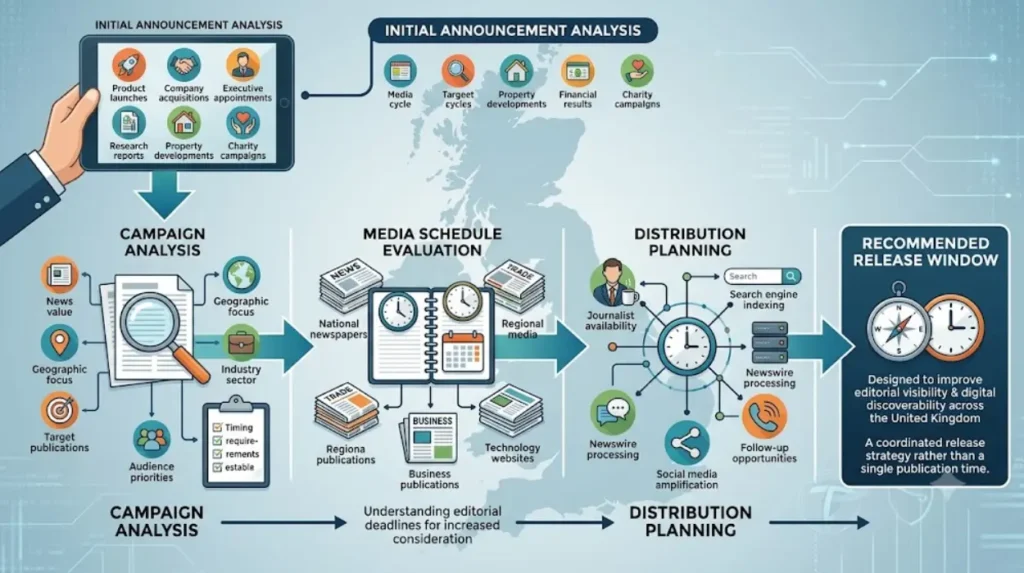
Time Intelligence Media Group conducts a structured timing assessment by analysing campaign objectives, target media, industry activity, search trends, publication schedules, and distribution logistics. The review produces a recommended release window designed to improve editorial visibility and digital discoverability across the United Kingdom.
The review begins with understanding the announcement itself.
Examples include:
- Product launches
- Company acquisitions
- Executive appointments
- Research reports
- Property developments
- Financial results
- Charity campaigns
Each announcement type follows different media cycles.
Step 1: Campaign analysis
The team reviews:
- News value
- Geographic focus
- Industry sector
- Target publications
- Audience priorities
This establishes the timing requirements before selecting a release window.
For deeper insight explore:
How to Choose the Right Send Window for a UK Press Release
Step 2: Media schedule evaluation
Different publications operate with different editorial deadlines.
Examples include:
- National newspapers
- Trade publications
- Regional media
- Business publications
- Technology websites
Understanding these schedules increases the likelihood of editorial consideration.
Step 3: Distribution planning
The recommended publication time considers:
- Journalist availability
- Search engine indexing
- Newswire processing
- Social media amplification
- Follow-up opportunities
The result is a coordinated release strategy rather than a single publication time.
What benefits does a professional timing review provide?
A professional timing review improves campaign planning, strengthens media visibility, reduces scheduling conflicts, supports search performance, and increases opportunities for editorial coverage. The process creates a predictable distribution strategy supported by measurable timing analysis instead of assumptions or historical habits.
Timing directly affects campaign outcomes.
Publishing too early can reduce relevance.
Publishing too late can reduce newsworthiness.
Publishing during major competing news events can significantly reduce visibility.
A structured review addresses these risks before distribution.
Better journalist engagement
Journalists receive hundreds of press releases each day.
A release arriving during active editorial planning receives greater attention than one delivered outside normal newsroom workflows.
Improved search visibility
Search engines index press releases based on publication timing and authority signals.
Publishing during periods of active audience interest supports stronger organic visibility.
Better campaign coordination
Marketing teams often coordinate:
- Social campaigns
- Email marketing
- Website updates
- Investor communications
- Paid advertising
A timing review aligns these activities into one launch schedule.
When is a timing review most valuable?
A timing review delivers the greatest value before major announcements, competitive launches, regulatory updates, financial reporting, national campaigns, and seasonal promotions. Early planning allows sufficient time to optimise scheduling and coordinate supporting marketing activities across multiple communication channels.
Many organisations plan announcements months in advance.
Reviewing timing early creates greater scheduling flexibility.
Examples include:
- Annual reports
- New product launches
- Construction project announcements
- Retail campaigns
- Technology releases
- Healthcare initiatives
- Corporate partnerships
Large campaigns often involve multiple stakeholders.
A structured timing review keeps communication coordinated across departments.
High-competition industries
Timing reviews are particularly valuable in industries such as:
- Property
- Finance
- Healthcare
- Technology
- Manufacturing
- Energy
- Professional services
These sectors regularly compete for limited editorial attention.
What information should you prepare before booking?
Preparing accurate campaign information allows the timing review to deliver specific recommendations. Important details include announcement objectives, preferred publication dates, supporting assets, target audience, media priorities, and planned marketing activities across digital and traditional communication channels.
Providing complete information speeds up planning.
Useful information includes:
- Draft press release
- Target publication list
- Launch objectives
- Geographic coverage
- Industry category
- Supporting research
- Images
- Executive quotes
- Existing marketing schedule
This information enables a more accurate timing recommendation.
Supporting campaign assets
Helpful assets include:
- Company logos
- Product photography
- Infographics
- Research summaries
- Video content
- Fact sheets
These materials influence preparation timelines.
Why choose Time Intelligence Media Group for press release timing?
Time Intelligence Media Group combines structured timing analysis, UK media knowledge, distribution planning, and campaign coordination into one review process. The service supports organisations seeking measurable improvements in press release visibility, editorial engagement, and digital reach across United Kingdom media channels.
Rather than focusing only on publication time, the review evaluates the complete distribution strategy.
This broader approach includes:
- Editorial timing
- Industry calendars
- Distribution sequencing
- Search visibility
- Audience activity
- Campaign coordination
Businesses receive practical recommendations based on their specific announcement rather than generic timing advice.
How do you book a UK press release timing review with Time Intelligence Media Group?

Booking a UK press release timing review involves sharing campaign information, discussing objectives, reviewing distribution requirements, receiving timing recommendations, and confirming the preferred publication schedule. The process supports efficient planning before the press release enters distribution across targeted UK media outlets.
The booking process follows a straightforward sequence.
Initial consultation
The first discussion covers:
- Campaign objectives
- Industry sector
- Target audience
- Preferred publication period
- Distribution goals
Timing assessment
The review analyses:
- Media opportunities
- Editorial schedules
- Industry activity
- Search demand
- Campaign readiness
Recommendation
The final recommendation includes:
- Recommended publication date
- Recommended publication time
- Distribution sequence
- Follow-up schedule
- Coordination guidance
Organisations then proceed with distribution according to the agreed campaign plan.
Explore More Expert Insights:
Get a Free UK Media Reach Estimate From Time Intelligence Media Group
How Time Intelligence Media Group Onboards New UK Clients
A UK press release timing review transforms publication planning into a structured, evidence-based process. By evaluating newsroom schedules, industry activity, audience behaviour, search visibility, and campaign objectives, organisations improve the likelihood that important announcements receive timely attention.
Time Intelligence Media Group provides a comprehensive timing review designed for businesses seeking stronger media visibility across the United Kingdom. Whether preparing a product launch, financial announcement, research report, or corporate update, a structured timing assessment helps align every stage of distribution with measurable communication goals.