
Businesses, charities, startups, and public sector organisations in the United Kingdom use press releases to share announcements with journalists and news platforms. The distribution method directly affects who receives the release, how it is presented, and the likelihood of gaining media attention. Understanding the differences between free press release sites and paid UK distribution helps organisations choose the most suitable approach for their communication goals.
What is the difference between free press release sites and paid UK distribution?
Free press release sites publish announcements at no financial cost, while paid UK distribution delivers releases through professional media networks, editorial processes, and journalist databases. The main trade-off involves reach, credibility, targeting, reporting, and overall campaign effectiveness rather than publication alone.
Free press release sites allow organisations to upload announcements without paying a distribution fee. The content becomes available on the site’s public pages, where search engines can index it.
Paid UK distribution services use established media relationships, curated journalist databases, editorial reviews, and targeted delivery systems. Instead of simply publishing a release online, these services send relevant news directly to journalists and media outlets covering specific industries or regions.
The distinction is important because publication and media distribution serve different purposes. Publication creates an online record. Distribution places news before people who decide what gets covered.
How do free press release sites work?
Most free platforms follow a simple process:
- Users create an account.
- They upload a press release.
- The platform reviews basic formatting.
- The release is published on the website.
- Search engines index the page over time.
Many free platforms generate little journalist engagement because reporters rarely monitor every free submission portal.
How does paid UK distribution work?
Paid distribution normally includes:
- Editorial quality checks
- Media database targeting
- Industry-specific journalist lists
- Regional targeting across the United Kingdom
- Scheduled release timing
- Delivery reporting
- Coverage monitoring
This process focuses on reaching relevant media professionals rather than simply creating another webpage.
How do free press release sites benefit organisations?
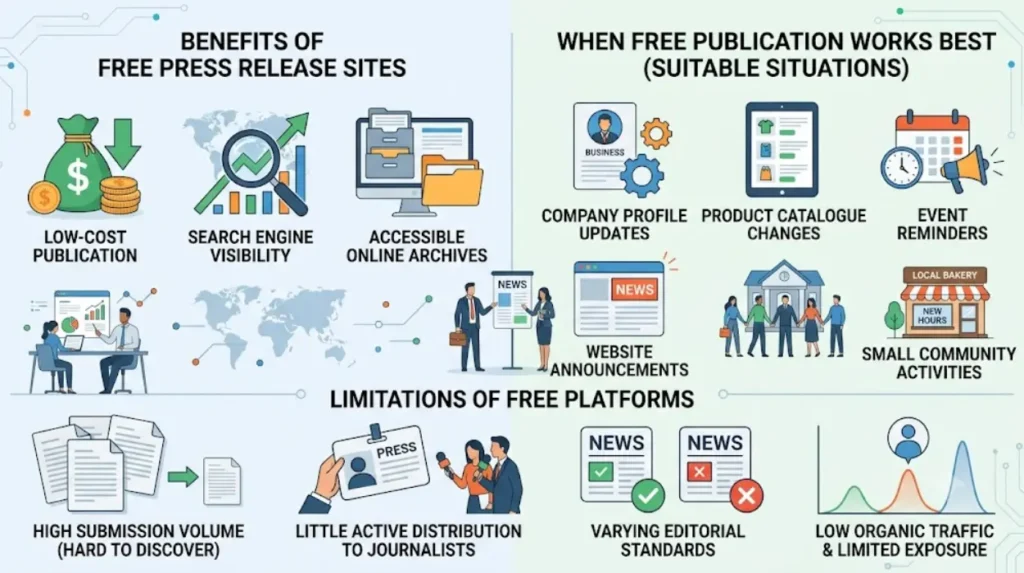
Free press release sites provide low-cost publication, search engine visibility, and accessible online archives. They work best for organisations seeking basic announcement publishing rather than extensive UK media outreach or journalist engagement across competitive news sectors.
Free distribution offers value when organisations have limited communication budgets or when the announcement does not require extensive press attention.
Which situations suit free publication?
Free platforms work well for:
- Company profile updates
- Product catalogue changes
- Event reminders
- Website announcements
- Small community activities
For example, a local bakery announcing new opening hours or a neighbourhood sports club publishing tournament dates gains basic online visibility without investing in wider media outreach.
What limitations affect free platforms?
Several factors reduce effectiveness.
Many free websites receive thousands of submissions each month, making individual releases difficult to discover.
Few platforms actively distribute releases to journalists.
Editorial standards vary considerably between websites.
Many publications receive little organic traffic, reducing overall exposure.
As competition for media attention increases, publication alone rarely generates earned editorial coverage.
What advantages does paid UK distribution provide?
Paid UK distribution focuses on targeted media outreach, editorial quality, measurable reporting, and professional delivery. These services improve relevance between announcements and journalists while providing organisations with structured communication processes and measurable campaign performance.
Paid services concentrate on reaching decision-makers inside news organisations.
Instead of publishing a release for anyone to discover, distribution systems actively send relevant stories to reporters covering business, finance, technology, healthcare, education, charities, or regional news.
Why does journalist targeting matter?
Journalists receive hundreds of pitches every week.
Targeting improves relevance by matching announcements with reporters covering related subjects.
For example:
- A fintech funding announcement reaches financial journalists.
- A university research project reaches education correspondents.
- A healthcare innovation reaches medical and health editors.
- A charity fundraising campaign reaches social affairs reporters.
Relevant targeting improves newsroom efficiency and increases the quality of media engagement.
How does editorial review improve quality?
Many paid distributors review releases before distribution.
Editorial teams typically check:
- Grammar
- Structure
- Headline clarity
- Contact information
- Formatting consistency
This process reduces technical errors that can affect professional presentation.
Which option delivers better UK media coverage?
Paid UK distribution consistently delivers stronger opportunities for media visibility because professional targeting places announcements before relevant journalists. Free publication increases online availability but rarely creates widespread editorial coverage without additional outreach activities.
Media coverage depends on newsworthiness, timing, relevance, and distribution.
Distribution determines who receives the announcement.
News value determines whether journalists publish it.
Both elements work together.
What influences media coverage?
Several factors affect publication decisions:
- News relevance
- Industry significance
- Geographic interest
- Supporting data
- Expert commentary
- Timeliness
- Distribution quality
Even a strong announcement gains limited attention if journalists never receive it.
Conversely, broad distribution cannot compensate for weak news value.
Organisations evaluating distribution methods often compare different reporting approaches. Related guidance appears in:
How Time Intelligence Media Group Reports Coverage to UK Clients
How do costs compare with potential outcomes?
Free platforms remove upfront distribution costs, while paid services invest in targeting, editorial support, reporting, and media infrastructure. Organisations compare financial investment with communication objectives instead of focusing only on initial publishing expenses.
Free publication reduces immediate spending.
Paid distribution increases investment but expands communication resources.
The comparison extends beyond cost.
It includes:
- Audience quality
- Journalist access
- Reporting detail
- Distribution accuracy
- Campaign measurement
What hidden costs exist with free distribution?
Free publication often requires additional work.
Organisations frequently spend time:
- Building journalist lists
- Researching media contacts
- Sending individual emails
- Following up with reporters
- Tracking coverage manually
These activities require staff time and communication expertise.
Paid distribution combines many of these functions into one process.
Which organisations benefit most from each approach?
Different communication objectives require different distribution strategies. Small announcements often fit free publication, while competitive campaigns, national launches, funding news, and sector-specific announcements benefit from professional UK media distribution services.
Communication goals determine the appropriate solution.
When does free publication fit?
Free options suit:
- Community organisations
- Volunteer groups
- Internal company announcements
- Local events
- Small website updates
These announcements primarily require online publication rather than national media attention.
When does paid distribution fit?
Paid services suit:
- Startup funding announcements
- Corporate acquisitions
- Product launches
- Government partnerships
- Charity campaigns
- Research publications
- Executive appointments
- National events
These stories depend on reaching journalists efficiently across the United Kingdom.
Organisations planning communication strategies often build knowledge through resources such as:
UK Charities Struggle to Get Media Coverage for Campaigns before selecting a distribution approach.
What factors help organisations choose the right distribution method?
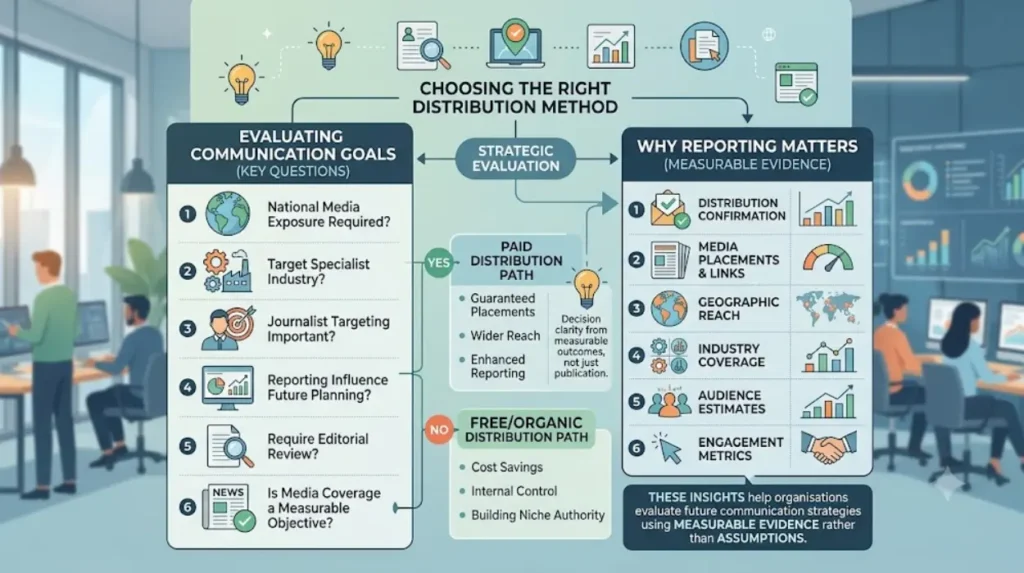
Choosing between free and paid distribution depends on campaign objectives, audience requirements, geographic scope, reporting expectations, and available communication resources. Decision-making becomes clearer when organisations evaluate measurable outcomes rather than publication alone.
Selecting a distribution method starts with defining communication goals.
Questions worth considering include:
- Is national media exposure required?
- Does the announcement target a specialist industry?
- Is journalist targeting important?
- Will campaign reporting influence future planning?
- Does the organisation require editorial review?
- Is media coverage a measurable objective?
Answering these questions clarifies whether publication alone satisfies communication needs.
Why does reporting matter?
Campaign reporting measures distribution performance.
Useful reports commonly include:
- Distribution confirmation
- Media placements
- Publication links
- Geographic reach
- Industry coverage
- Audience estimates
- Engagement metrics
These insights help organisations evaluate future communication strategies using measurable evidence rather than assumptions.
Explore More Expert Insights:
How to Benchmark Your UK PR Distribution Against Competitors
What a Good UK Coverage Report Should Include (With Examples)
Free press release sites and paid UK distribution perform different functions within public relations.
Free platforms provide accessible publication, basic search visibility, and online records for announcements. They suit organisations with straightforward communication objectives and limited outreach requirements.
Paid UK distribution expands beyond publication by combining editorial review, journalist targeting, structured delivery, and campaign reporting. This approach aligns announcements with relevant media professionals and provides measurable information about distribution performance.
The real trade-off is not simply free versus paid. It is publication versus professional distribution. Organisations achieve better communication decisions by matching their distribution method to campaign objectives, audience requirements, desired media reach, and reporting expectations.