Choosing the right press release distribution strategy determines who reads your announcement, how relevant the coverage becomes, and whether your story reaches the intended audience. In the United Kingdom, businesses typically choose between national, regional, and trade media distribution based on business objectives, target audiences, and news value. Understanding the differences helps marketing teams allocate budgets effectively and improve media relevance rather than simply increasing distribution volume.
What is the difference between UK national, regional, and trade distribution?
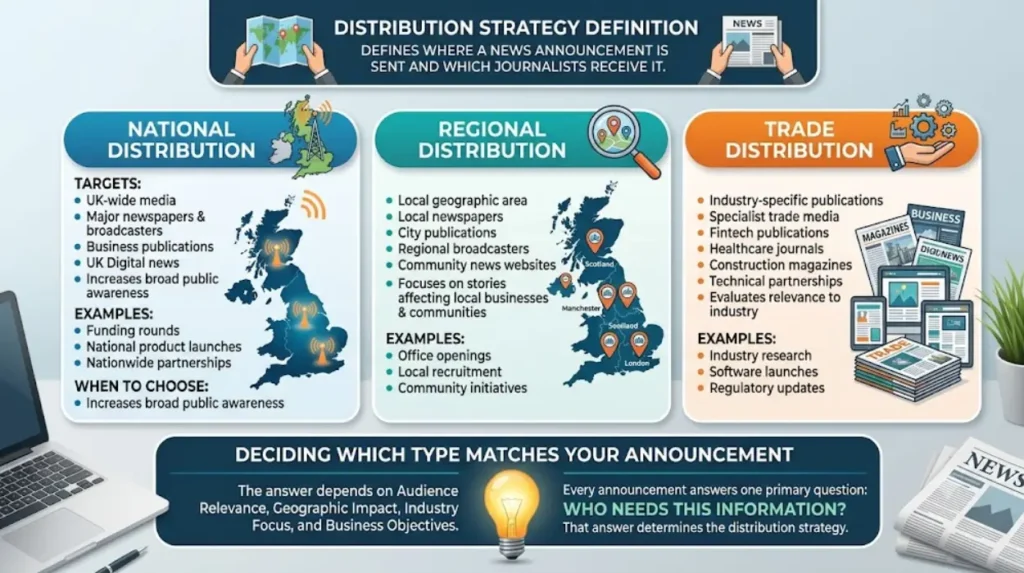
UK national, regional, and trade distribution each target different audiences. National distribution reaches country-wide media, regional distribution focuses on specific geographic areas, and trade distribution delivers news to industry-specific publications. Each option serves a different communication objective and audience profile.
A press release distribution strategy defines where a news announcement is sent and which journalists receive it.
The three primary distribution categories are:
- National distribution targets UK-wide newspapers, broadcasters, business publications, and online news outlets.
- Regional distribution focuses on local newspapers, city publications, regional broadcasters, and community news websites.
- Trade distribution reaches specialist publications that serve individual industries.
Each category serves a distinct purpose rather than competing with the others.
National distribution
National distribution targets media with audiences across the United Kingdom.
Examples include:
- National newspapers
- National television news
- National business publications
- UK-wide digital news websites
National coverage increases broad public awareness when a story has relevance beyond one location or industry.
Regional distribution
Regional distribution focuses on one geographical area.
Examples include:
- Manchester business publications
- Birmingham local newspapers
- Scotland-based news websites
- South West regional broadcasters
Regional journalists prioritise stories affecting local businesses, employment, investment, education, or community development.
Trade distribution
Trade distribution delivers announcements directly to journalists covering a specific sector.
Examples include:
- Fintech publications
- Healthcare journals
- Construction magazines
- Manufacturing news websites
Trade journalists evaluate stories according to industry relevance instead of consumer appeal.
How do you decide which distribution type matches your announcement?
The correct distribution type depends on audience relevance, geographic impact, industry focus, and business objectives. Matching the story to the appropriate media category increases journalist interest and improves the likelihood of editorial coverage.
Every announcement answers one primary question:
Who needs this information?
That answer determines the distribution strategy.
Choose national distribution when
National distribution fits announcements such as:
- Major funding rounds
- National product launches
- Large consumer campaigns
- Nationwide partnerships
- UK market research
These stories affect audiences across multiple regions.
Choose regional distribution when
Regional distribution works well for:
- Office openings
- Local recruitment
- Community initiatives
- Regional investment
- Local events
A company opening a new office in Leeds benefits more from Yorkshire media than from national consumer newspapers.
Choose trade distribution when
Trade distribution supports announcements including:
- Industry research
- Software launches
- Regulatory updates
- Product innovations
- Technical partnerships
For example, cybersecurity software updates interest technology journalists more than general news reporters.
Businesses comparing distribution strategies often benefit from understanding:
Why Most UK Startup Funding Announcements Get No Pickup before selecting a distribution approach.
Why does audience targeting matter more than distribution size?
Audience relevance produces stronger media outcomes than sending announcements to the largest possible contact list. Journalists prioritise stories that match their publication’s editorial focus and audience expectations instead of broad promotional announcements.
Large distribution lists do not automatically produce better coverage.
Editors evaluate announcements based on:
- Reader relevance
- News value
- Timeliness
- Editorial fit
- Industry importance
A regional manufacturing publication values factory expansion news more than a national lifestyle website.
Similarly, a fintech trade publication values banking technology research more than local community news.
Quality outweighs quantity
Sending one relevant story to 150 suitable journalists creates better opportunities than sending the same announcement to 3,000 unrelated contacts.
Relevant distribution improves:
- Open rates
- Journalist responses
- Editorial consideration
- Media relationships
- Coverage quality
Targeted distribution also reduces irrelevant outreach.
Can businesses combine national, regional, and trade distribution?
Many organisations combine multiple distribution categories to reach different audiences simultaneously. Combining national, regional, and trade media creates broader visibility while preserving audience relevance for each publication type.
One announcement often contains several news angles.
For example, a UK fintech raising £15 million contains:
- National business news
- London regional business news
- Financial technology industry news
Each audience values different parts of the announcement.
National angle
Focus on:
- Investment significance
- UK market impact
- Business growth
Regional angle
Focus on:
- Local employment
- Office expansion
- Community investment
Trade angle
Focus on:
- Technology innovation
- Industry implications
- Product capabilities
Tailoring each version increases editorial relevance.
What factors influence the right distribution choice?
Business objectives, audience location, industry sector, budget, and news value determine the most suitable distribution strategy. Evaluating these factors before distributing a press release improves campaign efficiency and editorial relevance.
Several practical considerations influence distribution planning.
Geographic relevance
Ask:
- Does the story affect one city?
- One region?
- The whole UK?
Geographic scope directly affects journalist interest.
Industry relevance
Technical announcements perform best when sent to journalists who regularly cover that industry.
Examples include:
- Renewable energy
- Financial services
- Artificial intelligence
- Biotechnology
Audience type
Different announcements target different audiences.
Examples include:
- Consumers
- Investors
- Business buyers
- Government organisations
- Industry professionals
Distribution follows audience priorities rather than company preferences.
News significance
High-impact announcements justify wider distribution.
Routine operational updates perform better through targeted industry or regional outreach.
What are the advantages of each distribution option?
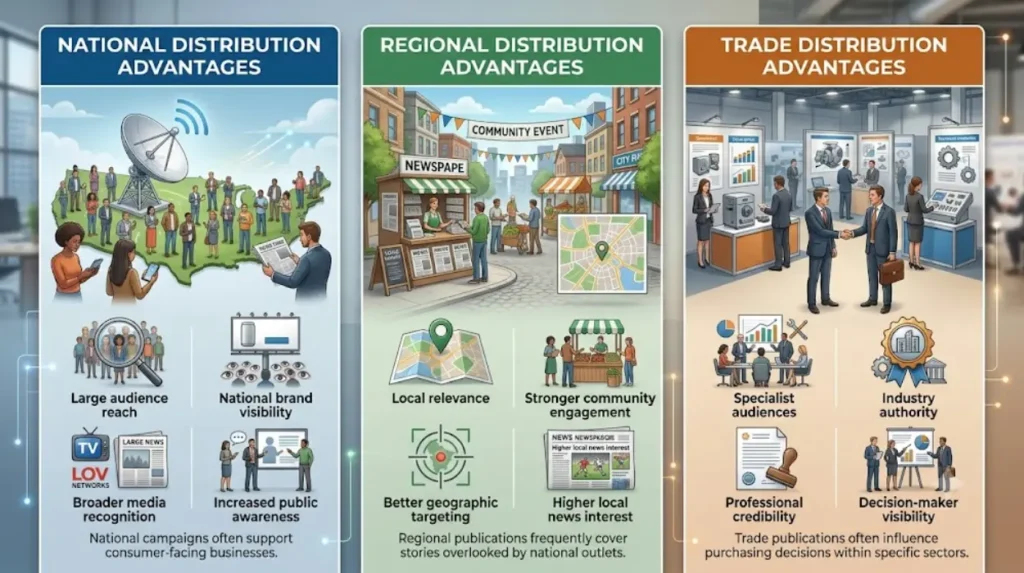
Each distribution type offers distinct strengths. National distribution builds broad awareness, regional distribution strengthens local visibility, and trade distribution delivers industry credibility among specialist audiences and professional decision-makers.
National distribution advantages
Benefits include:
- Large audience reach
- National brand visibility
- Broader media recognition
- Increased public awareness
National campaigns often support consumer-facing businesses.
Regional distribution advantages
Benefits include:
- Local relevance
- Stronger community engagement
- Better geographic targeting
- Higher local news interest
Regional publications frequently cover stories overlooked by national outlets.
Trade distribution advantages
Benefits include:
- Specialist audiences
- Industry authority
- Professional credibility
- Decision-maker visibility
Trade publications often influence purchasing decisions within specific sectors.
How do businesses avoid choosing the wrong distribution strategy?
Businesses improve media performance by aligning announcements with journalist interests instead of selecting distribution solely by audience size. Clear objectives and targeted outreach produce stronger editorial relevance than broad, untargeted campaigns.
Several common mistakes reduce press coverage.
Sending local news nationally
A single-office refurbishment rarely attracts national media attention.
Regional publications provide a better editorial fit.
Ignoring trade publications
Industry journalists regularly publish stories that national newspapers overlook.
Specialist coverage often reaches buyers, investors, and business leaders directly.
Treating every announcement equally
Not every announcement requires nationwide distribution.
Businesses classify stories based on:
- Geographic importance
- Audience relevance
- Industry significance
- Business objective
This structured approach improves campaign efficiency.
Explore More Expert Insights:
How to Choose a PR Distribution Service That Understands UK Fintech
Cheap vs Premium PR Distribution for UK Fintech Startups: What’s Worth It
How can businesses build an effective UK distribution strategy?
An effective UK distribution strategy begins with clear objectives, identifies the appropriate audience, selects suitable media categories, and tailors messaging for each publication type. Structured planning improves media relevance and supports stronger editorial outcomes.
Rather than viewing national, regional, and trade distribution as competing options, businesses benefit from treating them as complementary tools.
A structured process includes:
- Define the communication objective.
- Identify the primary audience.
- Assess geographic relevance.
- Determine industry significance.
- Select the appropriate distribution mix.
- Tailor the press release for each media category.
- Measure coverage quality rather than distribution volume.
Businesses evaluating specialist distribution partners often continue their research by exploring:
How Time Intelligence Media Group Gets UK Fintechs Coverage on a Startup Budget.
Choosing between UK national, regional, and trade distribution depends on matching each announcement with the audience that finds it most relevant. National distribution supports stories with UK-wide significance, regional distribution strengthens local visibility, and trade distribution reaches specialist industry communities. Many organisations achieve stronger results by combining these approaches and tailoring the news angle for each audience. A structured distribution strategy improves editorial relevance, increases meaningful media coverage, and helps organisations communicate more effectively with the people who matter most.