
Publishing a press release on a newswire marks the beginning of the distribution process rather than its conclusion. After a release reaches the wire, it moves through multiple technical, editorial, and digital stages before journalists, news websites, search engines, and monitoring platforms access it. Understanding this lifecycle helps organisations evaluate how press release distribution works and what outcomes to expect from each stage.
What happens immediately after a press release hits the wire in the UK?
A press release enters a structured distribution network where it undergoes validation, formatting, indexing, and syndication before reaching journalists, media databases, news platforms, search engines, and monitoring systems across the United Kingdom through automated and editorial processes.
When a press release is submitted to a newswire, the first stage involves technical processing. The wire service checks the document format, publication schedule, headline structure, metadata, and attached media such as images or videos.
After validation, the release receives a publication timestamp and enters the distribution network. At this point, the content becomes available to subscribed newsrooms, media monitoring platforms, financial information systems where applicable, and online news portals.
The release is also assigned metadata including:
- Industry category
- Geographic relevance
- Keywords
- Organisation name
- Publication date
- Language
This information helps downstream systems classify and retrieve the content efficiently.
How is the release formatted?
Newswire platforms standardise formatting before publication. Typical elements include:
- Headline
- Dateline
- Introductory paragraph
- Main body
- Boilerplate
- Contact information
- Multimedia attachments
Consistent formatting allows automated publishing systems to process releases accurately.
How does a press release reach journalists across the UK?
Journalists receive press releases through newsroom subscriptions, editorial dashboards, email alerts, specialist industry feeds, searchable media databases, and newsroom management software that continuously imports newly published announcements from recognised wire services.
Most journalists do not search the public internet for company announcements. Instead, they use professional editorial systems that collect incoming releases throughout the day.
Different sectors rely on different distribution channels.
Examples include:
- National newspaper news desks
- Business publication editorial teams
- Technology journalists
- Healthcare reporters
- Local news organisations
- Financial correspondents
Each newsroom filters incoming releases according to topics, regions, industries, and publication priorities.
What determines whether journalists notice a release?
Editorial systems organise incoming content using several factors:
- Industry tags
- Geographic location
- Publication timing
- Headline relevance
- Company name
- Subject matter
Editors review releases alongside hundreds of other announcements published on the same day.
How is a press release published on websites?
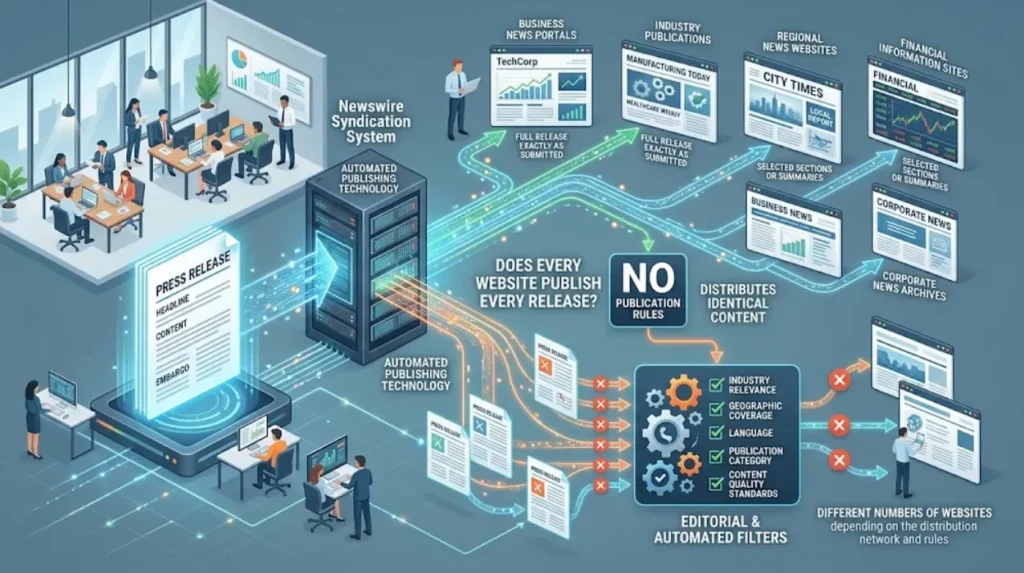
Newswire systems automatically syndicate eligible press releases to news websites, partner publishing platforms, financial portals, business directories, and searchable online archives according to each publisher’s distribution agreements and editorial policies.
Syndication distributes identical content across multiple websites using automated publishing technology.
Examples include:
- Business news portals
- Industry publications
- Regional news websites
- Financial information websites
- Corporate news archives
Some publishers display the entire release exactly as submitted. Others publish only selected sections or summaries.
Does every website publish every release?
No.
Each publisher maintains its own editorial or automated publication rules.
Common filters include:
- Industry relevance
- Geographic coverage
- Language
- Publication category
- Content quality standards
As a result, the same press release appears on different numbers of websites depending on the distribution network.
How do search engines process a published press release?
Search engines discover press releases by crawling publisher websites, indexing structured content, evaluating metadata, and connecting related entities before making the information searchable through standard web search results.
Search engines continuously crawl websites that publish news content.
Once discovered, the release enters the indexing process.
Search engines analyse:
- Headline
- Structured data
- Keywords
- Organisation names
- Publication date
- Links
- Images
The indexed content becomes searchable after processing.
What role does metadata play?
Metadata provides structured information that helps search engines understand the content.
Examples include:
- Article title
- Publication date
- Author or publisher
- Organisation name
- News category
- Geographic location
Accurate metadata improves classification within search indexes.
How is a press release used by journalists?
Journalists use press releases as verified source material for identifying news, confirming facts, gathering quotations, locating spokesperson information, and researching organisations before producing original editorial coverage.
A press release provides factual information in a structured format.
Journalists typically verify information before publication.
Common uses include:
- Confirming announcements
- Identifying company representatives
- Checking dates
- Finding statistics
- Reviewing official quotations
Editorial coverage remains independent from the original press release.
Does a press release automatically become a news story?
No.
Editors assess each announcement according to their editorial standards.
Factors include:
- Public relevance
- Industry significance
- Timeliness
- Originality
- Audience interest
Many published releases receive no editorial coverage, while others generate multiple news articles.
How is press release performance measured?
Performance measurement combines publication metrics, media coverage, search visibility, website traffic, audience engagement, and referral data collected from multiple analytics and monitoring platforms after distribution.
Measurement begins immediately after publication.
Organisations monitor technical distribution as well as audience activity.
Common metrics include:
- Number of publications
- Media mentions
- Search engine indexing
- Referral traffic
- Website visits
- Engagement with multimedia
- Link clicks
Each metric measures a different stage of the communication process.
What is the difference between distribution and coverage?
Distribution measures where the press release appeared.
Coverage measures original reporting produced by journalists.
For example:
- Distribution: publication on a newswire partner website.
- Coverage: an original article written by a national newspaper.
- Coverage: an interview with a company executive.
- Coverage: analysis published by an industry magazine.
These outcomes represent different forms of visibility.
Readers exploring performance measurement can continue with:
How to Attribute UK Media Coverage Back to Revenue.
What role do multimedia assets play after publication?

Images, videos, charts, and supporting documents accompany press releases through distribution networks, allowing publishers and journalists to access consistent visual assets alongside the written announcement.
Modern press releases frequently include multimedia.
Examples include:
- Executive photographs
- Product images
- Infographics
- Company logos
- Event photography
- Demonstration videos
These files remain associated with the release during distribution.
Why are multimedia assets standardised?
Newswire platforms apply consistent formatting so publishers receive compatible files.
Standardisation improves:
- Image display
- Download reliability
- Content management
- Mobile presentation
- Archive storage
This creates a consistent presentation across multiple publishing platforms.
How long does a press release remain available online?
Published press releases often remain accessible for months or years through news archives, publisher websites, search engine indexes, corporate databases, and digital media monitoring systems.
Availability depends on each publisher’s archive policy.
Many newswire archives maintain permanent historical records.
Search engines continue indexing archived releases while the pages remain publicly accessible.
Researchers, journalists, investors, and analysts frequently consult archived announcements when reviewing an organisation’s historical communications.
Why do archives matter?
Archived releases create chronological records of organisational announcements.
Examples include:
- Product launches
- Executive appointments
- Financial announcements
- Research findings
- Partnership announcements
- Regulatory updates
These archives support historical research and fact verification.
Explore More Expert Insights:
Why UK Journalists Ignore Most Founder-Led Announcements
How Long Should a UK Press Release Be in 2026?
Why is understanding the post-distribution process important?
Understanding the complete press release lifecycle helps organisations interpret publication outcomes, distinguish distribution from editorial coverage, evaluate performance metrics accurately, and understand how information moves through the United Kingdom’s digital news ecosystem.
A press release follows multiple stages after publication.
The process includes technical validation, media distribution, website syndication, search engine indexing, newsroom review, audience discovery, and long-term archiving.
Each stage serves a different function within the news ecosystem.
Understanding these stages explains why publication does not guarantee media coverage and why different measurement metrics describe different outcomes.
Readers interested in pricing models and distribution decision-making can continue with:
How Time Intelligence Media Group Prices PR Distribution for UK Businesses.
A press release does not end its journey when it reaches the wire. It enters an interconnected distribution system that delivers structured information to journalists, publishers, search engines, archives, and monitoring platforms throughout the United Kingdom. Each stage—from validation and syndication to indexing, editorial review, and long-term archiving—serves a distinct purpose within the media ecosystem.
Recognising how these processes work provides a clearer understanding of press release distribution, media coverage, and performance measurement. It also helps distinguish technical publication from independent journalism, ensuring organisations interpret distribution outcomes using accurate, evidence-based expectations rather than assumptions.