

A press release distribution checklist is a step-by-step list that ensures each release reaches the right audiences, complies with legal and media standards, and measures outcomes. It reduces missed steps that cause low pickup and wasted budgets.
A distribution checklist defines tasks from drafting to post-publication measurement. It lists recipient segmentation, embargo rules, file formats, media kit items, timing windows, and analytics tracking. For UK public relations, a checklist must reflect local media hours, media plurality rules, and GDPR compliance. A functional checklist reduces errors such as wrong contact details, missing legal disclaimers, and incompatible file attachments. It also standardises workflows for in-house teams and agencies so multiple releases maintain consistent quality.
A press release is a written statement for media distribution. Distribution channels include email lists, newswires, sector-specific platforms, and direct journalist outreach. Metrics include opens, clips, backlinks, and pick-up rate. GDPR refers to the UK General Data Protection Regulation governing personal data use. An embargo is a date/time when journalists may publish.
Which distribution steps do UK PR teams commonly skip?
UK PR teams commonly skip recipient verification, GDPR checks, tailored subject lines, mobile formatting, and post-distribution tracking, causing lower journalist engagement and weak measurement.
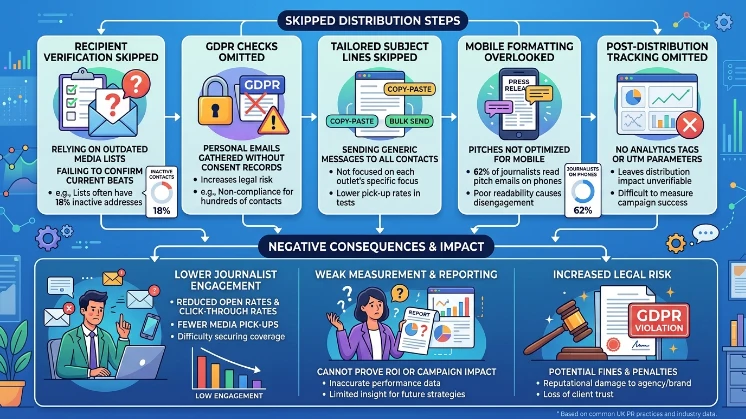
Teams often rely on outdated media lists, sending the same message to all contacts. They omit verifying that each recipient still covers the beat. GDPR checks are skipped when lists include personal emails gathered without proper consent records. Subject lines remain generic rather than tailored to each outlet’s focus. Mobile formatting is overlooked even though 62% of journalists read pitch emails on phones. Teams frequently fail to implement analytics tags and UTM parameters, leaving distribution impact unverifiable.
When a list contains 1,200 contacts with 18% inactive addresses, open rates fall sharply. When GDPR consent is absent for 240 contacts, legal risk increases. When subject lines are generic, pick-up rate declines by measurable percentages in A/B tests.
How should UK PR teams prepare a recipient list?
Prepare recipient lists by validating contact relevance, confirming current roles, recording consent status, and segmenting by beat and outlet type.
Start by auditing each contact: confirm the journalist’s current role, preferred contact method, and recent coverage. Record explicit consent or legitimate interest justification for each email under GDPR. Segment lists by beat (energy, finance, regional), outlet type (national, trade, local), and format preference (email, messaging platform). Maintain a date-stamped log of last contact and outcome. Use direct validation: check recent bylines within the past 90 days and update roles for any transfers between titles.
Remove contacts with no activity for 12 months. Flag high-priority contacts with indicators such as weekly columnists or sector editors. Document the source of each contact (press kit opt-in, event, industry database).
When is the best time to send a press release in the UK?
Send press releases during UK newsroom working hours with timing based on outlet cycle: national morning by 07:30–08:30, trade outlets 08:30–10:30, and regional outlets 09:00–11:00.
National newspapers and broadcasters plan morning editions and digital lead stories early. Delivering by 07:30 gives national desks time to assess and allocate resources. Trade titles publish later in the morning after briefing editors. Regional outlets work later still and accept midday submissions. Avoid Friday afternoons for news that requires same-week coverage; desk staffing drops and pickup falls. For embargoed releases, set embargo times that match newsroom shift patterns and state embargo terms clearly in the email header and body.
For breaking news, distribute immediately with clear timestamps. For feature or long-lead content, schedule distribution 5–10 working days ahead of publication windows.
What elements must a release file include for UK media?
Include a clear headline, 40–70-word summary, full body, contact details, media kit links, high-resolution images with captions, and licensing terms.
A headline must state the core news in 8–12 words. The summary should communicate the news angle and key data points. The body must contain a dateline, lead paragraph answering who/what/when/where/why, supporting facts, and a boilerplate. Provide an accessible media kit with logos, high-resolution images (300 dpi), and captions. Attach image permissions and credit lines. List a named press contact with direct telephone, mobile, and verified email. For embargoed items, include embargo line and the publish time in 24-hour GMT/BST format.
Send documents as PDF and plain-text in the email body. Provide images as JPEG or PNG under 5 MB each. Supply audio/video as MP3 or MP4 with transcript.
How must UK PR teams handle legal and data requirements?
Comply with GDPR by documenting lawful basis for processing, storing consent records, and offering easy opt-out; include legal disclaimers and relevant regulation references in financial or regulated-sector releases.
Record the lawful basis (consent or legitimate interest) for each personal contact. Keep consent timestamps and origin records for 36 months. Provide unsubscribe links or a clear opt-out instruction in every email. For financial statements, include necessary market disclosure details and refer to FCA guidance when applicable. For regulated sectors such as energy and healthcare, attach compliance statements and links to statutory notices. Retain distribution logs for audit for at least 24 months.
Log distribution timestamps, recipients, bounce reports, and follow-up outcomes. Store these records in a searchable format for legal review.
Which metrics show distribution success?
Track open rate, journalist response rate, pickup rate (media clips), unique backlinks, and reach; measure against baseline performance and campaign goals.
The open rate shows initial engagement. Journalist response rate (direct replies or requests for materials) indicates interest. Pickup rate equals the percentage of targeted outlets that publish; calculate as published clips divided by total targeted relevant outlets. Backlinks from published articles show SEO value. Reach estimates audience size using outlet circulation and online unique visitors. Compare current campaign metrics to past campaigns over the previous 12 months to judge improvement.
Report metrics at 24–48 hours for initial pickup, 7 days for follow-up coverage, and 30 days for backlinks and SEO impact.
How should teams write subject lines and email copy for higher pickup?
Write subject lines that state the news type, data point, and outlet relevance in under 12 words; keep the email body concise, with the lead paragraph visible without attachments.
Subject lines must include the news category (press release), a primary data point or claim, and the target beat or location. The email body should open with the dateline and a 30–40-word lead summarising the news. Provide the full release below or as an attached plain-text file. Include clear embargo lines where relevant and a direct press contact. Keep sentences short and factual to enable quick scanning by busy journalists.
What follow-up process improves journalist engagement?
Follow up once by email or phone within 24–48 hours for high-priority outlets, log outcomes, and provide tailored additional assets on request.
Limit follow-up to one proactive contact to avoid spamming. Use the logged contact preference and reach out by the preferred method. Offer exclusive angles or interview opportunities for top-tier outlets. Record journalist responses and next steps. Provide requested assets within 2 business hours when possible.
For embargoed releases, do not call before the embargo lifts. For immediate news, follow up after distribution if no response within standard pickup windows.
How does distribution integrate with measurement and SEO?
Add UTM parameters and canonical link recommendations and request hosted press page links; track backlinks and referral traffic within 30 days to assess SEO impact.
Embed UTM parameters on any public links included in the release to track referral traffic in analytics platforms. For stories republished online, advise journalists on canonical link preferences to protect SEO. Monitor linked coverage for anchor text and dofollow attributes. Use link tracking to quantify conversions and referral traffic from each outlet.
Explore More Expert Insights:
How UK Brands Achieve 3× More Pickups With Targeted Distribution
Selecting a Media Agency for Strategic Industry Report Distribution
When should teams use embargoes, exclusives, or targeted exclusivity?
Use embargoes for coordinated launches requiring synchronised publishing, exclusives to secure high-tier placement, and targeted exclusivity for segmented outreach to a single outlet.
Embargoes enable simultaneous reporting across outlets and support timed product launches. Offer exclusives to top-tier outlets to secure feature coverage, but restrict exclusivity to 24–72 hours. Use targeted exclusivity for local or trade outlets when the angle suits a specialist audience. State exclusivity terms clearly and record agreement details in distribution logs.
Document acceptance of exclusivity in writing. For embargoed items, include exact embargo time and legal consequences for breach if necessary.
What are common use cases that benefit from strict checklists?
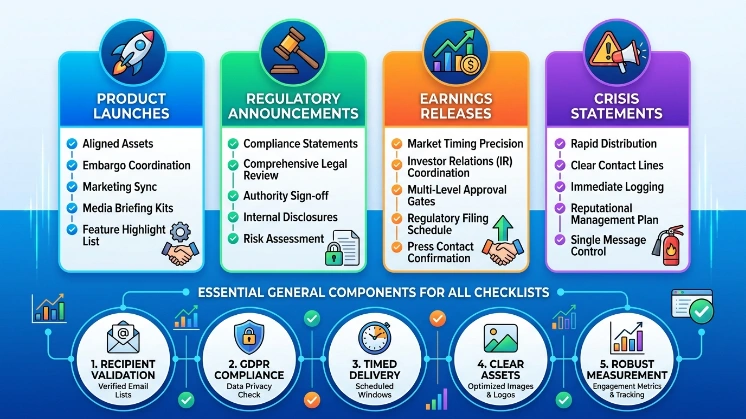
Product launches, regulatory announcements, earnings releases, and crisis statements benefit from strict checklists because they require legal compliance, timing precision, and clear measurement.
Product launches need aligned assets and embargo coordination. Regulatory announcements require compliance statements and legal review. Earnings releases demand strict timing to markets and investor relations coordination. Crisis statements require rapid distribution, clear contact lines, and logging for reputational management. Each use case benefits from defined roles, approval gates, and post-distribution audits.
For earnings, schedule legal sign-off, press contact confirmation, regulatory filing, and simultaneous press distribution within a single documented window.
Read More to Understand Better:
8 UK Media Gatekeepers Journalists Block by Default in 2026
A precise press release distribution checklist reduces errors, improves pickup, and creates a verifiable audit trail. Implement recipient validation, GDPR compliance, timed delivery, clear assets, and robust measurement. Use the checklist for launches, regulated announcements, earnings, and crisis communication to maintain quality and accountability.
Get the Full Insights Here:
Why 9 in 10 UK SMEs Switch to Managed PR Distribution in Year 2



