

Media planning depends on audience segmentation. UK advertisers use psychographic segmentation and behavioural segmentation to improve targeting, reduce waste, and increase campaign efficiency. Both methods help brands understand audiences, but they rely on different data sources and support different media-buying decisions. Understanding their differences helps marketers choose the right approach for specific campaign goals.
What is the difference between psychographic and behavioural segmentation?
Psychographic segmentation groups people by attitudes, values, interests, motivations, and lifestyles. Behavioural segmentation groups people by actions, purchase patterns, engagement signals, and measurable interactions. The first explains why people act, while the second explains what people do.
Audience segmentation helps advertisers organise consumers into meaningful groups. The difference lies in the type of data used.
What is psychographic segmentation?
Psychographic segmentation focuses on personal characteristics that influence decisions.
Common psychographic attributes include:
- Values
- Interests
- Lifestyle choices
- Beliefs
- Motivations
- Personality traits
For example, a UK outdoor clothing brand may target consumers interested in sustainability, hiking, and environmentally responsible purchasing.
Psychographic data helps advertisers understand emotional drivers behind decisions.
What is behavioural segmentation?
Behavioural segmentation focuses on observed actions.
Common behavioural indicators include:
- Website visits
- Product purchases
- App usage
- Content consumption
- Search activity
- Email engagement
For example, a streaming platform can target users who watched crime documentaries during the previous 30 days.
Behavioural data provides measurable evidence of audience activity.
Why does the distinction matter?
Media buyers need both audience understanding and performance signals.
Psychographic segmentation identifies motivations.
Behavioural segmentation identifies actions.
Together they create a more complete audience profile.
Why is behavioural segmentation becoming more important in UK media buying?
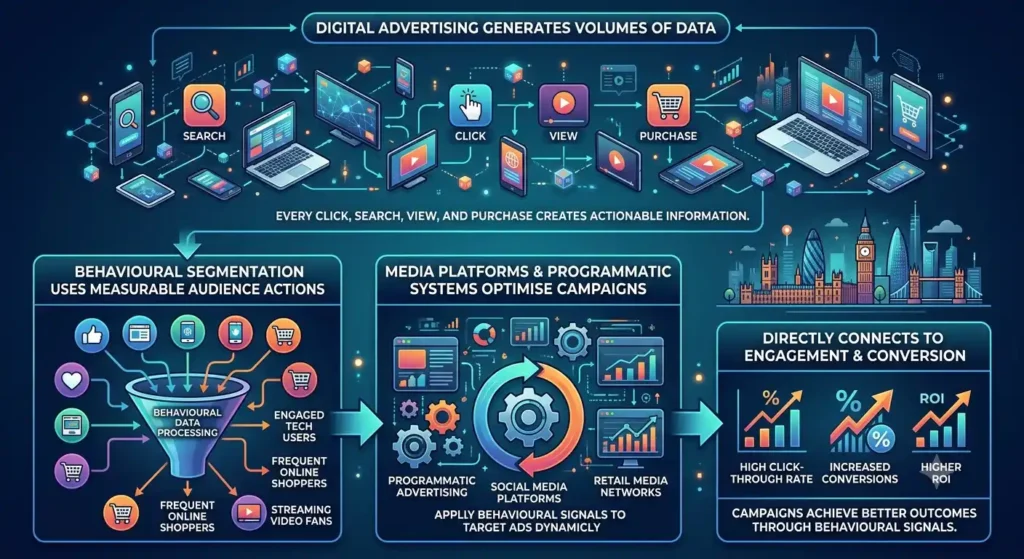
Behavioural segmentation has become increasingly important because it uses measurable audience actions. Media platforms, programmatic advertising systems, and retail media networks optimise campaigns using behavioural signals that directly connect to engagement and conversion outcomes.
Digital advertising generates large volumes of behavioural data.
Every click, search, view, and purchase creates actionable information.
How does behavioural data improve campaign accuracy?
Behavioural data allows advertisers to target users based on actual activity rather than assumptions.
Examples include:
- Frequent online shoppers
- Recent car buyers
- Video viewers
- Repeat customers
- Cart abandoners
These segments often align closely with campaign objectives.
A UK retailer promoting summer products can target consumers who recently browsed travel-related content instead of targeting broader lifestyle categories.
Why do platforms favour behavioural signals?
Major advertising ecosystems optimise around user actions.
Behavioural signals support:
- Conversion modelling
- Audience expansion
- Retargeting
- Frequency optimisation
- Budget allocation
Because behavioural data is continuously updated, audience relevance remains high throughout campaign delivery.
How does behavioural segmentation connect to audience insight reports?
Modern audience reports increasingly highlight behavioural patterns.
Advertisers seeking deeper interpretation of these patterns can explore:
What 39.7M Social Posts Reveal About UK Audience Behaviour in 2026
These reports often reveal consumption habits, content preferences, and platform engagement trends that influence media-buying decisions.
When does psychographic segmentation provide stronger value?
Psychographic segmentation delivers stronger value when advertisers need to understand motivations, brand affinity, lifestyle alignment, and long-term audience positioning. It helps explain emotional drivers that behavioural data alone cannot fully capture.
Not every purchase decision follows a simple behavioural pattern.
Many decisions involve identity, values, and aspirations.
How does psychographic data improve brand strategy?
Psychographic insights help advertisers create messages that resonate with audience beliefs.
Examples include:
- Sustainability-focused consumers
- Health-conscious families
- Luxury-oriented professionals
- Technology enthusiasts
These groups often share motivations despite different behavioural histories.
A sustainable fashion campaign benefits from understanding environmental values alongside purchasing behaviour.
Why is psychographic segmentation important for awareness campaigns?
Top-of-funnel campaigns often target audiences before purchase intent appears.
In these situations, behavioural signals can be limited.
Psychographic insights help advertisers identify audiences likely to engage with relevant messages.
This creates stronger brand positioning before conversion-focused activity begins.
What limitations does psychographic segmentation have?
Psychographic data can be harder to collect and validate.
Challenges include:
- Survey dependence
- Self-reported responses
- Slower updates
- Limited scalability
As a result, psychographic segmentation often works best when combined with behavioural evidence.
Which segmentation method performs better for UK media buys?
Behavioural segmentation generally delivers stronger short-term performance metrics, while psychographic segmentation often improves message relevance and long-term brand effectiveness. Performance depends on campaign objectives, measurement criteria, and audience maturity.
The question is not which method is universally superior.
The question is which method matches the campaign objective.
Which method supports direct response campaigns?
Behavioural segmentation often performs better for:
- Lead generation
- Ecommerce sales
- Subscription acquisition
- Retargeting campaigns
- Conversion optimisation
These objectives depend on measurable actions.
Targeting users who recently searched for mortgage products produces stronger intent signals than targeting users based solely on financial interests.
Which method supports brand-building campaigns?
Psychographic segmentation often supports:
- Brand awareness
- Market positioning
- New product launches
- Reputation campaigns
- Category creation
These objectives require emotional relevance and audience alignment.
Lifestyle and value-based insights help brands establish meaningful connections before purchasing behaviour emerges.
What do UK advertisers increasingly use?
Many UK advertisers combine both approaches.
This hybrid model supports:
- Better audience understanding
- Improved targeting precision
- Stronger creative relevance
- More efficient media spending
The combination often outperforms either method used independently.
How can advertisers combine psychographic and behavioural segmentation?
The most effective media-buying strategies combine behavioural evidence with psychographic understanding. Behavioural data identifies audience actions, while psychographic data explains the motivations behind those actions. Together they improve targeting, creative development, and optimisation decisions.
Integrated segmentation creates a fuller audience picture.
Step 1: Identify behavioural patterns
Start with measurable audience actions.
Examples include:
- Frequent purchasers
- Video viewers
- Newsletter subscribers
- Category researchers
These audiences already demonstrate relevant behaviours.
Step 2: Analyse psychographic characteristics
Next, identify common motivations among those audiences.
Questions include:
- What values influence decisions?
- What interests unite them?
- What lifestyle traits appear frequently?
- What content themes attract engagement?
These insights strengthen creative strategy.
Step 3: Build audience personas
Combined segmentation supports richer audience profiles.
For example:
Behavioural profile:
- Purchased fitness products twice in six months
- Watches exercise content weekly
Psychographic profile:
- Values personal wellbeing
- Prioritises self-improvement
- Interested in healthy lifestyles
This combination improves both targeting and messaging.
Step 4: Optimise continuously
Behavioural data updates rapidly.
Psychographic insights provide strategic context.
Using both creates a balanced optimisation framework.
What role does audience behaviour data play in modern UK advertising?
Audience behaviour data has become a core component of media planning because it provides direct evidence of consumer interests, engagement patterns, content consumption, and purchasing activity. These insights support more accurate targeting and budget allocation decisions.
Media buyers increasingly rely on audience intelligence platforms.
These platforms analyse:
- Social engagement
- Content interaction
- Search behaviour
- Platform preferences
- Purchase journeys
The resulting insights help advertisers understand where audiences spend attention.
How do social insights strengthen segmentation?
Large-scale social analysis reveals emerging audience patterns.
For example:
- Topic interests
- Platform usage
- Content engagement
- Community participation
These signals often uncover behavioural trends before traditional research identifies them.
Such insights help marketers identify audience shifts before planning campaigns.
How does behaviour data influence media budgets?
Audience behaviour reveals where engagement occurs.
This supports decisions about:
- Channel selection
- Platform investment
- Creative formats
- Frequency levels
- Audience prioritisation
Budget allocation becomes more evidence-driven when behavioural intelligence guides planning.
How should UK advertisers choose between psychographic and behavioural segmentation?
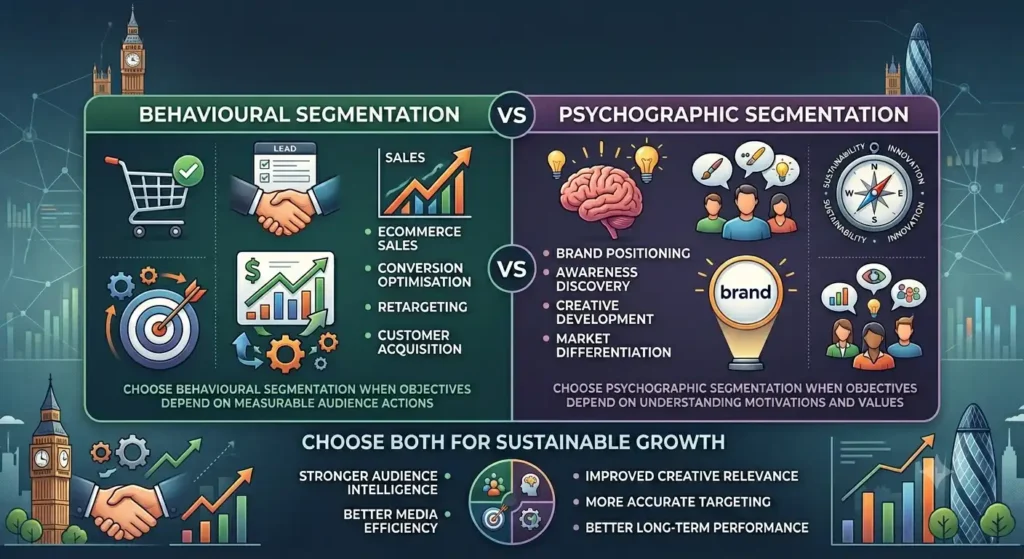
UK advertisers should select segmentation methods based on campaign objectives, available data, measurement requirements, and audience maturity. Behavioural segmentation supports performance-focused campaigns, while psychographic segmentation strengthens audience understanding and message relevance.
There is no universal winner.
The best choice depends on the marketing objective.
Choose behavioural segmentation when the goal is:
- Lead generation
- Ecommerce sales
- Conversion optimisation
- Retargeting
- Customer acquisition
These objectives depend on measurable audience actions.
Dive Deeper With Our Expert Guides:
How to Read a UK News Audience Report and Turn It Into a Campaign Strategy
Tracking Readers Across Web & Social
Choose psychographic segmentation when the goal is:
- Brand positioning
- Awareness building
- Audience discovery
- Creative development
- Market differentiation
These objectives depend on understanding motivations and values.
Choose both when the goal is sustainable growth
Integrated segmentation provides:
- Stronger audience intelligence
- Better media efficiency
- Improved creative relevance
- More accurate targeting
- Better long-term performance
Advertisers evaluating advanced audience intelligence approaches often compare these methods with proven performance outcomes such as those discussed in:
How Our Audience Insights Service Reduced One UK Brand’s CPL by 41%.
Psychographic segmentation and behavioural segmentation serve different functions in UK media buying. Psychographic segmentation explains audience motivations, values, and interests. Behavioural segmentation measures actual audience actions and engagement patterns. Behavioural targeting often delivers stronger short-term performance results, while psychographic insights improve message relevance and brand positioning. The most effective UK media-buying strategies combine both approaches, creating audience profiles that explain not only what consumers do but also why they do it. This combination supports more informed targeting, stronger creative execution, and better campaign outcomes.



