

Watch intent is a measured user inclination to view specific content; display ads increase it by delivering targeted visual prompts, contextual relevance, and frequency across web and app inventory.
Watch intent is the probability a user chooses to play a video or start a stream within a given timeframe. Marketers measure it using click-through rates (CTR), view-through rates (VTR), post-impression events, and platform telemetry such as session starts. Display ads influence watch intent by presenting a clear content cue (title, thumbnail, runtime) and a value proposition (episode count, genre tag, exclusive label) at moments of high attention. Ads placed near relevant editorial content or within entertainment-related environments raise contextual relevance.
Frequency caps and sequential messaging shape intent through repeated exposure while avoiding ad fatigue. Metrics for intent include CTR, VTR at 3–10 seconds, preview-to-play conversion, and incremental lift measured by holdout tests.
How do display ad formats differ in their effect on watch intent?
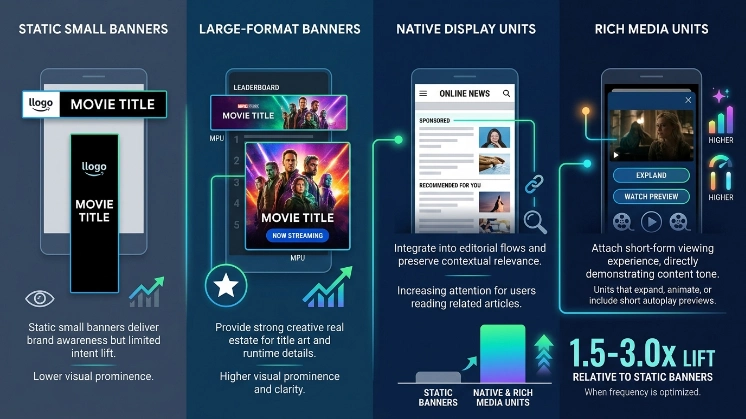
Different display formats deliver distinct visual prominence and interaction; large-format banners, native units, and rich media produce higher watch-intent lift than small banners due to visual clarity and engagement.
Large-format banners such as leaderboards and MPU provide strong creative real estate for title art and runtime details. Native display units integrate into editorial flows and preserve contextual relevance, increasing attention for users reading related articles. Rich media units that expand, animate, or include short autoplay previews attach a short-form viewing experience to the ad, directly demonstrating content tone. Static small banners deliver brand awareness but limited intent lift. Measurement studies show rich media and native units lift short-term trial or play intent by 1.5–3.0 times relative to static banners when frequency is optimised.
What targeting strategies drive higher watch intent from display ads?
Targeting uses first-party behavior, contextual signals, and cohort modeling to deliver ads to audiences with demonstrated interest patterns and content alignment.
Behavioral targeting uses streaming platform first-party signals and publisher-conveyed intent (searches, past viewing, watchlist activity) to match ads to users. Contextual targeting places ads within pages or apps that discuss the same genre or topic, such as placing a sci-fi series ad on science and technology articles. Cohort modeling aggregates similar users into segments based on viewing patterns, then scales reach without exposing individual identifiers. Demographic filters refine age and household composition for family or adult content. Location targeting restricts delivery to UK regions for relevant scheduling and rights. Combining signals reduces waste and increases the percentage of exposed users who convert to trial starts or plays.
How should creative be structured to convert intent into plays?
Creative must show content identity, runtime, episode information, and a clear next step in one frame to make users act on intent quickly.
Effective creatives place the title and a single, high-quality thumbnail or short preview in the foreground. Runtime and episode count communicate time commitment and lower friction for immediate plays. Genre tags and star names provide recognisable anchors for fast recognition. A concise call-to-action phrased as an action (for example, “Start episode one”) links the ad to the intended playback page. For sequential campaigns, creatives rotate to highlight different hooks: lead character, plot line, critic score, or premiere date. Testing three creative variations over two weeks with a controlled audience identifies the highest play-through variant.
What measurement methods prove display ads increase watch intent?
Use incrementality testing, view-through attribution, and platform telemetry to measure the causal effect of display ads on play events and trial signups.
Incrementality testing uses randomised control groups (exposed versus holdout) to calculate the lift in plays or signups attributable to display ad exposure. View-through attribution links ad impressions to later plays without direct clicks; include time windows such as 24 hours and 7 days to capture delayed actions. Platform telemetry tracks session starts and first-play events and ties them to ad campaign IDs through tagging. Cost-per-play and cost-per-trial metrics compute economic efficiency. Lift analysis requires statistically significant sample sizes, typically tens of thousands of users for smaller campaigns, and up to millions for low-conversion environments.
What campaign structures improve conversion from intent to trial signups?
Campaigns combine awareness, consideration, and conversion layers with tailored creative, frequency management, and channel sequencing to move users from intent to signup.
Begin with a wide reach layer using contextual and cohort targeting to seed interest. Follow with a consideration layer that uses richer creative and behavioral retargeting for users who engaged with the ad or visited the content page. Close with a conversion layer that targets high-intent users those who watched a preview, added a title to a watchlist, or visited a pricing page sing persuasive creative and clear membership offers. Frequency caps limit exposure to 3–7 impressions per user per week to balance recall and annoyance. Channel sequencing aligns display with native and video ads so the user experiences consistent messaging across stages. Attribution windows vary by stage: shorter windows for conversion, longer for awareness.
What role does creative testing play in increasing watch intent?
A structured creative test framework isolates variables and identifies assets that maximize play and signup rates.
Define one variable per test: image, headline, runtime display, CTA wording, or preview video length. Run A/B or multivariate tests with controlled audiences to detect lift. Measure primary KPIs such as VTR at 10 seconds, click-to-play rate, and trial conversion rate. Interpret results using confidence intervals and lift percentages. Implement winning assets and iterate at scale. Use test learnings to build a creative library mapped to audience segments and funnel stages.
How do privacy and measurement changes in the UK affect display ad strategies?
Privacy rules and identifier deprecation require reliance on first-party data, contextual targeting, and privacy-safe measurement like aggregated lift tests.
Post-cookie environments reduce access to third-party identifiers. Advertisers pivot to first-party data from platforms and publishers for targeting. Contextual signals increase in importance because they require no personal data. Aggregated measurement uses privacy-preserving analytics and cohort testing instead of individual-level tracking. Advertisers use server-side tagging and secured hashed identifiers where allowed under UK regulations. Brands maintain compliance by documenting data sources and obtaining required consents for personal data processing.
What are the main benefits of using display ads to raise watch intent?
Display ads scale reach, deliver contextual prompts, enable sequential messaging, and provide measurable lift in plays and trial signups when paired with proper targeting and measurement.
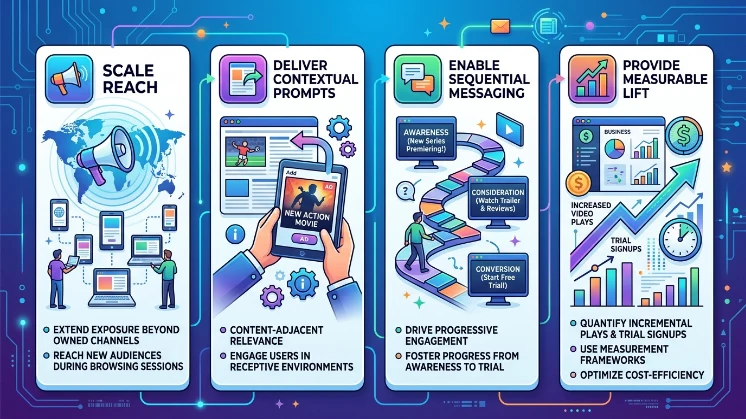
Display campaigns extend exposure beyond owned channels. They reach audiences during browsing sessions with content-adjacent relevance. Sequenced messaging fosters progressive engagement from awareness to trial. Measurement frameworks quantify incremental plays, enabling cost-efficiency optimisation. These benefits support lower-funnel outcomes when campaigns align creative, targeting, and measurement.
Explore More Expert Insights:
How OTT Platforms Nurture Viewers Using Show-Based Banner Campaigns
How Entertainment Platforms Build Subscription Interest Using Banner Ads
What are practical use cases where display ads effectively increase watch intent?
Use cases include new series launches, library reboots, limited-time premieres, and catalogue rediscovery campaigns to convert browsing audiences into active viewers.
For a new series launch, ads emphasise premiere date, episode one runtime, and star names to drive first-play intent. For catalogue reboots, ads highlight season availability and short episode runtimes to encourage immediate viewing. For limited-time or event programming, creative stresses urgency and exclusive access to convert fast. For audience retargeting, ads present trailers or episode highlights to users who previewed content but did not start a full episode.
Read the Full Blog Here:
How Streaming Services Increase Trial Signups Using Banner Ads
Display ads increase watch intent by combining targeted delivery, format selection, precise creative elements, and robust measurement. Campaigns that use contextual and first-party signals, test creative variables, and apply incrementality analysis produce measurable lifts in plays and trial signups.
For conversion-focused creative and measurement, see the following:
Streaming Display Ads That Convert Watch Intent Into Active Users



