Success story banner ads are digital advertisements that feature real student outcomes, academic achievements, career progress, or learning experiences to strengthen institutional trust and improve engagement among prospective students researching education options in the United Kingdom.
Education providers use success story banner ads to present evidence-based student outcomes through visual digital campaigns. These advertisements include graduate achievements, employment placements, certification completions, academic awards, and learner progression statistics.
Success story banner ads operate within the stage of the student journey. Prospective learners already understand educational offerings and actively compare institutions, teaching quality, student satisfaction, and outcome credibility. Banner campaigns at this stage focus on reassurance and proof-based communication.
A university promoting postgraduate business programs may display a banner featuring a graduate employed in financial consulting after course completion. An online learning provider may highlight a learner who completed a cybersecurity certification and secured an IT support role within six months.
These campaigns use concise messaging and measurable outcomes. Statements such as “92% Graduate Employment Rate,” “1,200 Healthcare Certifications Completed,” or “Level 7 Graduates Working Across the NHS” communicate institutional credibility quickly.
Readers seeking foundational understanding about digital education advertising can explore:
How Universities Boost Applications Using Digital Banner Advertising
Readers researching how providers transform trust-based engagement into final student enrollments can read:
How Education Providers Convert Success Story Engagement Into Enrollments Using Banner Ads
Why do success story banner ads increase trust in education providers?
Success story banner ads increase trust because they present real educational outcomes, visible learner experiences, and measurable academic progression that help prospective students evaluate institutional reliability during the research and comparison stage of the admissions journey.
Trust plays a central role in higher education decision-making. Students compare tuition costs, qualification value, career outcomes, and learning quality before submitting applications. Success story advertisements provide evidence that supports institutional claims.
Visual proof improves credibility. Prospective learners respond more positively to advertisements featuring real graduates, authentic campus environments, and verifiable educational achievements than generic promotional messaging.
Outcome-focused communication strengthens transparency. A banner stating “87% of Data Analytics Graduates Entered Employment Within Nine Months” delivers a direct measurable outcome. This structure creates stronger informational value than broad awareness messaging.
Student relatability also increases engagement. Prospective applicants often compare themselves with featured learners who share similar academic interests, career goals, or educational backgrounds. A mature learner researching online accounting qualifications engages more actively with advertisements featuring adult education success stories.
Consistency across platforms strengthens institutional recognition. Repeated exposure to authentic student achievements builds familiarity throughout the research process. This repeated visibility supports long-term trust formation during decision evaluation.
Education providers also use testimonial-focused banners to support course credibility in competitive sectors such as healthcare, engineering, law, teaching, and business education.
How do education providers create effective success story banner ads?
Education providers create effective success story banner ads by combining authentic learner outcomes, concise messaging, verified statistics, professional visuals, and audience-specific educational relevance within structured digital advertising formats designed for engagement and credibility.
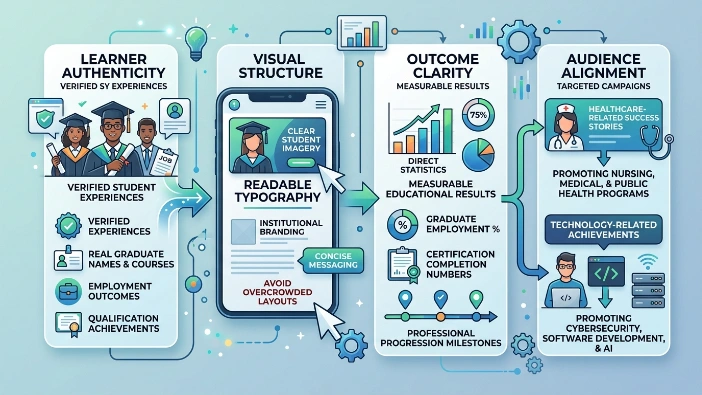
The first component is learner authenticity. Providers use verified student experiences rather than generic marketing statements. Real graduate names, course titles, employment outcomes, and qualification achievements increase campaign reliability.
Visual structure influences engagement rates. Effective banners include clear student imagery, readable typography, institutional branding consistency, and concise achievement-focused messaging. Overcrowded banner layouts reduce readability and weaken trust communication.
Outcome clarity remains essential. Education providers communicate measurable educational results using direct statistics. Examples include graduate employment percentages, certification completion numbers, internship placements, and professional progression milestones.
Audience alignment improves campaign performance. Healthcare-related success stories target prospective nursing, medical, and public health students. Technology-related learner achievements appear in campaigns promoting cybersecurity, software development, and artificial intelligence programs.
Device optimisation supports accessibility. Education providers design banner advertisements for mobile applications, desktop websites, tablets, and social platforms. Mobile-first formatting improves readability for prospective students researching courses through smartphones.
Message consistency across landing pages also supports trust development. When users click a success story banner, they expect to see expanded case studies, student testimonials, and course information aligned with the advertisement content.
What types of student success stories appear in banner advertisements?
Education providers use multiple types of student success stories in banner advertisements, including graduate employment achievements, academic progression outcomes, career-transition examples, professional certification completions, international student experiences, and apprenticeship advancement results.
Graduate employment stories represent one of the most common formats. Universities highlight students who secured roles in finance, engineering, healthcare, teaching, and digital technology after course completion.
Career-transition success stories target adult learners and professional development audiences. A banner advertisement may feature a hospitality employee who completed a project management diploma and entered corporate operations management within one year.
Academic progression campaigns focus on further educational advancement. Providers showcase students who completed undergraduate qualifications and progressed into postgraduate research or doctoral programs.
Professional certification success stories support vocational education marketing. Training institutions promoting accounting certifications, coding bootcamps, or healthcare qualifications frequently highlight exam pass rates and professional licensing outcomes.
International student experiences also strengthen institutional trust. Banner advertisements often feature global learners discussing academic support, accommodation services, cultural integration, and career opportunities after graduation in the United Kingdom.
Apprenticeship-related banners focus on work-integrated education outcomes. Providers display stories about learners progressing into full-time employment after completing employer-linked training programs.
Each success story category targets different audience priorities while supporting institutional credibility through evidence-based communication.
How do banner ads support the middle stage of the student journey?
Banner ads support the middle stage of the student journey by reinforcing institutional credibility, maintaining repeated engagement, presenting educational proof, and helping prospective students compare providers using visible learner outcomes and measurable academic results.
This stage begins after initial awareness and before final application submission. Students at this stage actively evaluate universities, colleges, online academies, and vocational training providers.
Success story banner ads maintain institutional visibility during comparison activity. Prospective students frequently visit ranking websites, tuition guides, student forums, and career resources while evaluating educational options. Banner campaigns keep providers visible throughout this research process.
Retargeting systems improve engagement continuity. A student who reads a data science course page later encounters banner advertisements featuring graduate employment stories related to analytics and technology careers.
Trust-building communication becomes more important during this stage than awareness-focused visibility alone. Prospective learners seek evidence that educational investment produces measurable academic and professional outcomes.
Educational comparison behaviour also increases. Students evaluate graduate outcomes, teaching quality, employability support, and learner satisfaction across multiple institutions. Banner advertisements containing verified success metrics help providers communicate competitive educational value.
Campaigns also support inquiry generation. Prospective students exposed to trust-based messaging frequently revisit websites, download prospectuses, attend virtual open days, or review course-specific student testimonials.
Explore More Expert Insights:
How Institutes Strengthen Admission Intent Using Retargeting Campaigns
How Online Learning Platforms Increase Course Consideration Using Banner Ads
What role does retargeting play in success story banner campaigns?
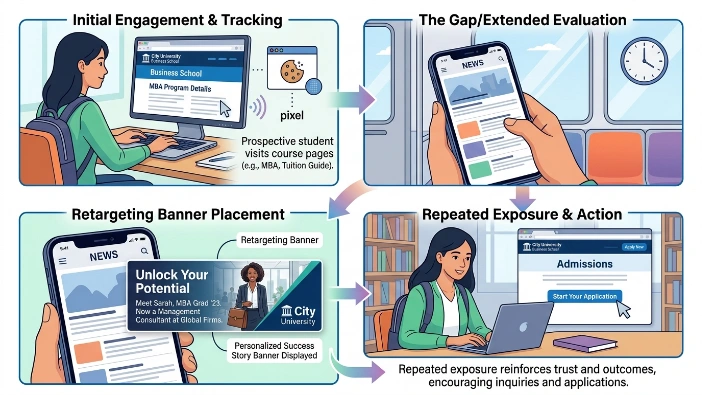
Retargeting plays a central role in success story banner campaigns by reconnecting education providers with previously engaged users and reinforcing institutional trust through repeated exposure to relevant learner achievements and educational outcomes.
Retargeting operates through browser-based behavioural tracking systems. When a prospective student visits a course page, application portal, or tuition guide, advertising systems record interaction signals for future campaign delivery.
Education providers then display personalised success story banners during later browsing sessions. A user researching business management programs may later encounter advertisements featuring MBA graduates employed in consulting, operations, or marketing roles.
This repeated exposure increases familiarity and information retention. Students often require multiple interactions before progressing toward inquiries or applications. Retargeting supports this extended evaluation process.
Audience segmentation improves message relevance. Undergraduate applicants receive different banner advertisements than postgraduate researchers or professional learners. This segmentation increases educational alignment and campaign effectiveness.
Retargeting also supports abandoned inquiry recovery. Students who started inquiry forms but did not complete submissions later receive reminder banners featuring student outcomes, graduate testimonials, or support-service highlights.
Frequency control systems prevent excessive advertisement repetition. Education providers maintain balanced visibility without creating audience fatigue.
Why are success story banner ads important in modern education marketing?
Success story banner ads are important in modern education marketing because they combine measurable educational outcomes, authentic learner experiences, digital visibility, and behavioural targeting to strengthen trust during competitive student recruitment and evaluation processes.
Modern students rely heavily on digital research before selecting educational institutions. They compare course structures, tuition fees, employability outcomes, teaching quality, and student experiences through online platforms.
Education providers operate within increasingly competitive recruitment environments across undergraduate education, postgraduate learning, vocational training, and professional certification sectors. Success story banner advertisements help institutions differentiate themselves through visible learner outcomes.
Trust-based communication has become more valuable within modern admissions marketing. Prospective students expect transparency, measurable progression statistics, and authentic student experiences rather than broad institutional claims.
Digital banner advertising also supports scalable communication. Education providers distribute learner-focused campaigns across educational websites, social applications, search networks, and video platforms simultaneously.
Data tracking systems improve long-term campaign optimisation. Providers monitor engagement rates, click behaviour, landing-page activity, and inquiry submissions linked to success story advertisements.
Success story banner ads now function as a core middle-funnel communication strategy within modern education marketing systems. They connect awareness-stage interest with later enrollment-focused engagement through evidence-driven student outcome communication.