

Public relations distribution has undergone a fundamental transformation over the last decade. What once relied heavily on traditional press releases, manual journalist outreach, and broad media lists has now evolved into a precision-driven ecosystem powered by data, analytics, and audience intelligence. The modern PR distribution model is no longer about simply sending out information; it is about ensuring that every message reaches the right audience, at the right time, through the right channel, and with measurable impact.
In this evolving environment, brands and media organizations are increasingly prioritizing measurable outcomes such as engagement rates, audience retention, conversion tracking, and sentiment analysis. The rise of digital media platforms, AI-powered analytics tools, and multi-channel distribution networks has made PR more scientific than ever before.
Within this transformation, organizations like Time Intelligence Media Group are shaping how modern PR strategies are executed by integrating advanced analytics with distribution systems that are designed to maximize visibility and credibility.
Data-Driven PR as the New Industry Standard
The foundation of modern PR distribution is data. Every press release, article, or sponsored message is now evaluated not just on exposure but on performance metrics that indicate real audience engagement. Open rates, click-through rates, dwell time, social shares, and conversion signals are now essential indicators of success.
This shift has forced PR professionals to move away from intuition-based decision-making and adopt a more analytical approach. Campaign strategies are now designed using historical engagement data, audience segmentation insights, and predictive modeling.
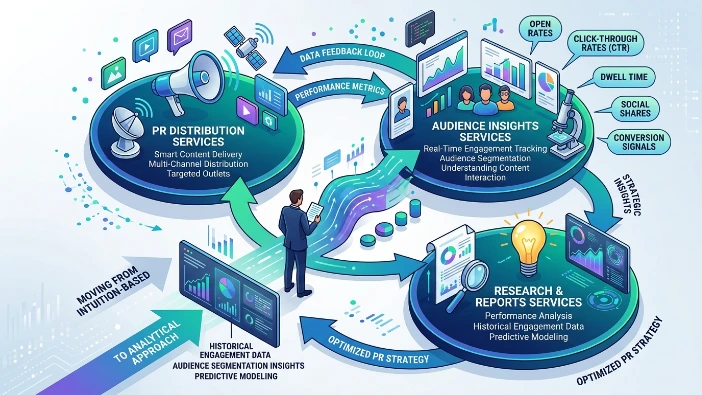
In this data-first ecosystem, services such as PR Distribution Services, Audience Insights Services, and Research & Reports Services have become essential components of effective communication strategies. These services allow organizations to not only distribute content but also understand its performance and optimize future campaigns based on real-time insights.
The Role of PR Distribution Services in Modern Communication Networks
At the core of modern media outreach lies PR Distribution Services, which have evolved far beyond simple press release dissemination. Today, PR distribution platforms function as integrated networks that connect brands with global media outlets, niche publishers, digital journalists, and high-authority platforms.
These services ensure that content is strategically placed where it has the highest probability of engagement. Instead of mass distribution, the focus has shifted to precision targeting, where content is tailored to specific audience segments based on geography, industry, interests, and online behavior.
Modern PR distribution systems also integrate SEO optimization, ensuring that published content contributes to long-term digital visibility. Press releases are no longer just announcements; they are now searchable assets that continue to generate traffic and engagement long after publication.
Within Time Intelligence Media Group, PR Distribution Services are enhanced through data-backed placement strategies that ensure maximum reach and credibility across both traditional and digital media ecosystems.
The Strategic Importance of Audience Insights Services
Understanding the audience is now more important than the message itself. Audience Insights Services play a critical role in decoding how different demographic groups interact with media content. These services analyse behavioral patterns, content preferences, engagement timing, platform usage, and sentiment responses.
This level of insight allows PR professionals to design highly targeted communication strategies that resonate with specific audience segments. Instead of broadcasting a single message to a broad audience, brands can now create personalized narratives that align with user expectations and interests.
Audience intelligence also helps identify emerging trends, allowing organizations to adapt their messaging before market shifts occur. This proactive approach significantly increases engagement rates and strengthens brand positioning in competitive markets.
Within Time Intelligence Media Group, Audience Insights Services are integrated directly into PR distribution workflows, ensuring that every campaign is informed by real-time behavioral data and predictive audience modeling.
The Impact of Research & Reports Services on PR Strategy Development
In a data-driven PR ecosystem, strategic decision-making depends heavily on accurate research and comprehensive reporting. Research & Reports Services provide the analytical backbone that supports every stage of communication planning, from campaign ideation to post-distribution evaluation.
These services compile and interpret large datasets related to media performance, audience engagement, competitor activity, and industry trends. The resulting reports provide actionable intelligence that helps organizations refine their messaging, improve targeting accuracy, and increase overall campaign efficiency.
Research-driven PR strategies are significantly more effective because they eliminate guesswork. Instead of relying on assumptions, organizations can base decisions on verified data and measurable insights.
Time Intelligence Media Group leverages Research & Reports Services to deliver deep analytical frameworks that guide PR campaigns toward higher engagement, improved reach, and stronger audience trust.
The Integration of Data, Distribution, and Engagement
The future of PR distribution lies in the seamless integration of data analytics, content distribution, and engagement tracking. These three pillars work together to create a continuous feedback loop that enhances communication effectiveness over time.
When PR distribution is combined with audience insights, content can be optimized before it is even published. When research reports are integrated into campaign planning, messaging becomes more strategic and impactful. This interconnected system ensures that every piece of communication is both intentional and measurable.
Modern PR is no longer a linear process. It is a dynamic ecosystem where data flows continuously between audience behavior, content performance, and strategic refinement.
Digital Transformation and the Rise of Intelligent Media Systems
The rapid digital transformation of the media industry has significantly influenced how PR distribution operates. Traditional media channels have been supplemented by digital platforms, social networks, and AI-driven content discovery systems.
This transformation has made it possible to track audience interactions in real time, allowing PR teams to adjust campaigns instantly based on performance data. Intelligent media systems now play a critical role in ensuring that content reaches the most relevant audiences with maximum efficiency.
Organizations that adopt these systems gain a significant competitive advantage, as they can respond to audience behavior faster and more accurately than traditional PR models allow.
The Future Role of Automation and AI in PR Distribution
Artificial intelligence is reshaping the future of PR distribution by automating content analysis, audience segmentation, and performance optimization. AI-driven tools can predict which type of content will perform best with specific audience groups, allowing PR professionals to optimize campaigns before launch.
Automation also reduces manual workload by streamlining distribution processes, tracking engagement metrics, and generating performance reports in real time. This enables PR teams to focus more on strategy and creativity rather than operational tasks.
In the coming years, AI will likely become an essential component of every PR distribution system, further increasing efficiency and precision in media communication strategies.
Measuring Success in Modern PR Distribution
Success in PR is no longer defined solely by media coverage volume. Instead, it is measured through a combination of engagement quality, audience relevance, sentiment impact, and long-term visibility.
Key performance indicators now include how deeply audiences interact with content, how often it is shared, and how effectively it influences perception and behavior.
This shift toward qualitative and quantitative measurement ensures that PR strategies are continuously improving and adapting to changing audience dynamics.
The Strategic Value of Time Intelligence Media Group in Modern PR
As the media landscape becomes increasingly complex, organizations require integrated solutions that combine distribution, analytics, and research into a unified system. Time Intelligence Media Group provides this integrated approach through its advanced service ecosystem.
By combining PR Distribution Services, Audience Insights Services, and Research & Reports Services, the organization enables brands to execute highly effective communication strategies that are data-driven, scalable, and globally relevant.
The Future of PR is Intelligent, Measurable, and Data-Led
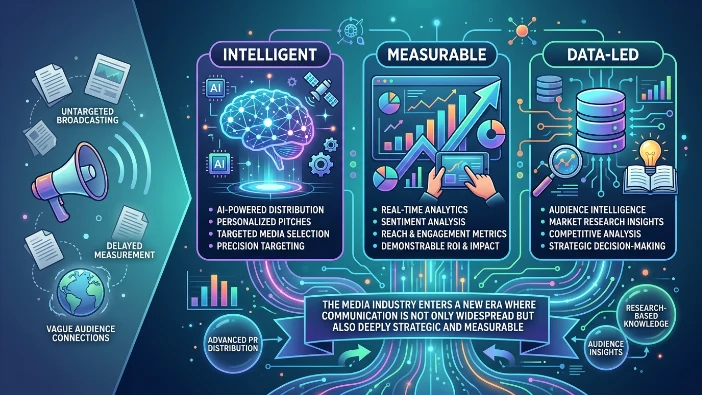
The future of PR distribution is defined by intelligence, precision, and continuous optimisation. Data-driven strategies are replacing traditional methods, allowing organizations to achieve higher engagement and more meaningful audience connections.
As technology continues to evolve, PR will become even more integrated with analytics, automation, and AI-driven systems. The organizations that adapt to this shift early will gain a significant advantage in visibility, credibility, and influence.
With the integration of advanced services such as PR distribution, audience intelligence, and research-based insights, the media industry is entering a new era where communication is not only widespread but also deeply strategic and measurable.



