

Regional UK media has traditionally been viewed as locally focused, serving communities within specific counties, cities, or districts. However, in the digital era, this traditional boundary has dissolved significantly. Local newspapers, digital publishers, and regional broadcasting platforms are no longer limited to domestic audiences. Instead, they are increasingly attracting international readers who access UK-based news content for economic insights, cultural updates, political analysis, and business intelligence.
This transformation has been driven by search engines, social media distribution, and digital publishing tools that allow hyperlocal stories to gain global visibility. A news article published in Manchester or Birmingham can now reach readers in New York, Dubai, Toronto, or Singapore within minutes. This shift has redefined the meaning of “local news,” turning it into a globally consumable information source.
In this evolving ecosystem, media organizations are relying heavily on data-driven strategies and specialized services to understand audience behavior, optimize distribution, and expand international reach. Platforms like Time Intelligence Media Group play a critical role in enabling this transformation through advanced media intelligence and strategic communication solutions.
The Rise of International Traffic in Local UK Journalism
The surge in international traffic for regional UK media is not accidental. It is the result of multiple overlapping factors including globalization, digital accessibility, and content indexing by search engines. UK regional news often covers topics such as economic policy changes, real estate trends, education reforms, healthcare updates, and political developments, all of which have global relevance.
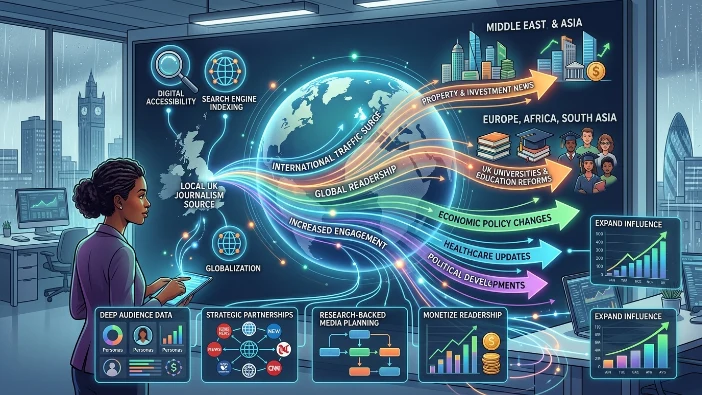
For example, property market changes in London or Manchester attract investors from the Middle East and Asia. Similarly, education-related news from UK universities is frequently accessed by students in Europe, Africa, and South Asia. This global demand has created a unique opportunity for regional media outlets to monetize international readership while expanding their influence.
However, capturing and sustaining this international audience requires more than just publishing content online. It demands deep audience understanding, strategic partnerships, and structured research-backed media planning.
Strategic Role of Audience Understanding in Global Media Expansion
One of the most important drivers of international media success is audience intelligence. Without understanding who is consuming content, where they are located, and what their interests are, regional media organizations struggle to scale effectively.
This is where Audience Insights Services become essential. These services help media organizations analyze behavioral patterns, demographic shifts, and engagement trends across different geographic regions. By identifying which topics attract international readers, publishers can tailor their editorial strategy to maximize global reach.
For regional UK media, audience insights reveal surprising patterns. For instance, crime reporting from UK cities often receives high engagement in international markets due to diaspora communities staying connected to their hometowns. Similarly, financial reporting from London frequently attracts institutional investors and global analysts.
With the support of data-driven audience intelligence provided through platforms like Time Intelligence Media Group, publishers can refine content strategies and ensure that local journalism resonates on a global scale.
Media Partnerships as a Gateway to International Distribution
Expanding international traffic is not solely dependent on content creation. Distribution plays an equally important role. Even high-quality journalism can remain unnoticed if it is not properly distributed across global networks.
This is where Media Partnerships Solutions become critical. Strategic collaborations with international news aggregators, syndication platforms, and digital publishers enable regional UK media outlets to extend their reach far beyond domestic audiences.
Through structured partnerships, local media organizations gain access to global distribution channels, allowing their content to be republished, referenced, and shared across multiple platforms. This not only increases visibility but also enhances credibility in international markets.
Media partnerships also support search engine optimization at a global scale. When regional news is consistently cited by international platforms, its authority increases, leading to higher search rankings and sustained organic traffic growth.
The Importance of Research-Driven Media Growth Strategies
In the competitive digital media environment, intuition alone is no longer sufficient for growth. Every decision must be backed by research, analytics, and structured reporting. This is particularly important for regional UK media attempting to scale internationally.
Research & Reports Services provide the analytical backbone required for informed decision-making. These services help media organizations understand market trends, audience behavior shifts, content performance metrics, and competitive positioning.
Through detailed research reports, publishers can identify which topics are gaining traction internationally and which formats are performing best across different regions. For example, long-form investigative journalism may perform well in European markets, while short-form breaking news may dominate engagement in South Asia.
By leveraging structured research insights, media organizations can allocate resources more efficiently and focus on high-impact content strategies that drive international traffic growth.
How Local News Becomes Global Content
The transformation of local UK news into global content is not a coincidence; it is a structured process influenced by digital amplification systems. Search engines index local stories based on relevance, keywords, and user intent. Social media platforms amplify content based on engagement signals. Aggregators distribute articles across international networks.
In this ecosystem, even a small regional news story can become globally significant if it aligns with international interest patterns. For example, a local infrastructure project in Leeds may attract attention from urban planners worldwide. Similarly, political decisions made at the local council level can be studied by governance experts in other countries.
This global relevance creates a feedback loop where regional media increasingly produces content with international audiences in mind. Over time, the distinction between “local” and “global” journalism becomes increasingly blurred.
Monetization Opportunities from International Audience Growth
International traffic is not only a metric of visibility; it is also a significant revenue opportunity for regional media organizations. Global audiences open new monetization streams including digital advertising, sponsored content, subscription models, and content syndication.
Global advertisers are particularly interested in UK regional media because of its credibility and trust factor. Unlike purely commercial platforms, regional journalism maintains editorial integrity, which enhances the effectiveness of sponsored content placements.
Additionally, international readership allows media organizations to diversify their revenue base beyond local advertising markets, making them more financially resilient in a competitive industry.
Digital Transformation and the Future of Regional Media
The future of regional UK media is deeply connected to digital transformation. Traditional print circulation has declined significantly, while online readership has expanded exponentially. This shift has forced media organizations to rethink their business models, content strategies, and distribution frameworks.
Digital-first journalism now requires integration of analytics, automation, and audience segmentation tools. It also requires continuous adaptation to search engine algorithms and social media distribution trends.
Organizations that invest in intelligence-driven media systems are better positioned to compete in this evolving landscape. Platforms like Time Intelligence Media Group support this transition by offering integrated media solutions that combine audience insights, research intelligence, and strategic partnerships.
Global Visibility Through Data-Driven Media Strategy
Data is the foundation of modern journalism expansion. Without data, media organizations cannot understand how content performs beyond their immediate geographic boundaries.
Audience analytics reveal where international traffic originates, what content formats perform best, and how users engage with regional news stories. This information allows publishers to refine headlines, optimize content structure, and improve distribution timing.
When combined with structured services such as Audience Insights Services and Media Partnerships Solutions, data becomes a powerful tool for global expansion. It transforms regional journalism into a scalable international content ecosystem.
The Evolution of Local Journalism into a Global Information Network
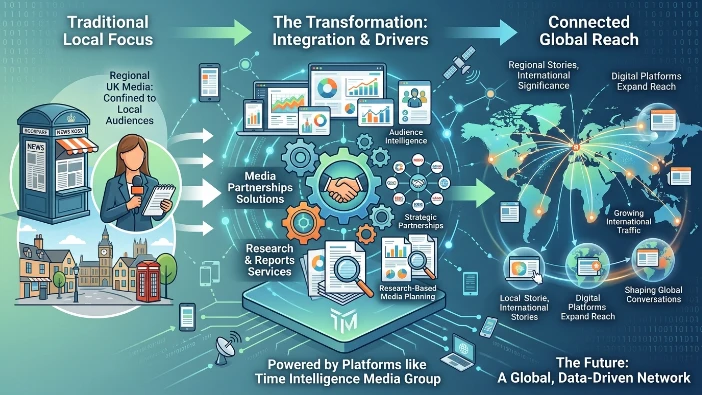
Regional UK media is no longer confined to local audiences. It has become part of a global information network where local stories carry international significance. This transformation is driven by digital platforms, audience intelligence, strategic partnerships, and research-based media planning.
The integration of Audience Insights Services, Media Partnerships Solutions, and Research & Reports Services enables media organizations to understand their audiences, expand their reach, and strengthen their global presence.
As international traffic continues to grow, the distinction between local and global journalism will continue to fade. Regional UK media stands at the center of this evolution, shaping how local stories influence global conversations.
With the support of platforms like Time Intelligence Media Group, the future of regional journalism is not just local—it is global, data-driven, and deeply interconnected.



