

The media landscape in London has undergone a dramatic transformation over the past decade, driven largely by the rapid adoption of mobile devices, social platforms, and algorithm-driven content delivery systems. Among the most significant changes is the rise of video news, particularly short-form content designed to capture attention within seconds.
Traditional journalism once relied heavily on long-form reporting, print circulation, and scheduled television broadcasts. Today, audiences in London are increasingly consuming news in bite-sized video formats across platforms such as TikTok, Instagram Reels, YouTube Shorts, and even embedded video segments within digital newspapers.
This shift is not just a change in format but a fundamental redefinition of how news is produced, distributed, and monetized. Media organizations are now competing not only with each other but also with influencers, citizen journalists, and AI-generated content streams.
Within this evolving ecosystem, media strategies supported by services such as Audience Insights Services, Sponsored Content Services, and Banner Advertising Services have become central to understanding and monetizing audience behavior effectively.
The Evolution of Video News in the Digital Age
Video news is not new, but its current form is fundamentally different from traditional broadcast journalism. In London’s fast-paced digital environment, audiences expect instant updates, visually engaging storytelling, and mobile-first accessibility.
Short-form video content typically ranges between 10 seconds and 90 seconds, designed to deliver key information quickly while maximizing engagement metrics such as watch time, shares, and retention rates.
The shift toward short-form video is driven by several factors. Attention spans have shortened significantly due to social media consumption habits. Mobile-first browsing dominates digital traffic. Algorithms prioritize engagement over depth, pushing short videos to wider audiences.
Newsrooms across London have adapted by restructuring editorial workflows, investing in video production teams, and optimizing content for platform-specific algorithms. The success of this transformation depends heavily on understanding audience behavior at a granular level, which is where Audience Insights Services play a crucial role.
Why Short-Form Video News Is Dominating London Media
The dominance of short-form video news in London can be attributed to several interconnected trends.
Audiences prefer content that is fast, visually appealing, and easy to consume during commuting, breaks, or multitasking. Smartphones have become the primary device for news consumption, making vertical video formats more effective than traditional widescreen broadcasts.
Social media platforms reward content that generates quick engagement, leading to a cycle where shorter videos gain more visibility. This algorithmic preference has forced news organizations to rethink their storytelling strategies.

Additionally, younger audiences in London are less likely to engage with traditional news formats. Instead, they rely on curated video feeds that blend entertainment with information.
To adapt to this environment, media companies increasingly rely on Sponsored Content Services to integrate branded storytelling into video news formats without disrupting audience experience. This allows publishers to maintain revenue streams while delivering content in formats that audiences actually engage with.
The Role of Audience Behavior in Shaping Video News Strategies
Understanding audience behavior is at the core of successful video news strategies. Media organizations in London now operate in a data-driven environment where every click, swipe, and view is analyzed.
This is where Audience Insights Services become essential. These services help media companies identify what type of content performs best, what time audiences are most active, and how different demographic groups interact with video content.
For example, younger audiences may prefer fast-paced, visually dynamic reporting, while professional audiences might engage more with explainer-style short videos that break down complex political or economic developments.
By leveraging detailed audience analytics, media organizations can refine their editorial strategies and increase engagement rates significantly. This data-driven approach has become a cornerstone of modern digital journalism in London.
Short-Form Video as a Revenue Driver in Modern Journalism
One of the most important aspects of the rise of short-form video news is its impact on monetization strategies. Traditional advertising models based on print circulation or television ratings are no longer sufficient in a digital-first environment.
Short-form video content opens new opportunities for monetization through embedded ads, sponsored segments, and programmatic advertising.
Banner Advertising Services play a significant role in this ecosystem. While video content drives engagement, strategically placed banner advertisements across news platforms help maximize revenue without disrupting user experience. In London’s competitive media market, optimizing banner placement and design has become a critical part of digital publishing strategy.
At the same time, Sponsored Content Services allow brands to integrate seamlessly into video news formats. Rather than traditional interruptive advertising, sponsored content is designed to blend with editorial storytelling, creating a more organic and engaging user experience.
This hybrid model of monetization ensures that media companies can sustain high-quality journalism while adapting to modern consumption habits.
The Impact of Social Platforms on London’s News Ecosystem
Social media platforms have become the primary distribution channels for short-form video news in London. Platforms such as TikTok, Instagram, Facebook, and YouTube have fundamentally changed how audiences discover and consume news.
Algorithms prioritize content that generates immediate engagement, which has led to the rise of emotionally compelling, visually engaging, and highly shareable news clips.
This shift has forced traditional media organizations to rethink their distribution strategies. Instead of relying solely on websites or broadcast channels, news publishers now optimize content for platform-specific formats.
The challenge lies in maintaining journalistic integrity while adapting to algorithm-driven content ecosystems. This balance requires careful editorial planning, data analysis, and strategic content partnerships supported by Media Partnerships Solutions.
Media Partnerships and the Expansion of Video News Distribution
In the modern media landscape, collaboration is more important than competition. Media organizations in London increasingly rely on Media Partnerships Solutions to expand the reach of their video news content.
These partnerships allow publishers to distribute content across multiple platforms, increase visibility, and reach diverse audience segments. By collaborating with digital platforms, streaming services, and other media outlets, news organizations can amplify their storytelling impact.
Media partnerships also help reduce production costs while increasing content distribution efficiency. This is particularly important in the fast-paced world of short-form video, where speed and scalability are essential.
The Role of Sponsored Content in Video Journalism
Sponsored content has become a defining feature of modern digital journalism. In the context of short-form video news, it provides a sustainable revenue model while maintaining audience engagement.
Unlike traditional advertising, sponsored video content is designed to align with editorial storytelling. This creates a more natural viewing experience and reduces audience resistance to promotional messaging.
In London’s competitive media environment, Sponsored Content Services enable publishers to collaborate with brands in a way that enhances both storytelling and revenue generation.
When executed properly, sponsored content does not compromise journalistic integrity but instead supports the financial sustainability of news organizations.
Banner Advertising in the Era of Video News
While video content dominates engagement, banner advertising remains a crucial component of digital monetization strategies. In London’s media ecosystem, Banner Advertising Services are used strategically alongside video content to maximize visibility and revenue.
Modern banner advertising is no longer static or intrusive. It is data-driven, responsive, and highly targeted. Advertisers can reach specific audience segments based on behavior, location, and content preferences.
When integrated effectively with video news platforms, banner advertising enhances user experience rather than disrupting it. This synergy between content and advertising is essential for sustaining digital journalism in a competitive market.
The Future of Short-Form Video News in London
The future of video news in London is expected to become even more dynamic, personalized, and interactive. Artificial intelligence, real-time analytics, and immersive storytelling technologies will further transform how news is produced and consumed.
Short-form video will continue to dominate due to its accessibility and engagement power. However, its success will increasingly depend on how effectively media organizations integrate data, advertising, and distribution strategies.
Services such as Audience Insights Services, Sponsored Content Services, and Banner Advertising Services will remain central to this evolution, enabling publishers to stay competitive in a crowded digital ecosystem.
A New Era of Journalism
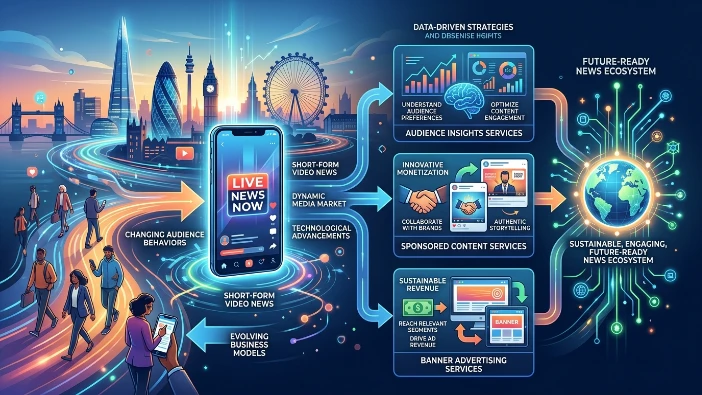
The rise of short-form video news represents a fundamental shift in the journalism industry, particularly in dynamic media markets like London. It reflects changing audience behaviors, technological advancements, and evolving business models.
Media organizations that embrace data-driven strategies, strategic partnerships, and innovative monetization models are best positioned to thrive in this new environment.
By integrating solutions such as Audience Insights Services, Sponsored Content Services, and Banner Advertising Services, publishers can build sustainable, engaging, and future-ready news ecosystems.
For more information about modern media solutions and digital transformation in journalism, visit: Time Intelligence Media Group



