
In today’s digital publishing ecosystem, search engines are no longer just indexing content—they are evaluating credibility, authority, and trust at a structural level. For independent news groups, this shift has completely changed the rules of visibility. The concept of E-E-A-T—Experience, Expertise, Authoritativeness, and Trustworthiness—now plays a decisive role in whether a news article ranks on the first page or disappears into obscurity.
Independent publishers often face a unique challenge. Unlike established legacy media houses, they do not automatically benefit from inherited authority signals. Instead, they must actively build trust through consistent editorial quality, transparent sourcing, strong distribution networks, and credible external validation.
This study explores how trust signals influence search performance for independent news organisations and how strategic media services such as PR Distribution Services, Media Partnerships Solutions, and Sponsored Content Services from Time Intelligence Media Group can significantly strengthen E-E-A-T performance and ranking outcomes.
Understanding E-E-A-T in the Context of Independent News Publishing
E-E-A-T is not a single ranking factor but a composite framework used by search systems to evaluate content quality. For independent news organisations, each element of E-E-A-T plays a different role in shaping visibility.
Experience refers to whether content is created by individuals with real-world exposure to the topic. Expertise evaluates the depth of knowledge and accuracy of reporting. Authoritativeness is built through recognition, backlinks, and mentions from trusted sources. Trustworthiness, however, is the most critical layer, especially for news publishers, as it reflects transparency, reliability, and consistency.
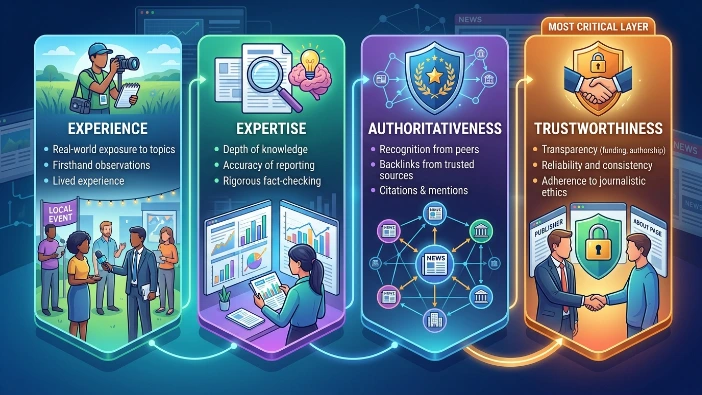
Independent news groups often struggle most with authority and trust because they operate without the institutional reinforcement that large media brands enjoy. This is where structured media support services become essential.
The Role of Trust Signals in Search Ranking Systems
Trust signals are the digital indicators that search engines use to evaluate whether a news source is credible. These signals are both internal and external.
Internal signals include content accuracy, editorial consistency, author identity clarity, and website transparency. External signals include backlinks from reputable domains, media mentions, syndication across trusted platforms, and engagement metrics.
For independent news publishers, external signals often determine whether content is considered reliable enough to surface in competitive search queries. Even well-written content can underperform if it lacks authoritative validation from external ecosystems.
This is why structured visibility strategies are essential in modern digital publishing.
PR Distribution Services and Their Role in Strengthening E-E-A-T
PR Distribution Services play a fundamental role in building trust signals at scale. When news content is distributed across reputable media outlets, it gains immediate credibility in the eyes of search engines.
Through structured distribution networks, independent news organisations can ensure their stories are picked up by verified platforms, increasing the number of authoritative backlinks and brand mentions. This not only improves visibility but also reinforces the perception of legitimacy.
PR distribution also enhances content lifecycle longevity. Instead of being limited to a single publication window, news content continues to generate authority signals as it is syndicated across multiple platforms.
In the context of E-E-A-T, PR distribution directly supports Authoritativeness and Trustworthiness, two of the most influential ranking dimensions for news-based content.
Media Partnerships Solutions as a Long-Term Authority Builder
Media Partnerships Solutions create structured collaborations between independent publishers and established media networks. These partnerships are not simply about content sharing; they are about credibility transfer.
When an independent news group collaborates with recognised media entities, it inherits part of the authority ecosystem of its partners. This results in stronger trust signals, increased referral traffic, and higher indexing priority.
Search engines interpret such partnerships as indicators of reliability and editorial validation. Over time, consistent collaboration builds a strong authority footprint that significantly improves ranking stability.
Media partnerships also help diversify content exposure across multiple audience segments. This increases engagement metrics such as dwell time and return visits, which further strengthen perceived content value.
Sponsored Content Services and Controlled Trust Signal Amplification
Sponsored Content Services, when used strategically, can enhance E-E-A-T rather than weaken it. The key lies in transparency, relevance, and placement within authoritative environments.
For independent news organisations, sponsored content offers an opportunity to place editorial narratives within established media ecosystems. When properly labeled and distributed through credible platforms, sponsored content can generate high-quality backlinks and audience engagement.
More importantly, it increases brand visibility across trusted domains, which contributes to overall authority scoring. Search engines increasingly evaluate how consistently a brand appears across verified environments, not just organic search results.
Within E-E-A-T, sponsored content primarily supports Authoritativeness and Experience by demonstrating active industry presence and real-world engagement.
How Trust Signals Influence Ranking Performance for Independent News Groups
Search ranking systems prioritise content that demonstrates credibility across multiple layers. For independent news groups, trust signals act as a validation system that compensates for lack of historical authority.
When a news article is supported by strong PR distribution, reinforced through media partnerships, and amplified via sponsored placements, it creates a multi-layered trust ecosystem.
This ecosystem signals to search engines that the content is not isolated but part of a broader verified information network. As a result, indexing speed improves, ranking stability increases, and content visibility expands across competitive search queries.
Trust signals also reduce content volatility. Independent publishers often experience ranking fluctuations, but strong authority frameworks help stabilize performance over time.
The Relationship Between Editorial Integrity and External Validation
While external signals are important, they cannot replace editorial integrity. Search engines continuously analyze content quality, factual accuracy, and structural consistency.
Independent news organizations must ensure that external amplification strategies align with internal editorial standards. Misalignment between content quality and external promotion can lead to reduced trust scores.
This balance is essential. External services such as PR distribution and media partnerships amplify content, but the foundation must remain strong journalism practices.
When both internal and external trust signals align, E-E-A-T performance becomes significantly stronger, resulting in sustained ranking improvements.
Building a Sustainable E-E-A-T Framework for Independent Publishers
Sustainability in E-E-A-T requires long-term consistency rather than short-term optimization. Independent news groups must focus on building layered credibility over time.
This includes maintaining transparent author profiles, ensuring consistent publication quality, and developing strong external validation networks. Services like PR distribution, media partnerships, and sponsored content should be integrated into a broader strategy rather than used in isolation.
Time Intelligence Media Group provides structured solutions that support this ecosystem by connecting independent publishers with verified distribution channels and authority-building opportunities.
The Future of Trust-Based Ranking in Independent News Ecosystems
The future of search ranking is increasingly centered around trust architecture. Algorithms are evolving beyond keyword relevance and moving toward credibility mapping.
Independent news organizations that invest early in structured trust-building systems will have a significant advantage. E-E-A-T is not a static guideline—it is an evolving framework that continues to prioritise reliability, transparency, and external validation.
As misinformation challenges grow, search engines will likely place even greater emphasis on verified authority networks. This makes strategic media services not just beneficial but essential for long-term survival in digital publishing.
E-E-A-T as the Foundation of Independent News Success

The E-E-A-T framework has fundamentally reshaped how independent news organisations achieve visibility. Trust signals now determine ranking potential more than ever before, and without them, even high-quality journalism struggles to gain traction.
By integrating PR Distribution Services, Media Partnerships Solutions, and Sponsored Content Services, independent publishers can significantly enhance their authority profile and build a sustainable presence in competitive search environments.
Ultimately, success in modern news publishing is no longer just about content creation—it is about trust engineering across digital ecosystems.