

Social media has become one of the most influential spaces where public opinion is shaped, expressed, and amplified. In a diverse and densely populated city like London, where each borough reflects its own social, economic, and cultural identity, digital sentiment offers a real-time mirror of community concerns. Social Media Sentiment Analysis provides a structured way to interpret these voices, helping organisations, policymakers, and media strategists understand what people are truly thinking beyond surface-level reporting.
Across major London boroughs such as Westminster, Camden, Hackney, Tower Hamlets, Southwark, and Croydon, online discussions reveal a wide spectrum of grievances ranging from housing affordability and transport inefficiencies to healthcare access and local governance challenges. These conversations are not random; they form patterns that can be mapped, analyzed, and transformed into actionable insights.
This is where advanced digital intelligence frameworks become essential, particularly when combined with specialized services like Audience Insights Services, Research & Reports Services, and PR Distribution Services offered through Time Intelligence Media Group homepage.
The Role of Sentiment Analysis in Urban Community Understanding
Sentiment analysis is no longer just a marketing tool; it has evolved into a socio-digital diagnostic system. In the context of London boroughs, it helps decode emotional tones embedded in thousands of daily posts, comments, reviews, and discussions across platforms like X (formerly Twitter), Facebook, Reddit, and community forums.
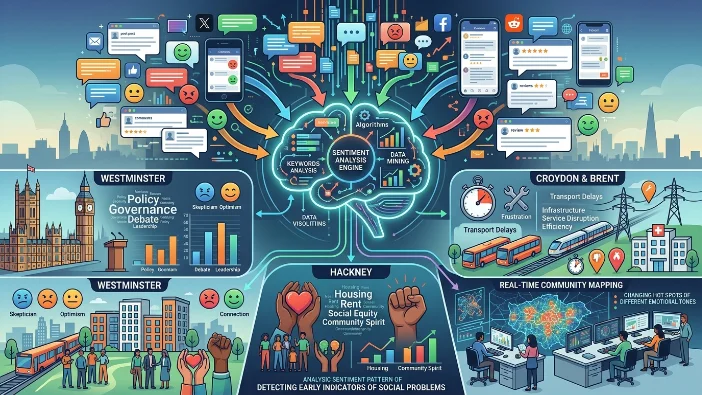
Each borough exhibits unique sentiment patterns. For example, Westminster often reflects political discourse and governance-related sentiment, while Hackney tends to show stronger engagement around housing and social equity. Meanwhile, boroughs like Croydon and Brent frequently generate sentiment linked to infrastructure, transport delays, and public services.
The importance of interpreting these digital signals lies in their ability to uncover hidden grievances that traditional surveys often miss. People are more likely to express frustration or satisfaction openly on social platforms than in formal questionnaires, making sentiment analysis a powerful tool for real-time community mapping.
Audience Insights Services and the Mapping of Borough-Level Behavior
Audience Insights Services play a central role in transforming raw social media data into meaningful behavioral intelligence. In the context of London’s boroughs, these services help identify not only what people are saying but also who is saying it, how frequently, and in what emotional context.
Through audience segmentation, patterns emerge that reveal demographic sensitivities. Younger populations in boroughs like Islington and Camden tend to express concerns about cost of living and job opportunities, while older demographics in Richmond or Kingston often focus on healthcare services and local amenities.
The value of Audience Insights Services lies in their ability to connect sentiment with identity layers such as age groups, professional backgrounds, and community interests. This creates a multidimensional view of urban sentiment that goes far beyond simple keyword tracking.
By applying these insights across boroughs, organisations can identify early signals of dissatisfaction or approval, allowing for proactive engagement strategies. For instance, rising negative sentiment around transport delays in South London boroughs can indicate infrastructure pressure before it escalates into wider public frustration.
Research & Reports Services and Data-Driven Urban Intelligence
Research & Reports Services provide the analytical backbone needed to convert sentiment data into structured intelligence. In a city as complex as London, raw sentiment without interpretation can be misleading. These services ensure that data is contextualised, validated, and presented in a meaningful narrative form.
When applied to borough-level sentiment analysis, research frameworks help identify long-term trends rather than isolated emotional spikes. For example, a temporary surge in negative sentiment in Tower Hamlets might be linked to a specific event, while sustained negativity in housing discussions across multiple boroughs indicates a systemic issue.
These services also enable comparative analysis between boroughs. One borough may show improving sentiment regarding public safety, while another experiences growing dissatisfaction with local council responsiveness. Such comparisons help stakeholders understand regional disparities and prioritise interventions accordingly.
Research & Reports Services also play a critical role in policymaking environments, where evidence-based decisions are essential. By integrating sentiment analysis with structured reporting, decision-makers gain a clearer understanding of public perception trends over time.
PR Distribution Services and the Management of Public Narrative
In the modern digital ecosystem, analysing sentiment is only part of the equation; managing communication in response to that sentiment is equally important. PR Distribution Services ensure that strategic messaging reaches the right audiences at the right time, especially in response to emerging community grievances.
When negative sentiment rises in specific boroughs, timely and well-structured communication can help address misinformation, clarify policies, or highlight corrective actions. This is particularly important in areas like healthcare communication, transport updates, and housing policy announcements.
In London’s interconnected media environment, PR Distribution Services help bridge the gap between institutions and communities. They ensure that official responses are not only published but also amplified across relevant digital channels where public conversations are actively happening.
By aligning PR strategies with sentiment data, communication becomes more responsive rather than reactive. This creates a feedback loop where public sentiment informs messaging, and messaging influences public sentiment in return.
Mapping Community Grievances Across London Boroughs
The diversity of London means that no single narrative defines the entire city. Each borough contributes its own layer of sentiment, shaped by local experiences and challenges.
In Westminster, sentiment often revolves around governance decisions, political discourse, and tourism-related pressures. In contrast, Hackney reflects stronger emotional engagement around housing affordability and social inequality. Southwark frequently highlights urban development and regeneration projects, while Croydon shows recurring concerns about transport infrastructure and service reliability.
These grievances are not isolated issues but interconnected signals of urban stress. Social Media Sentiment Analysis allows these patterns to be visualized collectively, revealing how different boroughs experience different dimensions of the same metropolitan system.
When aggregated, these insights provide a holistic emotional map of London. This map is not static; it evolves daily based on public discourse, events, and policy changes.
Integrating Time Intelligence Media Group Solutions into Sentiment Ecosystems
Time Intelligence Media Group homepage provides a structured ecosystem of digital intelligence services designed to interpret, analyze, and act on complex data environments like London’s social sentiment landscape.
By combining Audience Insights Services, Research & Reports Services, and PR Distribution Services, a comprehensive analytical framework emerges. This framework enables organizations to not only understand sentiment but also respond to it strategically and effectively.
Audience Insights Services decode who is speaking and why. Research & Reports Services interpret what it means in a broader socio-political context. PR Distribution Services ensure that the right responses reach the right audiences at the right time.
Together, these services form a continuous cycle of listening, analyzing, and communicating that is essential for managing public perception in a digitally connected city.
The Future of Sentiment Analysis in Urban Governance and Media Strategy
As London continues to evolve, the importance of social sentiment analysis will only increase. Urban governance, media organizations, and public institutions are becoming more reliant on real-time digital intelligence to guide decision-making.
Future developments will likely include deeper integration of AI-driven sentiment models, multilingual analysis capabilities reflecting London’s diversity, and predictive analytics that anticipate community grievances before they fully emerge.
In this future landscape, borough-level sentiment mapping will not just be a reporting tool but a foundational component of urban planning and communication strategy.
Organisations that adopt these systems early will be better positioned to understand public emotion, respond effectively to concerns, and build stronger relationships with communities across all boroughs.
Turning Digital Voices into Actionable Intelligence

Social Media Sentiment Analysis offers a powerful lens through which the emotional and social dynamics of London boroughs can be understood. By mapping community grievances across digital platforms, stakeholders gain access to real-time insights that reflect the lived experiences of residents.
When combined with Audience Insights Services, Research & Reports Services, and PR Distribution Services through Time Intelligence Media Group homepage, sentiment analysis becomes more than just observation. It becomes a structured system for understanding, interpreting, and responding to the evolving voice of the city.
In a world where public opinion shifts rapidly, the ability to listen intelligently and respond strategically is no longer optional. It is essential for any organisation aiming to remain relevant, responsive, and connected to the communities it serves.



