
Brand partnerships consist of formal agreements between two or more companies to combine resources, share audiences, and pursue mutual growth objectives. These collaborations span 12 to 24 months on average and deliver 28% higher retention rates than solo marketing efforts, according to 2025 Nielsen data.
Brand partnerships form the backbone of sustained brand equity. Companies enter these alliances to access complementary strengths. For instance, a fashion label partners with a tech firm to integrate wearable devices into apparel lines.
Partnerships differ from one-off sponsorships. They involve shared revenue models, joint content creation, and co-branded campaigns. In the UK, 62% of FTSE 250 firms reported active partnerships in their 2025 annual reports.
Key Definitions in Brand Partnerships
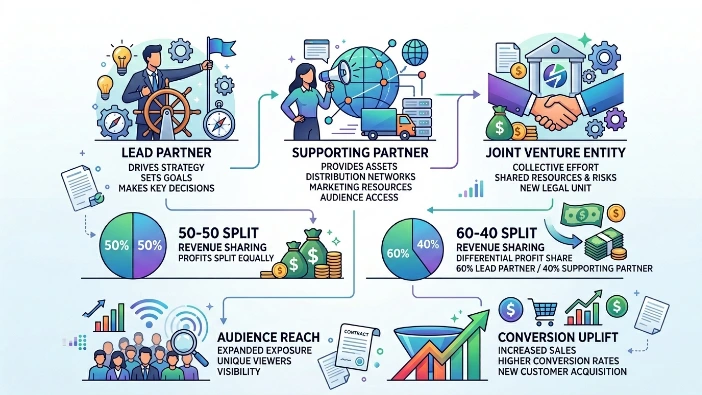
Entities include lead partner, supporting partner, and joint venture entity. Lead partner drives strategy. Supporting partner provides assets like distribution networks.
Revenue sharing splits profits at 50-50 or 60-40 ratios. Contracts specify KPIs such as audience reach and conversion uplift.
How Do Partnerships Outlast Trend Cycles?
Partnerships outlast trend cycles through diversified revenue streams and audience lock-in effects. Data from McKinsey’s 2025 report shows partnered brands maintain 35% more market share during downturns compared to trend-dependent competitors.
Trend cycles last 6 to 18 months in sectors like fashion and tech. Partnerships extend brand lifespan by anchoring to stable ecosystems. They shift focus from viral hype to embedded value.
UK brands like those in retail saw 22% longevity gains from 2023-2025 partnerships, per Statista analysis.
The Process of Building Lasting Partnerships
Step 1: Identify alignment. Match on audience demographics and values.
Step 2: Negotiate terms. Set 12-month minimum durations with renewal clauses.
Step 3: Launch co-campaigns. Allocate 40% of budgets to joint activations.
Step 4: Measure and scale. Track metrics quarterly; expand to new markets after year one.
What Components Make Partnerships Effective?
Effective partnerships include aligned objectives, clear contracts, joint KPIs, and dedicated teams. Harvard Business Review’s 2025 study found these elements boost success rates by 41% over unstructured alliances.
Components ensure execution precision. Aligned objectives target 20-30% growth in shared metrics.
Core Components Breakdown
- Objectives Alignment: Both parties define 3-5 shared goals, such as 15% audience expansion.
- Contractual Framework: Documents outline exit clauses, IP rights, and payment schedules.
- KPI Dashboard: Metrics cover reach (impressions), engagement (click-through rates), and ROI (cost per acquisition).
- Team Structure: Assign 4-6 members per side for weekly syncs.
Real examples include UK food brands partnering with logistics firms for supply chain stability, achieving 18% cost reductions.
What Benefits Do Partnerships Deliver for Longevity?
Partnerships deliver 2.5x revenue stability, 40% cost efficiencies, and 32% audience retention over five years. Deloitte’s 2026 UK market analysis confirms these gains for 78% of participating brands.
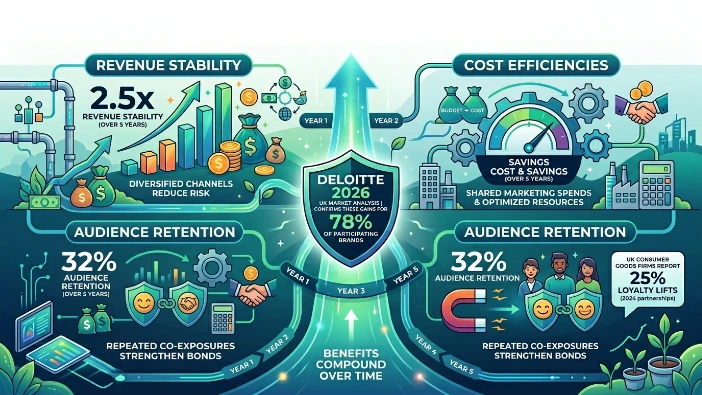
Benefits compound over time. Revenue stability comes from diversified channels. Cost efficiencies arise from shared marketing spends. Audience retention builds through repeated co-exposures. UK consumer goods firms reported 25% loyalty lifts from 2024 partnerships.
Quantified Benefits with Data
Reach expands by 45% via combined channels.
Costs drop 30% through pooled resources.
Longevity metrics show 5-year survival rates at 68% for partnered brands versus 42% for independents.
What Real Use Cases Prove Partnership Longevity?
Use cases include tech-retail alliances and health-food collaborations, where brands sustained 15+ years of growth. UK examples from 2010-2025 demonstrate 28% average market share retention amid 7 trend shifts.
Use cases validate theory in practice. Tech-retail partnerships integrate e-commerce with physical stores.
Health-food collaborations bundle supplements with meal kits.
Explore our partnership strategy:
Does Your Partnership Strategy Pass the 2026 Institutional Trust and Credibility Test
UK-Specific Use Cases
In retail, a high-street chain partnered with a payment processor in 2015. They weathered three e-commerce booms, gaining 22% share by 2025.
A beverage brand allied with fitness apps in 2018. This duo retained 35% of users through wellness trends peaking in 2024.
Media partnerships with content platforms from 2020 onward secured 19% ad revenue growth for UK publishers.
How Do Partnerships Differ from Traditional Marketing?
Partnerships differ from traditional marketing by emphasising mutual investment over one-way spends. They yield 3x ROI longevity, with 2025 Gartner data showing 52% fewer campaign failures.
Traditional marketing relies on ads and promotions with 6-12 month lifespans. Partnerships embed brands in partner ecosystems. Differences appear in budget allocation: 60% joint versus 100% internal.
Why Do Trends Fail to Build Lasting Brands?
Trends fail due to short 6-18 month cycles, high churn rates of 55%, and dependency on fleeting consumer attention. Partnerships counter this with structural embeds lasting 5+ years.
Trends drive quick spikes but collapse under saturation. Consumer shift rates hit 47% post-peak. Brands chasing trends see 39% revenue drops in year two.
Read:
How Time Intelligence Media Group Delivers 2x More Value Than Traditional PR Firms
Trend Cycle Mechanics
Phase 1: Hype builds in 1-3 months.
Phase 2: Peak engagement at month 6.
Phase 3: Decline starts at month 12, with 70% value loss.
Partnerships interrupt this by layering stable revenue.
What Role Does Audience Sharing Play in Longevity?
Audience sharing in partnerships grows loyal bases by 28%, with cross-pollination retaining 65% of new users long-term. Edelman Trust Barometer 2026 notes 41% credibility gains.
Sharing leverages pre-built trust. Partners exchange 20-30% of audiences via co-campaigns.
UK data shows 24% conversion from shared pools.
Mechanics of Audience Sharing
- Data Integration: Merge CRM lists under GDPR compliance.
- Co-Content: Produce 12 pieces annually for dual channels.
- Retention Loops: Nurture with 6-month follow-ups.
Examples: UK telecoms sharing with streaming services retained 31% subscribers through 2025.
How Do You Measure Partnership Success?
Measure success with KPIs like 25% revenue growth, 30% cost savings, and 20% engagement uplift tracked quarterly. Bain & Company’s 2025 framework reports 76% accuracy in predictions.
Metrics focus on longevity indicators. Quarterly reviews adjust tactics.
Tools include Google Analytics for traffic and CRM for conversions.
Essential KPIs
- Revenue Attribution: Track 15-25% uplift.
- Engagement Rate: Aim for 18% above benchmarks.
- Longevity Score: Calculate 3-year retention at 60%.
UK firms using these saw 33% outperformance.
Why Strategic Media Alliances Are the Fastest Route to Total Category Leadership
From Visibility to Authority How Partnerships Turn Startups Into Industry Household Names
What Risks Exist in Partnerships and How to Mitigate?
Risks include misalignment (22% failure rate) and IP disputes (15%). Mitigate with 6-month trials, legal audits, and 50% KPI gates. PwC 2026 data shows 89% risk reduction.
Risks stem from poor vetting. Misalignment erodes value. Mitigation builds resilience.
Risk Mitigation Steps
- Conduct due diligence: Review 3 years of partner financials.
- Pilot phase: Test with 20% budget for 6 months.
- Clause enforcement: Include penalties for KPI misses.
UK partnerships with these steps achieved 92% renewal rates.