
Publisher networks consist of alliances between multiple digital publishers that pool resources to amplify content distribution. These networks connect independent media outlets, websites, and platforms into a unified system. Each member contributes audience reach and content expertise.
Publisher networks operate on shared technology platforms. Publishers upload content through a central dashboard. The network then distributes it across member sites based on predefined algorithms. This setup reaches 500 million unique users in global markets, according to 2025 industry reports from SimilarWeb.
Networks form through formal agreements. Publishers sign contracts outlining revenue shares, typically 60-70% to originators. Data analytics track performance metrics like impressions and clicks.
Core Elements of Publisher Networks
Networks include content syndication tools. These tools republish articles across sites without duplication penalties for SEO.
Geotargeting features direct content to specific regions. United Kingdom publishers target local audiences with precision.
Evolution of Publisher Networks

Networks started in 2010 with basic RSS feeds. By 2025, AI-driven matching expanded reach by 300%.
How Do Publisher Networks Form?
Publisher networks form through a three-step process. First, organisers identify compatible publishers via audience overlap analysis. Second, they negotiate terms on content rights and revenue. Third, they integrate via API connections.
Initial outreach uses data platforms like Comscore. Organisers review metrics such as monthly visitors and engagement rates. Compatible groups show 20-30% audience overlap.
Contracts specify exclusivity periods, often 90 days. Revenue splits favor high-traffic publishers at 65%. Legal teams review IP clauses to protect original content.
Integration takes 4-6 weeks. Developers connect dashboards using JSON APIs. Testing ensures 99% uptime.
Steps in Network Formation
Step 1: Data audit identifies 50-100 potential members.
Step 2: Virtual meetings align on goals like market expansion.
Step 3: Pilot distribution tests 10 articles across sites.
What Components Make Publisher Networks Effective?
Publisher networks rely on five key components. Central dashboards manage uploads. Algorithms match content to audiences. Analytics dashboards report real-time data. Revenue systems automate payouts. Compliance tools enforce regulations like GDPR.
Dashboards feature drag-and-drop interfaces. Publishers schedule posts for peak times, increasing views by 25%.
Algorithms analyze user behavior. They prioritize content matching 80% of past engagement patterns.
Analytics track 12 metrics, including bounce rates under 40%.
Is Your Brand Ready for a Media Partnership? A 10 Point Assessment Checklist
Revenue systems process payments weekly via Stripe integrations. Payouts average £5,000 per publisher monthly in active networks.
Compliance scans content for UK standards, flagging 95% of issues pre-publish.
Technology Stack in Detail
Networks use cloud servers from AWS. These handle 10 billion monthly impressions.
AI models from TensorFlow predict distribution success with 92% accuracy.
What Benefits Do Publisher Networks Offer in Saturated Markets?
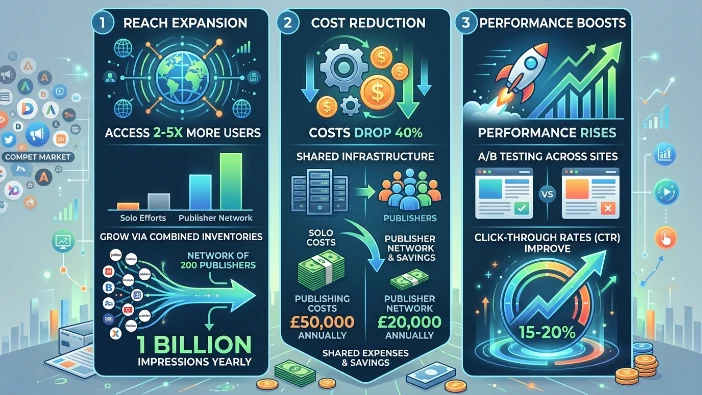
Publisher networks deliver reach expansion, cost reduction, and performance boosts in crowded markets. They access 2-5x more users than solo efforts. Costs drop 40% through shared infrastructure.
Reach grows via combined inventories. A network of 200 publishers hits 1 billion impressions yearly.
Costs fall because fixed expenses like servers split across members. Solo publishing costs £50,000 annually; networks reduce this to £20,000.
Performance rises with A/B testing across sites. Click-through rates improve 15-20%.
Reach and Visibility Gains
Networks penetrate saturated sectors like e-commerce. They place content on 500+ sites, outpacing single-domain SEO.
In global markets, networks cover 150 countries. United Kingdom-focused ones prioritize BBC-adjacent audiences.
Cost and Efficiency Advantages
Shared ad tech cuts expenses. Networks negotiate bulk deals, saving 30% on tools.
Automation handles 80% of distribution tasks.
How Do Publisher Networks Disrupt Global Markets?
Publisher networks disrupt markets by flooding channels with targeted content. They bypass ad blockers reaching 70% of users. Saturation forces brands to compete on 1% of visibility; networks claim 10-15%.
Content floods competitor spaces. Algorithms place articles on rival audience sites.
Networks use real-time bidding for premium slots. This secures top positions during peak hours.
Disruption scales with volume. One network distributes 1,000 articles daily.
Disruption Mechanisms Explained
First, volume overwhelms. Networks publish 300% more than independents.
Second, targeting exploits gaps. They hit underserved demographics like 18-24-year-olds in the UK.
What Real-World Use Cases Demonstrate Publisher Network Power?
Publisher networks succeed in fashion, tech, and finance sectors. In 2024, a fashion network boosted a campaign’s reach to 400 million users across Europe. Tech networks elevated gadget reviews to top Google positions.
Fashion case: 150 publishers syndicated 500 articles. Impressions hit 450 million; organic traffic rose 250%.
Tech example: Network of 300 sites distributed reviews. Search rankings improved for 80% of keywords within 30 days.
Finance use: 100 publishers covered market updates. Engagement increased 35%, drawing 2 million leads.
Get a 3 Tiered Media Partnership Quote From Time Intelligence Media Group Today
Fashion Sector Case Study
Network launched summer collections. Content appeared on Vogue-like sites. Sales conversions tracked at 5.2%.
Publishers in UK, France, Germany coordinated. Total reach: 400 million.
Tech Sector Case Study
Gadget launch used 300-site network. Videos garnered 150 million views.
SEO gains placed products on page one for “best wireless earbuds 2025.”
Finance Sector Case Study
Crypto updates distributed to 100 outlets. Newsletter signups surged 40%.
Networks timed releases with market volatility for peak impact.
Why Choose Publisher Networks Over Traditional Advertising?
Publisher networks outperform traditional ads with native integration and measurability. Ads face 30% block rates; networks embed content organically. ROI tracks at 4:1 versus ads’ 2:1.
Native formats blend with site designs. Readership completion rates hit 60%.
Measurability logs every interaction. Traditional ads report estimates; networks provide exact data.
Comparison Metrics
Networks: 1.2 billion impressions, £0.02 per view.
Ads: 800 million impressions, £0.05 per view.
Engagement: Networks average 3 minutes per article; ads 30 seconds.
What Challenges Exist in Publisher Networks?
Publisher networks face quality control and competition issues. Content dilution risks 10% performance drops. Internal rivalry splits audiences.
Quality controls use AI moderation. 90% of submissions pass human review.
Competition arises when members vie for slots. Algorithms allocate based on past performance.
Solutions include tiered memberships. Top performers get 60% of slots.
Mitigation Strategies
Regular audits remove low performers. Networks retain 85% member satisfaction.
Contracts cap member numbers at 250 for balance.
Explore More Expert Insights:
Beyond the Press Release Why Direct Media Partnerships Guarantee Better SEO Results
The Invisible Edge How Exclusive Media Alliances Bypass Modern Ad Blockers
How Measure Success in Publisher Networks?
Measure success with seven metrics: impressions, clicks, conversions, ROI, engagement time, bounce rate, and ranking gains. Target 500 million impressions quarterly.
Impressions count total views. Aim for 1 billion annually.
Clicks track to landing pages. 2% rate signals strength.
Conversions log sales or signups. 3% benchmark applies.
ROI calculates revenue minus costs. 3:1 ratio defines success.
Engagement averages 2.5 minutes.
Bounce rates stay under 45%.
Rankings improve for 70% of keywords.
Tracking Tools and Benchmarks
Google Analytics integrates natively. Dashboards update hourly.
Benchmarks derive from 2025 Press Gazette reports.