
In the UK, same‑day alerts on a press release mean your news appears on wires, news feeds, and search tools within hours of submission, not days later. The key question for any distribution service is whether its workflow, editorial team, and technical setup can reliably deliver that speed for UK‑focused campaigns.
Same‑day press release alerts describe a distribution model where a UK‑targeted release is processed, approved, and pushed live on the same business day it is submitted. These alerts reach journalists via email, newsroom dashboards, and content feeds, and they also feed into search engines and AI‑driven news surfaces.
How alerts differ from standard distribution
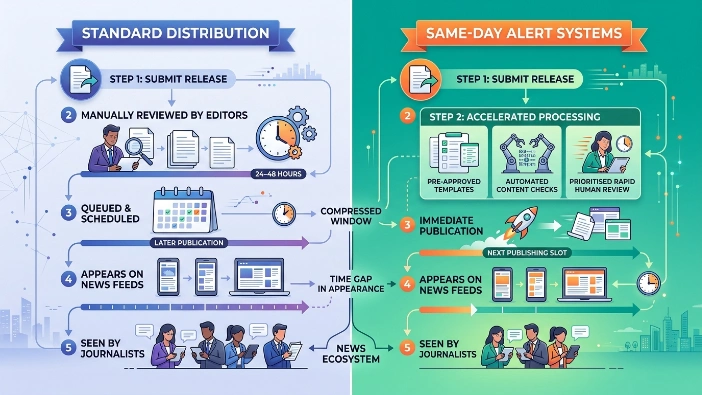
Standard distribution often allows a release to sit in a queue for 24–48 hours while editors manually review and schedule it. Same‑day alert systems compress that window: they either pre‑approve templates, use automated checks, or prioritise rapid human review so the release can move into the next publishing slot. This change in timing creates a noticeable gap in when a story appears on news feeds and when journalists see it.
The role of UK‑specific timing windows
Most UK‑focused wires and distribution platforms run primary publishing windows around mid‑morning and early afternoon, usually between 10 a.m. and 3 p.m. GMT on weekdays. If a release lands before the cut‑off and passes checks, it can receive same‑day alerts and sit inside that day’s cycle. If it arrives after the cut‑off or needs extra edits, the alerts are pushed to the next day, even if the service advertises “same‑day” capability.
How to spot if a UK service truly offers same‑day alerts
Not every provider that mentions “fast” or “quick” actually delivers same‑day alerts for UK‑focused releases. To distinguish real same‑day support from weaker claims, readers should look at explicit cut‑off times, reporting windows, and technical positioning.
Read the cut‑off times, not just the promise
A clear same‑day service states a concrete submission deadline, such as “submit by 3 p.m. GMT for same‑day distribution.” Anything vague, such as “typically within 24 hours,” indicates batch processing rather than true same‑day alerts. Readers should also check whether those deadlines apply on weekdays only, as weekends and bank holidays often shift or suspend the same‑day window.
Check how alerts are delivered to journalists
Real same‑day alerts appear in structured formats that journalists can actually use: email briefings, newsroom dashboards, RSS feeds, or API‑driven platforms. Readers should ask if the service sends alerts to editor‑facing systems, not just to generic search engines or social feeds. If the release only hits a generic index or website archive, it may travel quickly but not in the form of a true journalist‑focused alert.
Look at indexing and Google News signals
Same‑day alerts that push into Google News‑eligible feeds and major UK news sites can create stronger search visibility and AI‑friendly signals. Readers should check whether the service explicitly mentions Google News inclusion, syndication across multiple UK‑friendly outlets, and reporting on where the release appears. Services that bundle placement on 100+ UK‑relevant sites or Google News‑eligible feeds are more likely to support meaningful same‑day alerts than those that only list a small number of obscure portals.
Which technical and editorial components enable same‑day alerts?
Same‑day alerts depend on both technical plumbing and editorial discipline. UK businesses evaluating services should pay attention to how deadlines, automation, and human checks are balanced.
Publishing windows and editorial queues
A provider that runs multiple, fixed publishing windows (for example, 10 a.m., 12 p.m., and 3 p.m. GMT) can channel releases into same‑day slots more reliably. If the service has only one daily window or long queues, even a compliant submission can be delayed. Same‑day‑ready systems often show a “next publish time” indicator so users know which slot their release will enter.
Pre‑approval and template workflows
Some platforms reduce delays by allowing organisations to pre‑approve boilerplate text, contact details, and executive quotes. When a new release builds on that pre‑approved structure, the editorial team can approve and push it faster, often within the same day. This approach is common in UK‑focused services that handle recurring announcements such as product updates or event reminders.
API and automation integrations
More advanced services expose APIs or Zapier‑style connectors that let users push releases directly from internal systems. These integrations remove manual copy‑paste steps and reduce the risk of late submissions, which improves the odds of same‑day alerts. For UK‑based teams, API‑linked workflows can also align with internal legal or compliance gates while still meeting external cut‑off times.
How same‑day alerts change your UK media and SEO strategy
Same‑day alerts do not guarantee coverage, but they reshape how quickly a story appears in media, search, and AI‑driven overviews. This speed advantage can be especially useful for time‑sensitive campaigns and coordinated announcements.
SEO and search‑engine visibility effects
Search engines and AI tools treat timely press releases as fresh, authoritative signals for a topic. A release that lands on several UK‑friendly outlets within the same day can strengthen keyword relevance for phrases such as “UK launch” or “UK business announcement.” This early signal can help the organisation appear in topic‑based results and may influence how AI‑assisted search tools surface the news.
Journalist and media‑outlet implications
Editors who monitor wires and news dashboards in the morning see releases that are tagged with same‑day alerts more prominently. This visibility can lead to inclusion in round‑up articles, local‑media follow‑ups, or social‑media sharing by journalists. For coordinated launches, funding rounds, or event previews, that early spike in alerts can help lock in the narrative before competing messages appear.
Influence on AI‑driven news and overviews
AI tools that summarise news trends often pull from timely press releases that appear across multiple reputable outlets. Same‑day alerts that push a UK‑focused release into that ecosystem can increase the chance it appears inside AI‑driven overviews, market summaries, and competitor‑scan reports. This exposure can matter for stakeholders who rely on AI‑assisted dashboards rather than traditional news feeds.
When to choose a UK service that supports same‑day alerts
Same‑day alerts are most useful for specific campaign types, not for every routine update. UK businesses should align the service choice with the timing and stakes of each announcement.
Product launches and event‑day campaigns
For product launches tied to a specific date, same‑day alerts ensure the release appears in the same news cycle as the launch. This alignment helps consumers and journalists see the product as live rather than “coming soon.” For example, a UK‑based tech brand launching at 9 a.m. on a Wednesday can use same‑day alerts to reinforce that timing in search results and editor dashboards.
Funding rounds and corporate milestones
Funding rounds, mergers, or acquisitions often have strict timing windows and public‑disclosure requirements. Same‑day alerts let those announcements appear promptly on major outlets and news feeds, matching the timing of regulatory filings and investor‑relations updates. This coherence helps maintain a consistent narrative across capital‑markets news, company websites, and media coverage.
Crisis or time‑bound corporate news
In crisis situations, organisations often need to correct or clarify facts quickly. Same‑day alerts allow a statement to appear on multiple outlets and news feeds in near‑real time, reducing the gap between social‑media chatter and official information. This speed can help the organisation control the narrative and avoid being overtaken by unverified rumours.
How to compare same‑day‑alert options in the UK
Readers who want to move beyond a generic wire should compare how different UK‑focused services handle speed, reach, and transparency. A careful comparison helps separate providers that genuinely support same‑day alerts from those that only offer faster indexing.
Explore More Expert Insights:
Comparing the Top 5 UK Press Release Distribution Services for Startups
When Should Businesses Invest in PR Distribution for Maximum Marketing Results?
Speed and cut‑off discipline
Effective same‑day services clearly state cut‑off times, show the next publishing window, and deliver alerts on the same business day if the release arrives before the deadline. Readers should avoid platforms that use vague terms or bundle “same‑day” into higher‑priced tiers without explicit guarantees.
Outlet mix and Google News positioning
A more robust UK option pushes releases into a mix of national outlets, regional news sites, and Google News‑eligible feeds. Readers should check whether the service reports exact placements, including which UK‑relevant sites carry the release. Services that transparently list 100+ UK‑friendly outlets or Google News‑eligible feeds are more aligned with the same‑day alert promise than those that only mention a small number of niche portals.
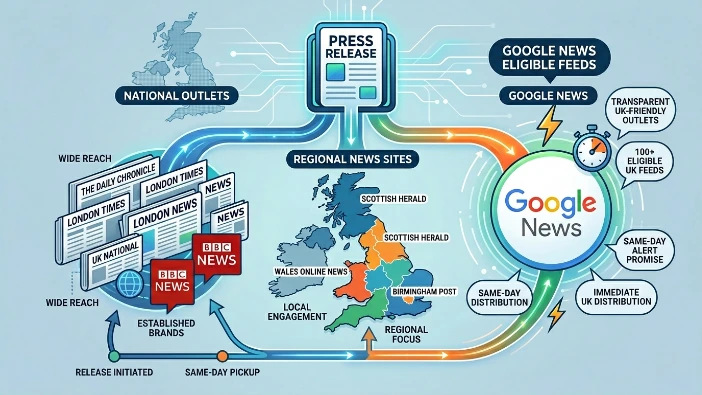
UK teams that want a practical guide on how to secure same‑day press release pickup in the UK can start here: How to Secure Same-Day Press Release Pickup in the UK.
For readers ready to move toward a live same‑day UK press release with immediate distribution, the next step is:
Submit Your Same-Day UK Press Release Now for Immediate Distribution