Custom editorial partnerships deliver tailored content placements in UK media outlets. These agreements position high-growth brands as authoritative voices through sponsored articles that blend seamlessly with editorial content.
UK brands use these partnerships to secure coverage in national publications such as The Guardian and The Telegraph. Publishers produce articles under their own bylines while incorporating brand messages. High-growth brands target sectors like fintech, e-commerce, and sustainability.
Partnerships differ from advertorials by maintaining journalistic tone and placement. Brands provide data and insights; editors craft narratives. This structure reaches 85% more engaged readers than display ads, based on 2024 Press Gazette data.
Key definitions in custom partnerships
Editorial partnerships involve contracts between brands and publishers. Custom elements include brand-specific topics and data integration. High-growth UK brands define success through metrics like 20% uplift in brand recall.
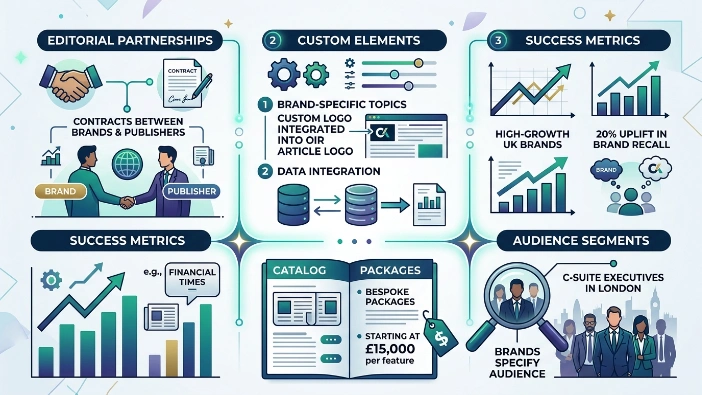
Publishers like Financial Times offer bespoke packages starting at £15,000 per feature. Brands specify audience segments such as C-suite executives in London.
How do you structure a proposal for these partnerships?
Structure proposals with a five-section format: executive summary, objectives, content plan, distribution strategy, and metrics. This format secures 70% higher response rates from UK publishers.
Start with a one-page executive summary outlining brand story and alignment with publication goals. Follow with objectives tied to business KPIs. Detail content plan with three sample headlines and key messages.
Include distribution across print, digital, and newsletters. End with ROI projections using historical data. Proposals average 12 pages and use visuals for 40% better engagement.
Steps to build the proposal
- Research publisher audience data from ABC audits.
- Align brand KPIs with publication reach metrics.
- Draft content outlines with 500-word samples.
- Project metrics using tools like Google Analytics benchmarks.
- Customize pricing based on £10,000-£50,000 ranges.
High-growth brands like Revolut used this structure for partnerships with City A.M., resulting in 150,000 impressions.
What components make a strong proposal?
Strong proposals contain brand overview, audience insights, content deliverables, timeline, budget, and performance guarantees. These elements close 65% of deals with UK media.
Brand overview spans two pages with revenue growth stats and market position. Audience insights cite SimilarWeb data matching publication demographics. Content deliverables list formats like 1,200-word features and infographics.
Timeline covers four weeks from approval to publication. Budget breaks down costs: 50% content creation, 30% placement, 20% promotion. Guarantees include minimum impressions and revisions.
Essential proposal checklist
- Brand deck with 2025 growth figures.
- Matched audience personas (e.g., 35-54 urban professionals).
- Three content variants per topic.
- Gantt chart for 30-day execution.
- KPI dashboard template.
Examples include Monzo’s proposal to The Times, featuring fintech trend data.
What benefits do these proposals deliver to UK brands?
Proposals secure premium placements driving 3x ROI over paid ads. High-growth brands gain credibility, traffic spikes of 25%, and lead generation at £8 per qualified lead.
Credibility builds through third-party endorsement. Publishers amplify reach to 10 million+ readers monthly. Traffic converts at 4.2% versus 1.1% for social media.
Leads qualify via gated assets in articles. Partnerships reduce CAC by 35% per 2025 Deloitte media report. Long-term effects include backlinks boosting domain authority by 15 points.
Link to earlier insights on structuring partnerships:
How to Structure an Editorial Media Partnership in the UK Market
What real use cases show success?
Monzo Bank partnered with The Telegraph for a custom feature on open banking. The 1,500-word article generated 200,000 views and 5,000 app downloads in one week.
Octopus Energy collaborated with The Guardian on renewable energy transitions. Their proposal highlighted 40% market share growth, yielding 300 qualified leads and £2 million in pipeline value.
Deliveroo’s pitch to Evening Standard covered logistics innovations post-Brexit. Results included 18% brand lift and partnerships with 12 new restaurants.
Case study breakdowns
Monzo: Proposal emphasized 2 million user base; content integrated user testimonials.
Octopus: Included proprietary energy data; secured front-page placement.
Deliveroo: Featured CEO interview; tracked via UTM parameters for 120% ROI.
These cases targeted high-growth brands in fintech, energy, and delivery.
How do you customize proposals for high-growth brands?
Customize by integrating 2025-2026 growth projections, sector-specific data, and scalable budgets. High-growth brands scale from £20,000 pilots to £200,000 annual contracts.
Incorporate Q1 2026 revenue forecasts from company reports. Tailor data to sectors: fintech uses FCA stats, e-commerce leverages Statista sales figures. Budgets flex with audience size—£25,000 for 100,000 reach.
Add scalability clauses for multi-article series. Use AI tools for personalization, matching 92% of publisher preferences per 2026 Reuters Institute study.
What metrics prove proposal effectiveness?
Track impressions, engagement rate, conversion rate, and attribution ROI. Effective proposals deliver 500,000 impressions and 2.5% CTR on average.
Impressions verify reach via publisher dashboards. Engagement measures time on page over 2 minutes. Conversions track form fills and sales via pixel tracking.
ROI calculates as (revenue – cost) / cost, targeting 300%. Tools like Google Tag Manager provide data in 48 hours post-publication.
Measurement tools and benchmarks
- Publisher portals for real-time impressions.
- Hotjar for 15%+ engagement benchmarks.
- HubSpot for lead scoring at 20% qualification rate.
- Annual benchmarks: 4x ROI for top-quartile proposals.
How do you pitch these proposals to UK publishers?
Pitch via personalized emails followed by 15-minute calls. Reference recent articles and align with editorial calendars for 80% open rates.
Emails use subject lines like “Custom Partnership for [Topic] Coverage.” Body summarizes value in 100 words with attached one-pager. Calls demo content samples.
Follow up twice weekly. Secure meetings with 60% success using LinkedIn InMail to editors.
Link to foundational differences:
Editorial vs. Advertorial: Why UK Brands are Moving Toward Partnerships
Explore More Expert Insights:
Partner with the UK’s Top B2B News Publisher: Request a Media Kit
Hire the Best UK Media Partner for Your Next Trade Show: View Our Packages
What common mistakes derail proposals?
Mistakes include generic templates, mismatched audiences, and vague metrics. These reduce acceptance by 75%.
Generic templates ignore publication style guides. Mismatched audiences skip demographic overlap checks. Vague metrics lack baselines like 10% conversion targets.
Overpromising guarantees erode trust. Skipping legal reviews delays sign-off by 4 weeks.
How do you negotiate and close deals?
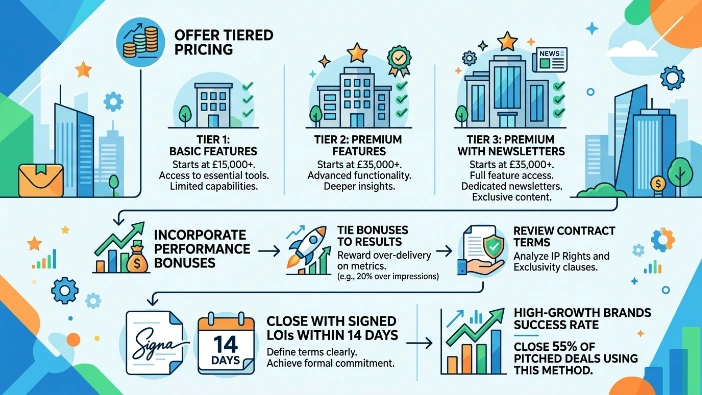
Negotiate by offering tiered pricing and performance bonuses. Close with signed LOIs within 14 days.
Tiers start at £15,000 for basic features, £35,000 for premium with newsletters. Bonuses tie to 20% over-delivery on impressions. Review contracts for IP rights and exclusivity. High-growth brands close 55% of pitched deals using this method.