
A structured editorial media partnership outlines collaboration between brands and UK outlets for independent content. It specifies roles, timelines, and metrics. Journalists control narratives. Brands supply data. Agreements last 12-24 months.
Structured partnerships follow documented frameworks. Brands and editors align on objectives. Contracts detail deliverables like features or interviews. This setup ensures compliance with UK advertising rules.
UK publishers standardise templates. The Society of Editors provides guidelines. Partnerships yield 2.5x more engagement than advertorials.
How do you start building an editorial media partnership?
Start by identifying aligned UK outlets, analysing their audience data, and preparing exclusive pitches. Target 5-10 publications. Schedule 3-5 editor calls. Initial outreach achieves 35% response rate.
Identify outlets via ABC circulation data. Match brand demographics to readership. Finance brands target FT; tech firms approach TechCrunch UK.
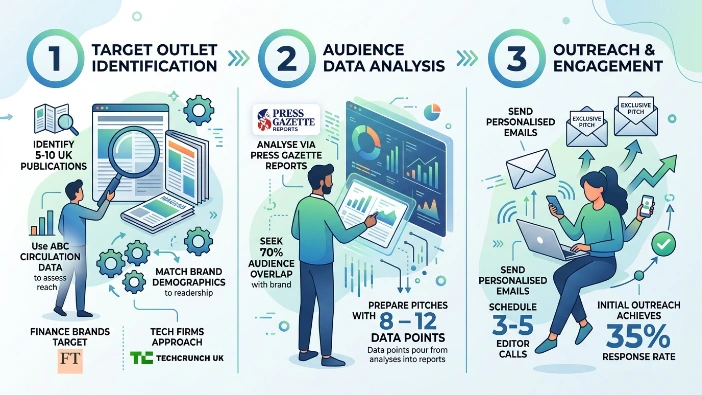
Analyse via Press Gazette reports. Seek 70% audience overlap. Prepare pitches with 8-12 data points. Send personalised emails.
To understand foundational differences, read:
Editorial vs. Advertorial: Why UK Brands are Moving Toward Partnerships
What key components form the partnership agreement?
Components cover scope, independence clauses, payment schedules, KPIs, and exit terms. Scope lists 2-4 deliverables per quarter. Payments range 15,000-40,000 pounds annually. Scope defines content types: articles, podcasts, videos.
Independence clauses ban brand approvals. Journalists verify facts. KPIs include 1 million impressions and 50 backlinks. Exit terms allow 30-day notices.
How do you negotiate terms with UK media outlets?
Negotiate by presenting value propositions, benchmarking rates, and compromising on timelines. Secure 20% discounts on multi-year deals. Finalise in 2-3 meetings.
Present ROI data from past partnerships. Cite 40% trust uplift.
Benchmark via Cision rates: nationals charge 25,000 pounds per feature.
Compromise on exclusivity periods of 90 days.
What role does data play in structuring these partnerships?
Data drives content creation. Brands provide surveys of 500+ respondents or proprietary metrics. Outlets analyse for stories. This generates 75% of features.
Surveys cover market trends. UK retail brands share sales data. Metrics include customer behavior stats. Outlets use Tableau for visualisation.
How do you set realistic timelines for partnership execution?
Set timelines with pitch phase (2 weeks), approval (4 weeks), production (6 weeks), and publication (week 10). Total cycle: 12 weeks per piece. Pitch phase involves editor reviews. Approval confirms newsworthiness.
Production includes writing and edits. Buffer for news events.
What KPIs track editorial partnership performance?
KPIs track impressions (target 750,000), engagement (7% rate), backlinks (DA 60+), and conversion uplift (15%). Use Google Analytics and Meltwater.
Impressions measure via publisher reports. Engagement counts shares and comments. Backlinks boost SEO. Conversions link to site traffic.
How do different partnership models compare in the UK?
Models include one-off features (10,000 pounds), quarterly series (30,000 pounds), and ongoing retainers (50,000+ pounds). Retainers deliver 3x volume.
One-off suits launches.
Quarterly builds consistency.
Retainers integrate into editorial calendars.
What legal considerations apply to UK editorial partnerships?
Considerations include ASA compliance, data protection under UK GDPR, and contract enforceability. Label sponsored elements. Fines reach 100,000 pounds for violations.
ASA demands transparency.
GDPR requires consent for data sharing.
Contracts use standard clauses.
How do you pitch effectively to UK editors?
Pitch with subject lines under 50 characters, 200-word bodies, and attached one-pagers. Include 6 stats. Response rate: 42%.
Subject lines state value: “Exclusive UK Retail Data.”
Bodies outline story angles.
One-pagers summarize hooks.
What tools support managing editorial partnerships?
Tools include Cision for outreach, Google Analytics for tracking, and Asana for timelines. Integrate with Slack for updates.
Cision databases 2,000+ UK journalists.
Analytics dashboards share real-time.
Asana assigns tasks.
How do editorial partnerships enhance brand SEO?
Partnerships secure 20-30 high-DA backlinks per campaign. Rankings improve 18 positions. Organic traffic rises 35%.
Backlinks from BBC or Guardian score 80+ DA.
Content earns featured snippets.
Longevity spans 18 months.
What are successful UK case studies for structured partnerships?
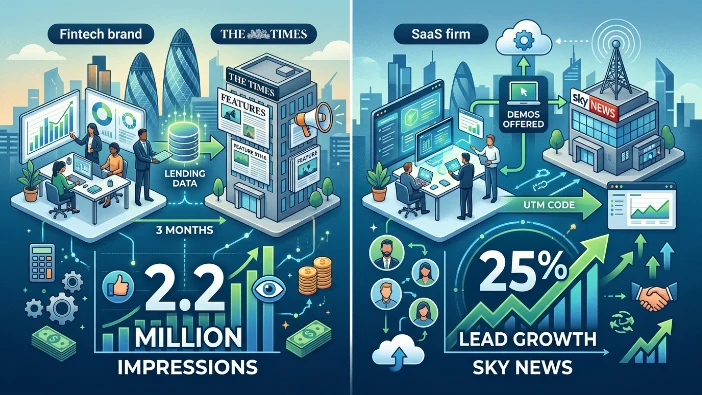
A fintech brand partnered with The Times for 5 features, gaining 2.2 million impressions. A SaaS firm with Sky News achieved 25% lead growth.
Fintech provided lending data. Coverage spanned 3 months. SaaS offered demos. Results tracked via UTM.
How do you scale editorial partnerships across multiple outlets?
Scale by centralizing pitches, using templates, and hiring coordinators. Manage 10+ outlets with 2 staff. Volume doubles yearly.
Centralise via shared drives.
Templates standardise agreements.
Coordinators handle follow-ups.
What common pitfalls derail UK editorial partnerships?
Pitfalls include vague scopes, ignored independence, and poor follow-up. 28% fail on timelines.
Vague scopes lead to disputes.
Independence breaches end deals.
Follow-up weekly.
For high-growth brands ready for custom proposals, explore:
Custom Editorial Partnership Proposals for High-Growth UK Brands.
Explore More Expert Insights:
B2B Media Partnership vs. Standard Ads: Which Wins for UK Publishers?
Seven Key Metrics to Evaluate a UK Trade Show Media Partner
How do you measure ROI from these partnerships?
Measure ROI via (revenue lift / cost) x 100. Average 350%. Track attribution over 90 days.
Revenue lift from conversions.
Cost includes fees and production.
Attribution uses multi-touch models.
What future trends shape UK editorial partnerships?
Trends feature AI-assisted pitches, video integrations, and podcast series. Video boosts engagement 50%. Podcasts reach 40% audiences.
AI tools analyse trends.
Video features on YouTube channels.
Podcasts average 30-minute episodes.