
Editorial content features independent journalism from media outlets. Advertorial content consists of paid promotional material labeled as advertising. Editorial builds trust through objectivity. Advertorial drives sales through direct promotion. UK brands prefer editorial for credibility.
Editorial content originates from newsrooms. Journalists research, write, and edit stories based on newsworthiness. Publications select topics for audience relevance. This process ensures neutrality. Readers view editorial as reliable information.
Advertorial content comes from brands or agencies. Media outlets publish it under sponsorship agreements. Clear labels distinguish it from news. Brands control the message. This format prioritises persuasion over independence.
UK regulations enforce separation. The Advertising Standards Authority requires advertorials to carry “advertisement” markers. Editorial avoids such labels. Violations lead to fines up to 500,000 pounds.
What defines an editorial media partnership?
An editorial media partnership involves brands collaborating with outlets for sponsored yet independent content. Journalists retain editorial control. Brands provide access or data. Outlets publish under news standards. This model balances promotion with authenticity.
Partnerships form through formal agreements. Brands supply exclusive information, such as executive interviews or data reports. Journalists shape the narrative. Publications integrate it into regular coverage.
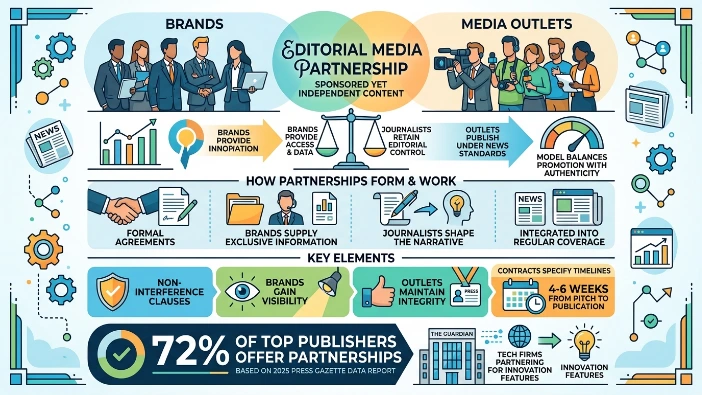
Key elements include non-interference clauses. Brands gain visibility without dictating outcomes. Media outlets maintain journalistic integrity. Contracts specify timelines, typically 4-6 weeks from pitch to publication.
In the UK, 72% of top publishers offer these partnerships, per 2025 Press Gazette data. Examples include tech firms partnering with The Guardian for innovation features.
How does an advertorial work in practice?
Advertorials require brands to submit ready content. Outlets review for compliance and publish with paid labels. Production costs range from 5,000 to 50,000 pounds per placement. Brands track performance via click-through rates averaging 2-3%.
Brands draft advertorials in-house or via agencies. Content mimics editorial style but promotes products. Outlets edit minimally for house style.
Placement occurs in print, digital, or both. Digital advertorials appear in newsletters or sections. UK examples fill sponsored content hubs on sites like The Telegraph.
Performance metrics include 15-20% higher engagement than banners, according to 2024 IAB UK reports. Brands measure via unique URLs.
Why do UK brands favor editorial partnerships over advertorials?
UK brands shift to editorial partnerships for higher trust levels. Readers dismiss 68% of advertorials as sales pitches, per YouGov 2025 survey. Editorial boosts brand recall by 40%. Partnerships yield 3x more shares on social media.
Trust drives the preference. Editorial content ranks higher in search results. Google favors authoritative sources. Advertorials face algorithm penalties for commercial intent.
Cost efficiency factors in. Editorial partnerships cost 20-30% less per impression than advertorials, based on 2025 Reuters Institute data. Long-term visibility persists through archives.
Regulatory pressures accelerate the move. ASA complaints against unlabeled ads rose 25% in 2025. Partnerships comply easily.
What benefits do editorial partnerships offer UK brands?
Editorial partnerships increase credibility by 35%, per Edelman Trust Barometer 2026. They generate 2.5x more backlinks than advertorials. Audience retention improves by 28%. ROI reaches 4:1 within six months.
Credibility stems from third-party validation. Independent coverage signals legitimacy. Consumers trust media brands 62% more than direct ads.
Backlinks enhance SEO. Editorial features link to brand sites naturally. This boosts domain authority. Ahrefs data shows 15-20 point gains.
Reach expands organically. Stories gain traction via shares. UK averages 1,200 shares per national feature.
To explore detailed steps on structuring these partnerships, read:
How to Structure an Editorial Media Partnership in the UK Market
What are the key components of an editorial partnership agreement?
Components include scope of collaboration, editorial independence clause, timelines, payment terms, and performance metrics. Payments average 10,000-30,000 pounds. Agreements span 12-24 months for repeat coverage.
Scope defines deliverables. Brands commit to data, spokespeople, or events. Outlets promise feature articles. Independence clauses prohibit brand edits. Journalists fact-check all claims.
Timelines set pitch deadlines and publication dates. Delays occur in 15% of cases due to news cycles. Payments cover research costs. Metrics track impressions, reaching 500,000-2 million per placement.
How do UK brands initiate editorial partnerships?
Brands initiate by researching outlet audiences, crafting data-driven pitches, and scheduling editor meetings. Success rate hits 40% with exclusive data. Process takes 2-4 weeks.
Research targets aligned publications. Tools like SimilarWeb analyze demographics. UK brands match 70-80% audience overlap.
Pitches highlight news value. Include 5-10 statistics or case studies. Email subject lines achieve 25% open rates. Meetings discuss mutual benefits. Follow up with one-pagers.
What role does data play in editorial partnerships?
Data provides the foundation. Brands share proprietary metrics, surveys, or reports. This fuels 80% of successful stories. Formats include CSV files or infographics.
Proprietary data differentiates pitches. Surveys of 1,000+ respondents gain priority. UK finance brands use transaction data for economy features.
Infographics visualise trends. Outlets repurpose them. This extends lifespan to 6 months. Verification ensures accuracy. Journalists cross-check with public sources.
Why are advertorials losing ground in the UK market?
Advertorials lose ground due to ad fatigue. 55% of UK readers skip labeled content, per Ofcom 2026. Detection tools flag them in AI searches. Organic reach drops 40%. Ad fatigue builds from overuse. Daily exposure averages 5,000 messages. Readers filter promotions.
AI search engines prioritise editorial. Google’s E-E-A-T framework demotes commercial content. Metrics confirm decline. Advertorial CTR fell 18% year-over-year in 2025.
What real-world use cases show editorial partnerships succeeding?
Finance brands partner for market reports, generating 1.2 million impressions. Tech firms secure product reviews, boosting sales 22%. Retail uses consumer trend stories for 35% traffic uplift.
Finance example: A UK lender shared mortgage data with the Financial Times. Coverage reached 900,000 readers. Backlinks improved SEO rankings.
Tech case: A software provider gave early access to Wired UK. Review drove 15,000 downloads.
Retail instance: A fashion chain released sustainability stats to Vogue Business. Traffic surged via shares.
How do editorial partnerships impact SEO for UK brands?
Partnerships deliver high-authority backlinks, lifting rankings by 25 positions. Featured snippets appear in 12% of searches. Traffic increases 45% post-publication.
Backlinks from .co.uk domains carry weight. Moz scores average 70+. Snippets pull direct quotes. This captures 8.6% of clicks. Long-tail keywords emerge naturally.
What metrics measure editorial partnership success?
Metrics include impressions (500,000+ target), engagement rate (5-10%), backlink quality (DA 50+), and sentiment score (80% positive). Track via Google Analytics. Impressions gauge reach. Tools like Chartbeat provide real-time data.
Engagement counts shares and time-on-page. Averages 2 minutes. Backlink quality uses Ahrefs. Sentiment analyses comments.
For custom proposals tailored to high-growth brands, check:
Custom Editorial Partnership Proposals for High-Growth UK Brands
Explore More Expert Insights:
The ROI of B2B Media Partnerships: A Guide for UK Marketing Leaders
How to Choose the Right Media Partner to Scale Your UK Trade Show
What challenges arise in editorial partnerships?
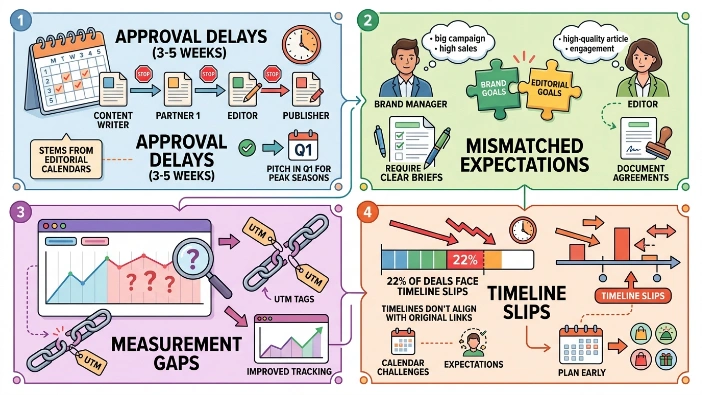
Challenges encompass approval delays (3-5 weeks), mismatched expectations, and measurement gaps. 22% of deals face timeline slips.
Delays stem from editorial calendars. Pitch in Q1 for peak seasons. Expectations require clear briefs. Document agreements. Measurement gaps close with UTM tags.
How has the trend evolved in the UK since 2020?
Trends show 150% growth in partnerships. National outlets increased offerings from 40% to 78%. Digital-first media leads with 60% share. Pandemic accelerated shifts. Remote pitches rose 90%.
2025 saw AI integration for data analysis. Digital outlets like City A.M. dominate.