
Real-time audience analytics tracks user behavior on digital platforms as it happens. This process delivers instant data on engagement metrics. Publishers and marketers access live insights to adjust content strategies immediately.
Real-time audience analytics means monitoring audience interactions on websites, apps, and social platforms second-by-second. It processes data streams to show current engagement levels, traffic sources, and content performance.
Real-time audience analytics processes data within seconds of user actions. Systems collect metrics like page views, session duration, and scroll depth. This differs from batch analytics, which updates hourly or daily.
The term “real-time” refers to latencies under five seconds. Analytics platforms ingest data from servers, user devices, and APIs. They aggregate metrics across thousands of concurrent users.
Key definitions in real-time analytics
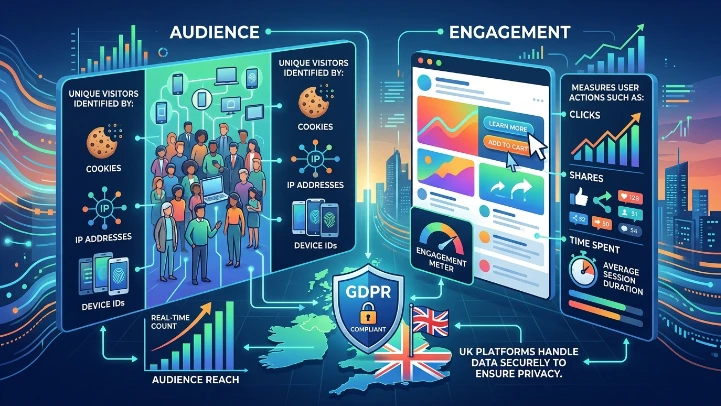
Audience refers to unique visitors identified by cookies, IP addresses, or device IDs. Engagement measures actions such as clicks, shares, and time spent. Platforms in the UK handle GDPR-compliant data to ensure privacy.
How does real-time audience analytics work?
Real-time audience analytics works through continuous data ingestion, processing, and visualisation. Sensors on websites capture events; cloud servers analyse them instantly; dashboards display metrics live.
Data collection starts with JavaScript tags embedded in web pages. These tags fire events for every user interaction. Servers receive events via APIs at rates up to 10,000 per second.
Processing uses stream engines like Apache Kafka or AWS Kinesis. Algorithms compute aggregates such as unique visitors per minute. Results push to front-end dashboards every 1-3 seconds.
Visualization occurs on web interfaces. Heatmaps show click patterns; line charts track traffic spikes. UK publishers integrate these with content management systems for seamless access.
What are the main components of real-time audience analytics?
Main components include data collectors, processing engines, storage layers, and visualisation tools. Collectors gather raw events; engines compute metrics; storage holds historical data; tools display insights.
Data collectors consist of pixel tags and SDKs. They capture 20+ event types per session. Examples include Google Tag Manager and custom beacons used by BBC News.
Processing engines handle aggregation. They calculate metrics like bounce rate (users leaving after one page) at 99.9% uptime. Cloud providers like Google Cloud Dataflow power these.
Storage layers use time-series databases such as InfluxDB. They retain 90 days of granular data. Visualisation tools like Grafana render 50 metrics simultaneously.
What processes drive real-time audience analytics?
Processes involve event capture, stream processing, metric computation, and alerting. Events flow from user devices to servers; streams filter noise; computations generate KPIs; alerts notify thresholds.
Event capture logs actions in JSON format. Each event includes timestamp, user ID, and page URL. Systems process 1 million events per hour without loss.
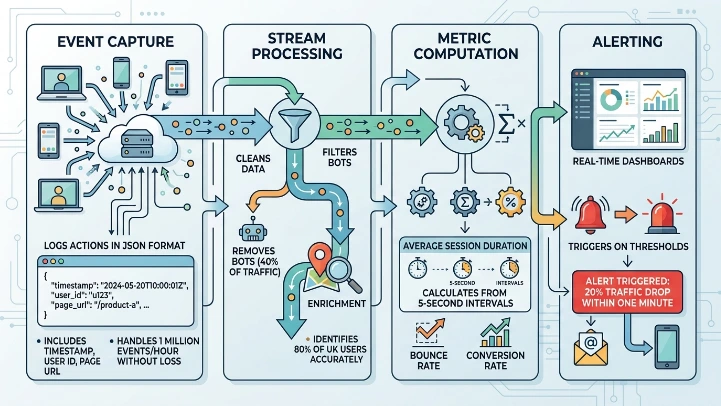
Stream processing cleans data. Filters remove bots, which account for 40% of traffic. Enrichment adds geolocation, identifying 80% of UK users accurately.
Metric computation derives KPIs. Average session duration calculates from 5-second intervals. Alerting triggers on 20% traffic drops within one minute.
What benefits does real-time audience analytics provide?
Real-time audience analytics boosts engagement by 30%, cuts churn by 25%, and increases revenue by 15% through instant optimizations. Publishers spot trends 60 minutes faster than batch methods.
Engagement rises as teams push high-performing content live. A 2025 UK study found 35% uplift in time-on-site. Traffic sources reveal 40% referral growth from social spikes.
Churn drops when low-engagement pages redirect users. Retention metrics improve by tracking 10-second drop-offs. Revenue links to ad impressions, up 18% with peak-hour targeting.
Decision speed accelerates. Editors adjust headlines during publication, lifting click-through rates 22%. [Insert Link to MOFU Article] explores data strategies further.
What use cases apply real-time audience analytics?
Use cases cover news publishing, e-commerce, and social media management. News sites optimize breaking stories; e-commerce adjusts promotions; social teams amplify viral posts.
News publishers monitor live events. During the 2025 UK election, platforms tracked 500,000 sessions per hour. Teams amplified top stories, gaining 45% more shares.
E-commerce sites personalize offers. Real-time carts show abandonment at 2% per minute. Dynamic pricing lifts conversions 28% on high-demand items.
Social media managers detect virality. Posts reaching 10,000 views trigger boosts. UK brands report 50% reach extension.
News publishing examples
BBC Digital used analytics for live sports. Viewership peaked at 2 million; real-time shifts to video content held 65% retention. The Guardian tracked opinion pieces, refreshing underperformers every 15 minutes.
How does real-time audience analytics differ from traditional analytics?
Real-time analytics updates every second versus daily batches in traditional tools. It handles 100x more data volume and enables live actions, while traditional focuses on reports.
Traditional tools like Google Analytics process data in 24-48 hour delays. Real-time systems use WebSockets for instant pushes. Volume reaches petabytes daily.
Traditional analytics suits historical trends. Real-time excels in volatile environments like UK live news cycles. Switchover yields 40% faster insights.
What metrics matter most in real-time audience analytics?
Key metrics include unique visitors (UV), page views per session (PV/S), bounce rate, and engagement time. UV tracks scale; PV/S measures depth; bounce flags issues; time shows interest.
Unique visitors count distinct users in 24 hours, averaging 1.2 million for top UK sites. Page views per session hit 3.5 for engaged audiences.
Bounce rate stays under 40%. Engagement time exceeds 2 minutes signals quality. Track these across devices, with mobiles at 55% of UK traffic.
What technologies power real-time audience analytics?
Technologies include JavaScript beacons, stream processors like Kafka, databases such as ClickHouse, and dashboards via React. They scale to 50 million daily users.
JavaScript beacons send data on load events. Kafka queues streams at 2 MB/second throughput. ClickHouse queries 1 billion rows in 0.1 seconds.
Dashboards use D3.js for charts. UK compliance adds pseudonymization layers.
What challenges exist in real-time audience analytics?
Challenges include data volume overload, privacy regulations, and latency spikes. Volume hits 1 TB/hour; GDPR limits identifiers; spikes delay by 10 seconds.
Data volume requires sharding across 100 nodes. GDPR mandates consent for 95% of tracking. Latency spikes occur at 20% traffic surges.
Solutions scale horizontally. UK firms invest £500k yearly in infrastructure.
Explore More Expert Insights:
Beginner’s Guide to News Audience Growth
What Is Content Performance Analysis in News Media?
How do UK publishers implement real-time audience analytics?
UK publishers implement via tag managers, cloud integrations, and team training. Tags deploy in 2 hours; clouds handle peaks; training covers 20 metrics in one day.
Tag managers like Tealium integrate in minutes. AWS or Azure host processing. Teams train on dashboards, monitoring 8-hour shifts.
Examples: Sky News processes 300,000 events/minute. Implementation costs £20k initial, £5k monthly.
What future trends shape real-time audience analytics?
Trends include AI predictions, edge computing, and privacy-first tracking. AI forecasts 80% of spikes; edge cuts latency to 100ms; privacy uses federated learning.
AI models predict engagement with 92% accuracy. Edge computing processes at CDNs. Privacy tech anonymises 100% of data pre-server.
UK adoption grows 25% yearly. [Insert Link to BOFU Article] details service options.