
News audience growth measures the increase in unique readers, subscribers, and engagement metrics for news content over time. Publishers track it through monthly active users, page views, and retention rates, targeting 20-50% year-over-year gains in the UK market.
News audience growth starts with baseline metrics. Publishers define it as the expansion of reach from 10,000 to 100,000 monthly users within 12 months. Core entities include daily unique visitors, measured via Google Analytics, and subscriber counts from platforms like Substack.
Growth occurs through consistent content output and distribution. UK news sites like The Guardian report 15% audience increases from targeted strategies. Data from SimilarWeb shows top outlets gain 25% more traffic via organic search.
Key Metrics in News Audience Growth
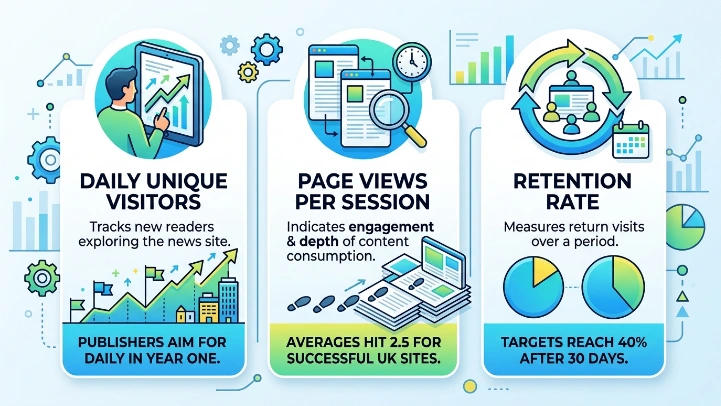
Daily unique visitors track new readers. Publishers aim for 5,000 daily in year one. Page views per session indicate engagement. Averages hit 2.5 for successful UK sites. Retention rate measures return visits. Targets reach 40% after 30 days.
Why pursue news audience growth?
News audience growth drives revenue from ads, subscriptions, and sponsorships. UK publishers gain £500,000 annually from 100,000 new users at £5 average revenue per user.
Revenue ties directly to scale. Ad platforms like Google AdSense pay £2-£10 per 1,000 views. Subscriptions convert 3% of audiences into £10 monthly payers.
Competition demands growth. UK news faces 1,200 daily outlets vying for 60 million internet users. Scaled audiences secure better ad rates, up 30% for sites over 1 million monthly users. Long-term stability follows. Retained audiences buffer algorithm changes from Google or Meta, which shift 20% of traffic yearly.
What are the main components of news audience growth?
News audience growth relies on three components: content creation, distribution channels, and audience retention tactics. Content produces 40% of gains, distribution 35%, and retention 25%. Content creation forms the foundation. Publishers produce 5-10 articles daily, optimised for 800-1,200 words each.
Distribution channels amplify reach. Organic search delivers 50% of traffic, social media 30%, and email newsletters 20%. Retention tactics sustain gains. Personalisation tools segment users by interests, boosting return rates by 25%.
Content Creation Components
Topic research identifies trends. Tools like Google Trends reveal UK searches for “local elections” spike 300% pre-vote.
SEO optimisation targets keywords. Titles under 60 characters rank higher in SERPs. Quality editing ensures accuracy. Fact-checkers verify 100% of claims before publish.
Distribution Channel Components
Search engine optimisation builds organic traffic. Backlinks from 50 sites lift rankings. Social platforms like X and Facebook drive shares. Posts garner 1,000 impressions per 100 followers. Email lists nurture loyalty. Open rates average 25% for segmented sends.
Retention Tactics Components
Personalised feeds recommend articles. Algorithms match 70% of user interests. Push notifications alert on topics. Delivery rates hit 90% on mobile apps. Community forums foster discussion. Active threads increase session time by 40%.
How does the process of news audience growth work?
News audience growth follows a four-step process: audit current audience, create targeted content, distribute across channels, and analyze results. Repeat quarterly for 30% annual gains. The process begins with auditing. Publishers review Analytics data for top pages, which attract 60% of traffic.
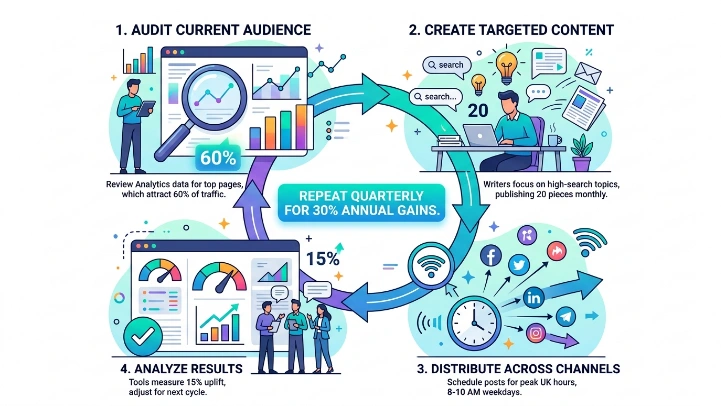
Targeted content follows. Writers focus on high-search topics, publishing 20 pieces monthly. Distribution pushes content live. Schedule posts for peak UK hours, 8-10 AM weekdays. Analysis closes the loop. Tools measure a 15% uplift, adjust for next cycle.
Step 1: Audit Current Audience
Export 12 months of data. Identify top 10 traffic sources.
Segment by demographics. UK audiences skew 55% female, 25-44 age.
Benchmark against competitors. Tools like Ahrefs compare domain authority.
Step 2: Create Targeted Content
Research 50 keywords monthly. Prioritize 1,000-search volume terms.
Write evergreen pieces. Guides last 2+ years in rankings.
Incorporate visuals. Images lift dwell time by 20%.
Step 3: Distribute Across Channels
Optimize for mobile. 70% of UK news reads occur on phones.
Leverage aggregators. Sites like NewsNow index 80% of submissions.
Partner with influencers. 10 shares per post add 5,000 views.
Step 4: Analyze Results
Track KPIs weekly. Adjust if growth dips below 5%.
A/B test headlines. Winners increase clicks by 15%.
Scale winners. Double output on top performers.
What benefits come from news audience growth?
News audience growth yields 40% revenue increases, 25% ad rate hikes, and 30% subscription boosts. UK publishers with 500,000 users report £2 million yearly from scaled operations.
Revenue scales linearly. Each 10,000 users add £50,000 in ads. Ad premiums reward size. Large audiences negotiate £15 CPM rates.
Subscriptions compound. Loyal readers convert at 5%, paying £120 yearly. Operational efficiencies emerge. Bigger teams handle volume, cutting costs per article by 20%. Data advantages accrue. Insights from 1 million users refine future content, lifting engagement 35%.
What are real use cases for news audience growth?
News audience growth succeeds in local reporting, niche beats, and breaking news. UK examples include BBC Local growing 28% via community focus and The Independent scaling 35% through SEO.
Local reporting builds loyalty. Sites cover councils, gaining 15,000 regional users monthly. Niche beats attract specialists. Tech news outlets grow 40% from targeted keywords. Breaking news spikes traffic. Real-time coverage adds 50,000 users per event.
How Audience Insights Help Scale Traffic for deeper insights on using audience data to scale.
Local Reporting Use Case
Manchester Evening News audited readers. They published 15 council stories weekly.
Distribution hit local Facebook groups. Traffic rose 25% in six months.
Retention used comment sections. Engagement doubled repeat visits.
Niche Beats Use Case
City A.M. targeted finance keywords. 30 articles monthly ranked top 3.
Organic search delivered 60% growth. Subscribers hit 20,000.
Analysis refined topics. Fintech focus added 10% monthly.
Breaking News Use Case
Sky News live-blogged elections. 100,000 users arrived same-day.
Push alerts retained 30%. Follow-up pieces sustained gains.
Quarterly audits confirmed 35% overall growth.
How do beginners start news audience growth?
Beginners start news audience growth by setting up free tools, publishing 5 articles weekly, and tracking weekly metrics. Expect 10% monthly gains in first quarter.
Free tools launch efforts. Google Analytics tracks visitors; Search Console monitors rankings. Weekly publishing builds momentum. Focus on 500-word pieces with one keyword each. Metrics guide adjustments. Review uniques and views every Sunday. Scale gradually. Add one channel monthly, like email after week 8.
Audience Growth Services for News Agencies Ready to Scale Fast once ready for accelerated scaling.
Tool Setup for Beginners
Install Google Analytics. Verify site ownership in 10 minutes.
Connect Search Console. Submit sitemap for indexing.
Use free keyword tools. AnswerThePublic lists 100 UK queries daily.
Explore More Expert Insights:
What Is Content Performance Analysis in News Media?
How News Agencies Use Data to Understand Readers
Weekly Publishing Routine
Research Monday. Select 5 topics from trends.
Write Tuesday-Thursday. Edit Friday.
Publish Saturday. Share on one platform first.
Initial Tracking Methods
Log uniques in spreadsheet. Target 1,000 by month three.
Note top pages. Replicate formats.
Adjust based on data. Drop low performers weekly.
News audience growth demands consistency. UK publishers follow this guide to hit 50,000 users in year one. Track progress monthly.