
Sponsored content consists of paid articles or media features that brands create with publishers. Publishers label these pieces as sponsored or advertorial to distinguish them from editorial content. In London media, sponsored content appears in newspapers, online news sites, and magazines. It integrates brand messages into formats that mimic news stories. The Advertising Standards Authority (ASA) requires clear disclosure of sponsorship.
London publishers produced 1,247 sponsored content pieces in 2024 across major outlets. These pieces generate 25% higher engagement than display ads, according to a 2025 Press Gazette report. Sponsored content reaches audiences who trust the host publication.
Definition in the UK Context
Sponsored content falls under native advertising. Native advertising matches the form and function of the platform it appears on. The UK defines it in the CAP Code, which mandates transparency. Publishers use labels like “Sponsored” or “Partner Content” at the top and bottom of articles.
Key Differences from Editorial Content

Editorial content reflects a publication’s independent journalism. Sponsored content originates from the sponsor’s input. Editors review sponsored content for compliance but do not control the message. This separation maintains journalistic integrity.
How does sponsored content work in London media?
Publishers and brands collaborate through a structured process. The process starts with a pitch and ends with publication. London media outlets handle 15-20% of their revenue from sponsored content in 2025 data from the News Media Association.
Brands select outlets based on audience reach. Negotiations set content guidelines and fees. Production involves writers from the brand or agency. Final approval ensures brand standards and publisher compliance.
Step-by-Step Process
Brands identify goals and target audiences first. They research London publications with matching demographics. Pitches outline content ideas aligned with editorial calendars. Publishers respond with rates, typically £5,000 to £50,000 per article based on circulation.
Content creation follows briefs. Publishers provide style guides. Review cycles include two to three rounds of edits. Publication occurs on agreed dates, often tied to news cycles. Post-publication analytics track views and shares.
Role of Regulations
The ASA enforces rules on misleading claims. Sponsored content must not editorialize. Publishers train teams on compliance. Violations lead to fines up to £100,000.
What are the main components of sponsored content?
Sponsored content includes headlines, body text, images, and calls to action. Each component serves a purpose in delivery. London examples feature 800-1,200 word articles with high-resolution visuals.
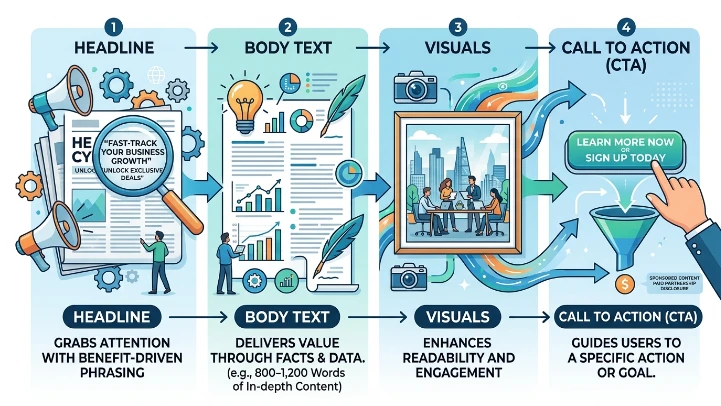
Headlines grab attention with benefit-driven phrasing. Body text delivers value through facts and data. Visuals enhance readability. Disclosures ensure transparency.
Essential Structural Elements
- Headlines: 60-80 characters, keyword-optimized for search.
- Introduction: Hooks readers in the first 100 words.
- Body: Three to five sections with subheads.
- Visuals: Two to four images or infographics.
- Disclosure: “Sponsored by [Brand]” in 14-point font.
- CTA: Links to brand sites without hard sells.
Content Creation Tools
Writers use data from sources like Statista or ONS for credibility. Tools include Canva for visuals and Grammarly for edits. Publishers integrate SEO tools like Ahrefs for keyword research.
What benefits does sponsored content offer in London media?
Sponsored content drives brand awareness and leads. It achieves 3.5 times more engagement than banners, per a 2024 Sharethrough study. London audiences, numbering 9.3 million daily news consumers, respond to trusted formats.
Benefits include audience trust transfer from the publisher. Metrics show 52% higher recall rates. Costs per thousand impressions average £20-£40, lower than TV ads.
Audience Reach and Engagement
London media reaches 68% of adults weekly via print and digital. Sponsored content boosts time-on-page by 37%. Shares increase by 22% compared to standard ads.
Measurable ROI Metrics
Track impressions, clicks, and conversions. Tools like Google Analytics report 18% average click-through rates. Lifetime value calculations show £4 return per £1 spent over six months.
What are real use cases for sponsored content in London?
Use cases span industries like finance, tech, and consumer goods. In 2025, 312 finance brands used sponsored content in London outlets. Tech firms published 189 pieces on innovation topics.
Finance brands educate on services. Tech companies showcase products. Retailers promote seasonal campaigns.
Finance Sector Examples
A bank published a guide on sustainable investing in a national newspaper. The piece garnered 250,000 views and 5% lead conversion. Another featured mortgage trends, driving 1,200 site visits.
Tech and Retail Cases
A software firm detailed AI tools in a business daily. Results included 15,000 downloads. A retailer highlighted eco-fashion, achieving 8% sales uplift.
How do you create effective sponsored content for London audiences?
Start with audience research using ONS data. London demographics include 40% aged 25-44 with high disposable income. Tailor content to interests like finance and culture.
Develop briefs with clear objectives. Use data-backed claims. Test headlines for click rates.
Research and Planning
Analyze competitor content. Identify gaps with tools like SEMrush. Align with seasonal events like London Tech Week.
Writing and Optimization
Write in active voice. Include 2-3 semantic keywords per 100 words. Optimize for mobile, as 62% of reads occur on phones.
For deeper comparisons of top outlets, read:
The Best London News Publications for High-Impact Sponsored Content.
What metrics track sponsored content success?
Key metrics include impressions, engagement rate, and conversions. Impressions measure reach; aim for 100,000+. Engagement tracks shares and comments.
Use UTM parameters for attribution. Benchmarks show 2-5% engagement rates as strong.
Primary Performance Indicators
- Impressions: Total views.
- CTR: Clicks divided by impressions.
- Bounce Rate: Under 50% ideal.
- Conversions: Form fills or purchases.
Advanced Analytics
Heatmaps reveal reader attention. A/B testing headlines improves CTR by 20%. Long-term tracking monitors brand lift via surveys.
Why choose London media for sponsored content?
London media offers unmatched reach and credibility. Nine million daily readers access outlets like The Times and Evening Standard. Trust levels stand at 61%, per Reuters Institute 2025.
Global brands target London for its 14 million metro audience. Digital extensions amplify reach to 20 million online uniques.
Explore More Expert Insights:
Why Sponsored Articles are the Most Cost-Effective PR for UK Startups.
The Benefits of Running Sponsored Content on UK Local News Networks.
Scale and Influence
Circulation totals 4.2 million print copies weekly. Online traffic hits 150 million monthly sessions. Influence shapes national opinions.
Cost Efficiency
Rates start at £10,000 for mid-tier outlets. ROI exceeds 300% in high-performing campaigns.
For placement strategies in leading outlets, check:
Buy Sponsored Content Placements in Leading London News Outlets.