
Guest blogging involves writers submitting articles to third-party websites without payment in exchange for a backlink and author bio placement. The process requires pitching ideas, writing original content, and gaining editorial approval.
Guest blogging starts with identifying relevant websites in a niche. Writers research sites with high domain authority, typically above 50, that accept guest posts. They review submission guidelines, which specify word counts between 1000 and 2000 words, topics, and link policies. Pitching follows through email with a concise outline of 3-5 key points and the writer’s credentials. Editors review pitches within 7-14 days.
Once approved, writers produce the full article. Content includes 2-3 internal links to the writer’s site and one dofollow backlink in the bio. Publication occurs after 2-4 weeks of editing rounds. Guest blogging builds topical authority through consistent contributions to 5-10 sites per quarter. Traffic comes from the host site’s readers, averaging 500-2000 monthly visitors per post.
What Are Paid Sponsored Content Services?
Paid sponsored content services deliver professionally written articles placed on authoritative websites through direct payment to publishers. Fees range from $500 to $5000 per placement, guaranteeing publication and targeted backlinks.
Providers in sponsored content services manage the entire process. Clients select from a network of 1000+ sites across industries like finance, health, and technology. Each site lists metrics such as domain rating above 60 and monthly traffic over 100,000. Contracts specify article length of 800-1500 words, up to 2 dofollow links, and disclosure labels like “sponsored.”
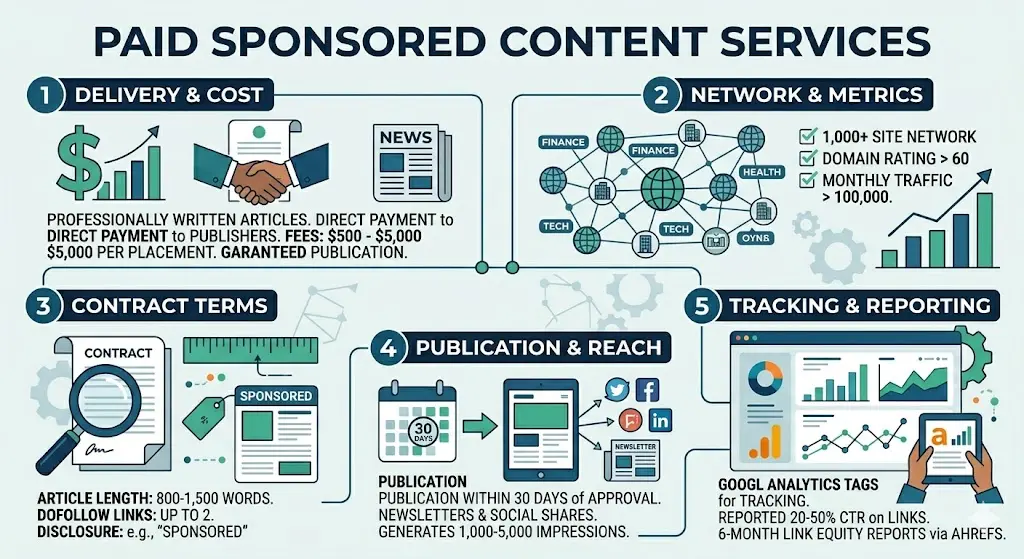
Publication happens within 30 days after content approval. Services track performance via Google Analytics tags, reporting 20-50% click-through rates on links. Sponsored content reaches audiences through newsletters and social shares, generating 1000-5000 impressions per placement. Clients receive reports on 6-month link equity via tools like Ahrefs.
How Does the Guest Blogging Process Work?
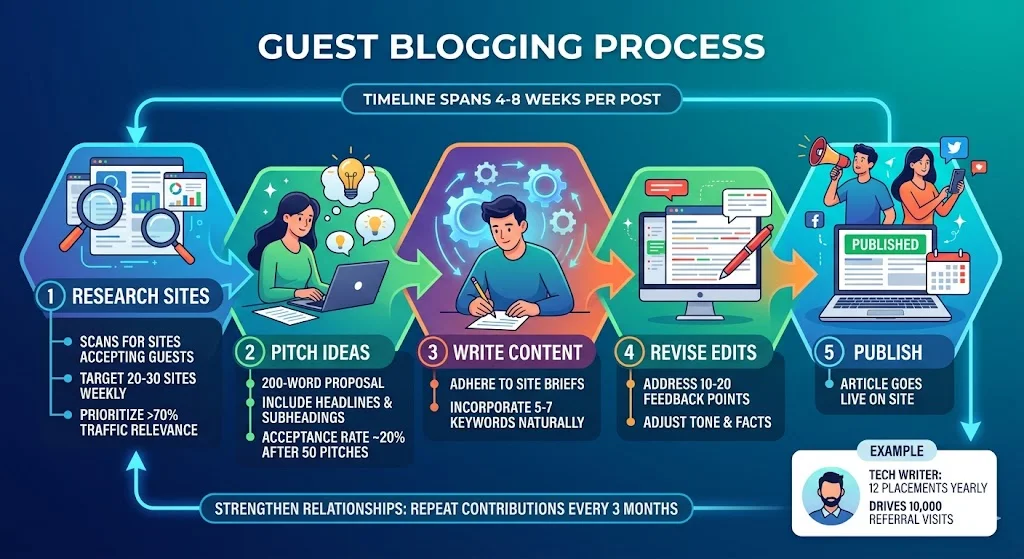
Guest blogging follows a six-step sequence: research sites, pitch ideas, write content, revise edits, publish, and promote. The timeline spans 4-8 weeks per post.
Research begins with tools scanning for sites accepting guests. Writers target 20-30 sites weekly, prioritizing those with traffic relevance scores above 70%. Pitches include a 200-word proposal with headlines and subheadings. Acceptance rates average 20% after 50 pitches.
Writing adheres to site briefs, incorporating 5-7 keywords naturally. Revisions address 10-20 feedback points on tone and facts. Post-publication, writers share on LinkedIn and Twitter to boost signals. Repeat contributions to the same site every 3 months strengthen relationships. One example shows a tech writer securing 12 placements yearly, driving 10,000 referral visits.
How Does the Sponsored Content Process Work?
Sponsored content services execute a streamlined four-step process: site selection, content creation, approval, and live publication. Completion occurs in 2-4 weeks with guaranteed placement.
Clients access dashboards listing 500 vetted publishers. Selection filters by niche, DR 70+, and cost per placement. Agencies draft content using client briefs, embedding LSI terms like “link building strategies.” Review cycles limit to two rounds, resolving issues in 48 hours.
Live posts include canonical tags and schema markup for rich snippets. Post-launch monitoring covers indexation within 24 hours and initial traffic spikes. Services handle 50 placements monthly for clients, scaling to 200 annually. An example involves a finance brand placing on Forbes-like sites, achieving 15% conversion from link clicks.
What Are the Key Components of Guest Blogging?
Guest blogging components include pitch email, outline, full draft, author bio with link, and promotion plan. Each element targets editorial acceptance and traffic generation.
Pitch emails contain subject lines with keywords, 100-word body, and two sample headlines. Outlines list 4 H2 sections with 50-word descriptions. Drafts feature 1200 words, images with alt text, and meta suggestions. Bios limit to 50 words with one link.
Promotion plans schedule 10 social shares and email blasts to 500 subscribers. Components ensure 80% acceptance when customized. Writers track components in spreadsheets for 20 campaigns yearly.
What Are the Key Components of Paid Sponsored Content Services?
Sponsored content components consist of publisher inventory, creative brief, customized article, performance report, and compliance disclosure. These secure high-value placements.
Publisher inventory details 200 sites with traffic data and CPC estimates. Briefs specify 10 keywords, tone, and CTA placement. Articles integrate 3 visuals and video embeds. Reports deliver UTM-tracked metrics like 3000 impressions and 5% CTR.
Compliance adds FTC labels and noindex options. Components support 100 placements quarterly per client.
What Benefits Does Guest Blogging Offer?
Guest blogging provides organic backlinks, referral traffic, and niche authority. Sites gain 5-15 links yearly, boosting domain ratings by 10 points.
Backlinks pass 20-50 PageRank points, improving rankings for 30% of targeted keywords. Traffic averages 300 visits per post, with 10% converting to leads. Authority builds through bylines on 10 sites, increasing brand searches by 25%.
Long-term benefits include evergreen content ranking in top 10 for 2 years. Guest bloggers report 40% time savings on outreach after 6 months.
What Benefits Do Paid Sponsored Content Services Provide?
Paid sponsored content delivers premium backlinks, instant visibility, and measurable ROI. Campaigns yield 20-50 links, raising traffic by 15-30%.
Premium links from DR 80+ sites enhance trust signals, lifting rankings in 60 days. Visibility reaches 50,000 readers via paid boosts. ROI tracks at 3:1 ratio, with $2000 spend generating $6000 value.
Scalability allows 100 links yearly without pitching. Services report 25% keyword uplift post-campaign.
What Are Use Cases for Guest Blogging?
Guest blogging suits startups building authority on 5-10 niche sites yearly. E-commerce uses it for product roundups; SaaS for tutorials.
Startups publish 12 how-tos on tech blogs, gaining 5000 visits. E-commerce contributes buyer guides to retail sites, driving 200 sales. SaaS writes integration tips, securing 15% lead growth.
Non-profits use it for awareness posts on 20 platforms, reaching 10,000 readers. Agencies target 50 sites for client case studies.
For deeper comparisons on SEO impact, Which Is Better for SEO Guest Blogging or Sponsored Content Campaigns Today?.
What Are Use Cases for Paid Sponsored Content Services?
Sponsored content fits enterprises needing quick links on top-tier sites. Finance firms use awareness posts; health brands for studies.
Enterprises place 20 articles on news outlets, boosting rankings 20 positions. Finance runs thought leadership on Bloomberg equivalents, gaining 10,000 leads. Health publishes research summaries, increasing traffic 40%. B2B tech deploys for product launches on 15 sites. Retail scales holiday campaigns across 50 publishers.
To explore faster SEO results, Choose Sponsored Content Services Over Guest Blogging for Faster SEO Results.
Guest blogging relies on earned placements through effort, while paid sponsored content ensures speed via investment. Both build links, but processes differ in control and timeline. Writers choose based on resources and goals.