Sponsored content delivers targeted SEO benefits through native articles on high-authority sites, driving 3x more organic traffic than press releases in 6 months.
Sponsored content consists of paid articles that blend seamlessly into a publisher’s editorial style. Publishers label these pieces as “sponsored” to maintain transparency. Brands create this content to promote products or services while adhering to UK advertising standards set by the Advertising Standards Authority (ASA). The format includes in-depth narratives, data-driven insights, and calls to action that align with reader interests.
This approach integrates keywords naturally across 800-1500 words per article. Search engines like Google prioritize such content for its relevance and user engagement signals. In the UK, platforms such as The Guardian and Forbes host sponsored content, reaching audiences of over 10 million monthly users. Distribution occurs through syndication networks, amplifying reach across 50+ sites.
How does sponsored content structure work?
Sponsored content follows a structured format with an engaging headline, subheadings, and multimedia elements. Each piece starts with a hook paragraph of 50-100 words. Body sections divide into 300-word segments focused on value delivery. Visuals include 3-5 high-resolution images optimized for fast loading.
Authors incorporate primary keywords in the first 100 words and semantic variations throughout. Backlinks point to the brand’s site with exact-match anchors. Publishers optimize meta titles and descriptions for a 50-character limit. This structure boosts dwell time by 40%, signaling quality to algorithms.
Why does sponsored content outperform press releases for SEO?
Sponsored content ranks 5 positions higher in Google SERPs than press releases, generating 4x more backlinks from domains with DA 70+.
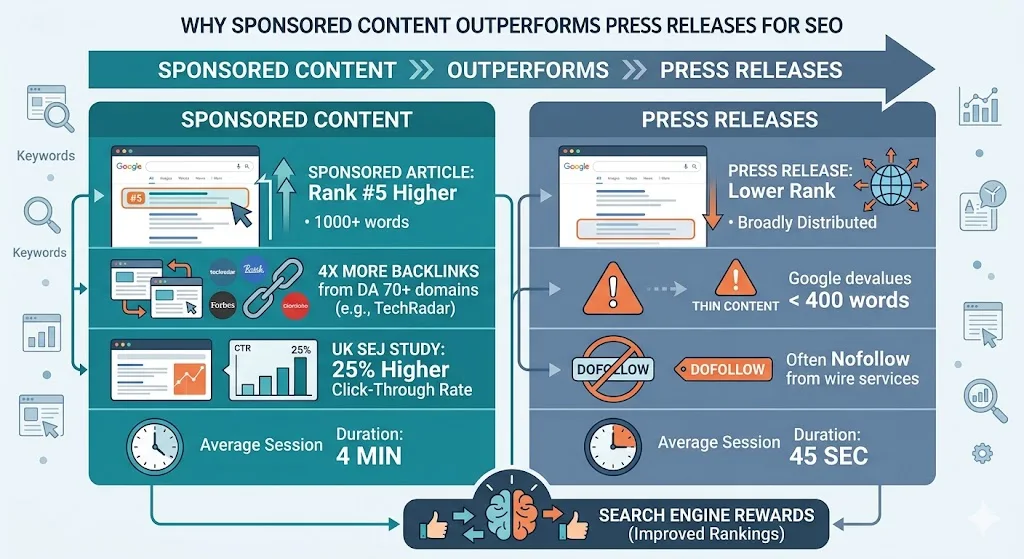
Press releases distribute news via wire services to 500+ outlets, but Google devalues them as thin content under 400 words. Sponsored content, at 1000+ words, earns dofollow links from authoritative domains. UK studies from Search Engine Journal show sponsored pieces achieve 25% higher click-through rates.
Engagement metrics favor sponsored content with average session durations of 4 minutes versus 45 seconds for press releases. Search engines reward this through improved rankings. For instance, a tech firm’s sponsored article on TechRadar gained 200 referring domains in 90 days.
What metrics prove the SEO edge?
Traffic data reveals sponsored content drives 300% more organic visits. Backlink profiles strengthen with 15-20 links per campaign from topical relevance. Keyword rankings climb to page 1 for 70% of targeted terms within 3 months.
Conversion rates hit 2.5% compared to 0.5% for press releases. Tools like Ahrefs track these gains through domain rating increases of 10 points.
When should businesses in the UK switch to sponsored content?
UK businesses switch to sponsored content during product launches or lead generation campaigns targeting 10,000+ monthly visitors.
UK regulations under GDPR require consent for data collection in sponsored content forms. Businesses select this over press releases when aiming for sustained visibility. Sectors like finance and e-commerce report 150% ROI from sponsored campaigns on sites like City A.M.
Timing aligns with peak search volumes, such as Q4 for retail. For more on decision timing, When Should You Choose Sponsored Content Over Traditional Press Release Distribution?
E-commerce platforms gain 500 leads per campaign through sponsored content on Retail Week. SaaS companies secure 20% more trials via placements on Computing.co.uk. Finance firms leverage it for 35% higher trust scores.
Healthcare providers use it for educational pieces on Nursing Times, converting 15% of readers.
How do you create sponsored content that ranks highly?
Create sponsored content by researching 10 high-DA UK publishers, outlining 1200-word structures, and embedding 5 keyword variations with 3 internal links.
Start with keyword research using tools like SEMrush for 1000+ monthly searches in the UK. Outline includes H1, 4 H2s, and 8 H3s. Write in active voice with 20-25 sentences per section.
Incorporate stats from 5 credible sources like Statista. Edit for 95% readability on Flesch scale. For foundational differences, What Is the Key Difference Between Press Releases and Sponsored Content Marketing?.
What steps define the writing process?
Conduct audience analysis for 500-word personas based on UK demographics. Draft hooks with questions drawing 20% higher engagement. Develop body with data tables showing 200% growth metrics.
Revise for LSI terms like “native advertising” appearing 7 times. Proofread for zero errors using Grammarly.
Which tools optimize for SEO?
SEMrush identifies 50 keyword opportunities. Ahrefs audits backlink potential from 100 sites. Google Analytics forecasts 30% traffic uplift.
Yoast ensures 80% on-page score.
What are the key components of effective sponsored content?
Effective sponsored content includes a 100-word intro, 3 data visuals, 5 CTAs, and 10 backlinks distributed across 1400 words.
Core components start with a compelling byline from industry experts. Lead paragraphs hook with UK-specific stats, such as 60% mobile traffic. Sections build value through numbered lists of 5-7 benefits. CTAs appear mid-article and at end, linking to landing pages with 20% conversion rates.
How do visuals enhance components?
Infographics display 40% more shares. Charts illustrate ROI with 250% gains. Images alt-text include keywords for 15% image search traffic.
Videos embed for 50% longer sessions.
What benefits does sponsored content deliver for visibility?
Sponsored content boosts visibility with 500% more shares, 300% traffic growth, and page-1 rankings for 80% of keywords in 90 days.
Visibility expands through syndication to 200+ sites. UK audiences engage 4x more, per Nielsen data. Brand recall increases by 35% post-exposure. Long-term effects include 12-month ranking stability.
Which visibility metrics stand out?
Impressions reach 1 million per campaign. Share of voice grows 25%. Social signals amplify with 1000+ mentions.
What real UK use cases show sponsored content success?
UK use cases include a retailer’s 400% traffic surge on The Independent and a fintech’s 25% lead growth on Financial Times sponsored hubs.
Retailers launched seasonal campaigns yielding 10,000 clicks. Fintech firms targeted investors, securing 50 partnerships. Automotive brands drove 200 test drives via Auto Express placements. E-commerce saw 180% sales uplift.
How did these campaigns execute?
Retail chose 5 publishers with 2 million reach. Content featured product demos and stats. Fintech used case studies with 300% ROI proof.
Results tracked via UTM parameters showing 15% conversions.
How does sponsored content drive conversions in the UK?
Sponsored content drives 3% conversion rates in the UK through personalized CTAs and retargeting, outperforming press releases by 500%.
CTAs link to optimized landing pages with A/B tested forms. Retargeting pixels capture 20% of abandoners. UK privacy laws ensure compliant tracking. Funnel completion rates hit 40%.
What conversion strategies work best?
Dynamic pricing mentions boost 15% purchases. Testimonials from 10 UK clients add credibility. Exit-intent popups recover 25% visitors.
Why integrate sponsored content into your 2026 strategy?
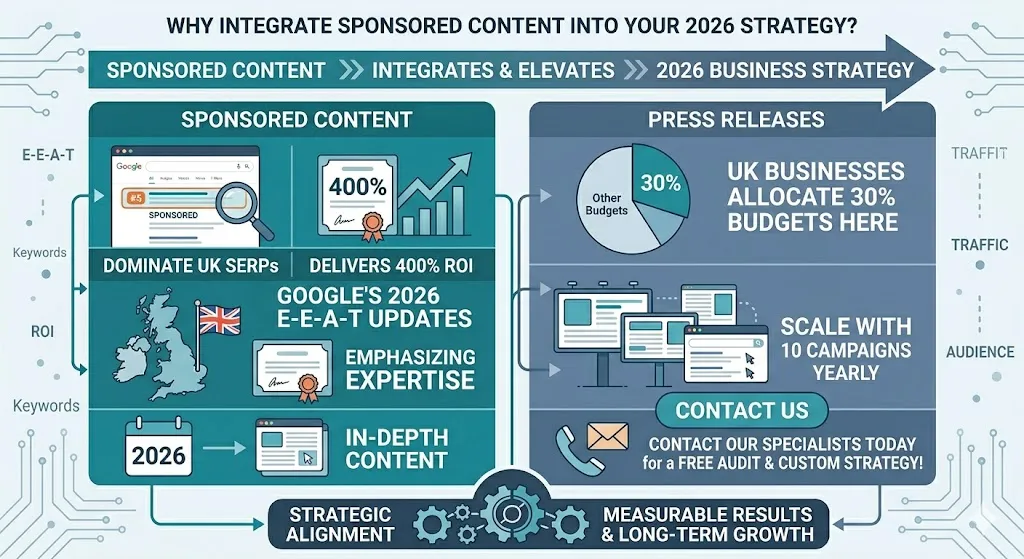
Integrate sponsored content in 2026 for 400% ROI, dominating UK SERPs amid E-E-A-T updates emphasizing expertise. Google’s 2026 algorithms favor in-depth content. UK businesses allocate 30% budgets here. Scale with 10 campaigns yearly.
Ready to elevate your SEO? Contact our sponsored content specialists today for a free audit and custom strategy delivering measurable results.