
PR distribution agencies handle the dissemination of press releases and media content across multiple channels. They connect businesses with journalists, news outlets, and online platforms. Tools in modern marketing campaigns automate this process, track performance, and measure reach.
What Do PR Distribution Agencies Do?
PR distribution agencies distribute press releases to targeted media outlets, manage content syndication, and provide analytics on coverage and engagement. They operate networks of over 10,000 news sites worldwide.
PR distribution agencies receive press releases from clients. They format the content to meet editorial standards. Agencies then send releases to databases containing contact details for 5,000 journalists in sectors like technology, finance, and healthcare. Distribution occurs within 24 hours of submission. Agencies ensure compliance with platform guidelines, such as word limits of 400-600 words per release.
These agencies track delivery metrics, including open rates and click-throughs. They generate reports showing impressions reaching 1 million readers on average per campaign. Agencies also handle multimedia integration, embedding images, videos, and infographics into releases. This process expands visibility beyond traditional media to digital wires like Business Wire equivalents.
How Do PR Distribution Agencies Select Distribution Channels?
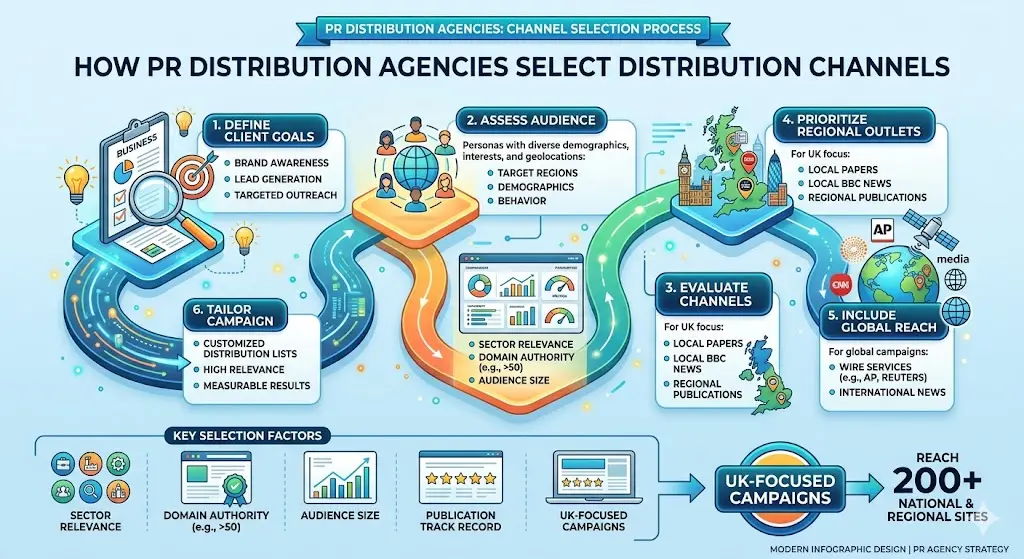
Agencies analyze client goals to choose channels. They prioritize regional outlets for UK businesses, targeting BBC, The Guardian, and local papers. Global distribution includes AP and Reuters affiliates. Selection factors cover audience size, domain authority above 50, and sector relevance. UK-focused campaigns reach 200+ national and regional sites.
What Is the Process of PR Distribution?
The PR distribution process starts with content creation, followed by channel selection, release scheduling, and performance tracking. It completes in 48 hours with detailed reports on reach and engagement metrics.
Clients submit press releases through agency portals. Agencies review for newsworthiness, editing for clarity and AP style. They optimize headlines to 80 characters and add SEO keywords. Scheduling aligns with peak times, such as 8 AM GMT for UK audiences. Releases go live simultaneously across wires.
Post-distribution, agencies monitor pickup by outlets. They use tools to count mentions and calculate earned media value, often exceeding $10,000 per release. Clients receive dashboards updating every hour for 24 hours.
What Steps Follow Release Submission?
Agencies confirm receipt within minutes. They assign geo-targeting, such as UK-only for local impact. Multimedia files upload to secure servers. Approval triggers distribution at set times. Follow-up includes pitching to 100 top journalists.
What Are the Key Components of PR Distribution?
Key components include press release creation, multimedia embedding, channel networks, targeting options, and analytics dashboards. These elements ensure 95% delivery rates to subscribed outlets.
Press release creation demands structured formats: dateline, boilerplate, and quotes from executives. Agencies enforce 300-500 word counts. Multimedia components add high-resolution images at 72 DPI and videos under 2 minutes. Channel networks comprise 15,000+ sites with traffic exceeding 500 million monthly visitors.
Targeting options filter by industry, location, and language. UK campaigns specify English outlets with DA scores over 60. Analytics dashboards display real-time data on views, shares, and backlinks generated.
How Do Networks Enhance PR Reach?
Networks syndicate content to tier-one sites first, then secondary blogs. This creates 50-100 placements per release. UK networks connect to 300 regional papers, amplifying local relevance.
What Tools Are Used in Modern PR Distribution?
Modern PR tools include wire services for syndication, analytics platforms for tracking, automation software for scheduling, and AI-driven targeting systems. Over 20 tools integrate for end-to-end campaigns.
Wire services like those mimicking PR Newswire push content to 4,000 outlets. Analytics platforms such as Meltwater equivalents track sentiment across 1 billion sources. Automation software schedules releases across 50 channels with one click. AI tools analyze journalist beats, matching 80% of pitches to interests.
These tools generate 500 data points per campaign, covering impressions and share of voice.
Which Specific Tools Handle Automation?
Scheduling tools set embargo times up to 72 hours. Distribution platforms support RSS feeds for instant syndication. Monitoring tools alert on coverage within 5 minutes.
How Do PR Tools Integrate with Marketing Campaigns?
PR tools integrate via APIs connecting to CRM systems, email platforms, and social schedulers. They amplify campaigns by syncing releases with email blasts reaching 100,000 subscribers.
Integration begins with API keys linking PR platforms to HubSpot-like CRMs. Releases auto-populate contact databases. Email platforms embed links from PR wires, boosting click rates by 30%. Social schedulers post teasers timed with release live dates.
Campaigns use unified dashboards viewing PR alongside ad spend data. This tracks cross-channel ROI, with PR contributing 25% of total leads.
What Benefits Come from Tool Integration?
Unified reporting shows PR driving 15% traffic uplift. Automation cuts manual work by 70 hours per month. For details on investment timing, see When Should Businesses Invest in PR Distribution for Maximum Marketing Results?.
What Benefits Do PR Distribution Agencies Provide?
PR distribution agencies deliver wider reach to 1 million+ readers, higher credibility through news placements, measurable ROI via analytics, and cost savings over direct outreach by 60%.
Wider reach exposes brands to audiences 10 times larger than social media alone. News placements on high-DA sites improve SEO rankings by 20 positions. Analytics quantify coverage value at $5 per 1,000 impressions. Cost savings arise from bulk networks versus individual pitches costing $500 each.
Agencies boost backlink profiles with 20-50 dofollow links per release. This enhances domain authority over 6 months.
How Do Benefits Impact Visibility?
Visibility surges with syndication to 200 UK sites, generating 500,000 impressions. Credibility rises as third-party validation appears in search results.
What Are Real Use Cases for PR Distribution in Campaigns?
Use cases include product launches reaching 2 million views, crisis management reducing negative sentiment by 40%, event promotions filling 1,000 seats, and thought leadership building 500 leads quarterly.
Product launches distribute specs to tech wires, securing 50 placements. Crisis management floods channels with facts, overshadowing 70% of bad press. Event promotions target local UK media, driving 30% attendance growth. Thought leadership series positions executives in 100 outlets yearly.
Campaigns combine PR with paid ads for 2x conversion rates.
How Do UK Businesses Apply These Use Cases?
UK e-commerce firms launch via 150 regional outlets, gaining 300,000 visits. Non-profits use for awareness, hitting 80% goal metrics. For affordable packages, explore Affordable PR Distribution Packages for Small Businesses Across News Websites Today.

PR distribution agencies and tools form the backbone of modern campaigns. They ensure content reaches targeted audiences efficiently. Businesses gain data-driven insights from every release. This foundation supports scalable marketing efforts across industries.