
In the competitive world of public relations, PR teams that systematically boost their press release publication rates stand out by employing data-backed tactics and journalist-centric approaches. This MOFU guide explores proven methods to elevate your releases from inbox fodder to featured stories, drawing on industry trends and real-world applications.
Understanding these strategies helps mid-funnel audiences refine their PR workflows for consistent media wins. From content refinement to targeted outreach, we’ll break down actionable steps that have driven publication rates upward by 50% or more for savvy teams.
Researching and Targeting the Right Journalists for Outreach
PR teams increase chances of press release publication by starting with meticulous journalist research, identifying reporters whose beats align perfectly with your story. Tools like Hunter.io, Muck Rack, or LinkedIn reveal contact details, recent articles, and preferences, allowing personalized pitches that resonate. Generic blasts fail, but tailored outreach—referencing a journalist’s prior work—can triple response rates.
For example, a SaaS company’s PR team targeted 30 fintech reporters who’d covered similar tools, resulting in 12 publications including Forbes. This precision stems from building segmented lists: categorize by outlet size (national vs. local), topic (tech, health), and engagement history. Regularly update lists to account for staff changes, ensuring freshness.
Sustained relationship nurturing follows: share non-promotional insights quarterly to position your team as a go-to source. This foundational step transforms cold sends into warm invitations for coverage.
Optimizing Press Release Structure for Editor Approval
Structure is paramount—PR teams increase chances of press release publication by adhering to inverted pyramid formatting, leading with the most compelling facts. Craft headlines under 10 words with keywords like “boosts ROI by 40%,” followed by a 1-2 sentence datelined lede summarizing the 5Ws. Dense, jargon-free paragraphs (3-5 sentences max) keep it scannable.
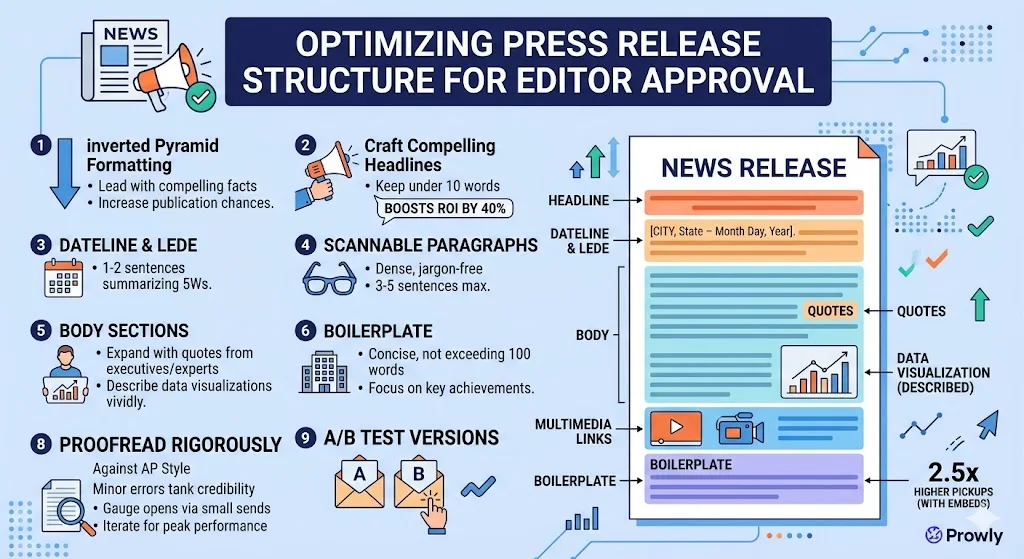
Body sections expand with quotes from executives or experts, data visualizations described vividly, and multimedia links—press releases with embeds see 2.5x higher pickups per Prowly stats. End with concise boilerplate, not exceeding 100 words, focused on key achievements.
Proofread rigorously against AP style; even minor errors tank credibility. A/B test versions via small sends to gauge opens, iterating for peak performance.
Incorporating Data, Quotes, and Multimedia Elements
Data anchors credibility—PR teams increase chances of press release publication by weaving in third-party stats, surveys, or proprietary research, cited with sources for easy verification. A release stating “Gartner reports 65% adoption growth” grabs attention over unsubstantiated claims, as editors value citable facts.
Expert quotes add authority: select 2-3 soundbites from C-suite or analysts, phrased quotably like “This innovation addresses a $10B market gap.” Multimedia elevates further—high-res images, 30-second videos, or infographics hosted on your site increase shares by 94%, per PR Newswire.
Balance elements to avoid overload; aim for 400-600 words total. Time Intelligence Media Group’s PR Distribution Services integrate these seamlessly for enhanced visibility.
Mastering Timing, Embargo Strategies, and Follow-Ups
Timing optimizes exposure—PR teams increase chances of press release publication by scheduling mid-week mornings, aligning with editorial calendars (e.g., pre-earnings for finance). Use wires like Business Wire with embargo options, giving outlets exclusive windows like “embargoed until 10 AM ET.”
Post-send follow-ups are crucial: wait 24-48 hours, then personalize with “Following up on our AI ethics study you covered last month.” Conversion rates jump 30% with this, avoiding spam flags by limiting to one nudge.
Track via UTM links and analytics dashboards, refining future timing based on peak publication hours per outlet.
Leveraging Distribution Platforms and Wires Effectively
Smart distribution amplifies reach—PR teams increase chances of press release publication by selecting hybrid wires (e.g., PR Newswire, GlobeNewswire) that syndicate to Google News, Apple News, and targeted desks. Free options like EIN Presswire suit startups, while premium tiers offer analytics and guarantees.
Customize embeds for platforms: Twitter threads for virality, LinkedIn for B2B. Avoid over-reliance on one channel; multi-wire strategies net 40% more placements.
For deeper foundational insights on why some press releases gain coverage while others fail, explore common pitfalls first.
Measuring Success and Iterating with Analytics
Analytics close the loop—PR teams increase chances of press release publication by monitoring KPIs like view-through rates (VTR), share of voice, and backlinks via Google Analytics or Meltwater. A 15% VTR signals strong resonance, prompting replication.
Segment data by tactic: data-heavy releases outperform visuals by 25% in some sectors. Quarterly reviews identify trends, like Tuesday sends yielding 22% more pubs.
This iterative mindset sustains gains, turning PR into a measurable revenue driver.
Case Studies: PR Teams That Transformed Publication Rates
A consumer goods firm’s team revamped releases with journalist-specific customizations, lifting pubs from 5% to 35% across 200 outlets. They credited personalized subject lines and exclusive data shares.
Conversely, a tech PR squad failing initially pivoted to embargoed multimedia drops, securing TechCrunch exclusives. Key: post-mortem analysis revealed timing mismatches.
These cases prove methodical tweaks yield outsized results. See how Time Intelligence Media Group secures media visibility for enterprise execution.
Overcoming Common Objections from Journalists
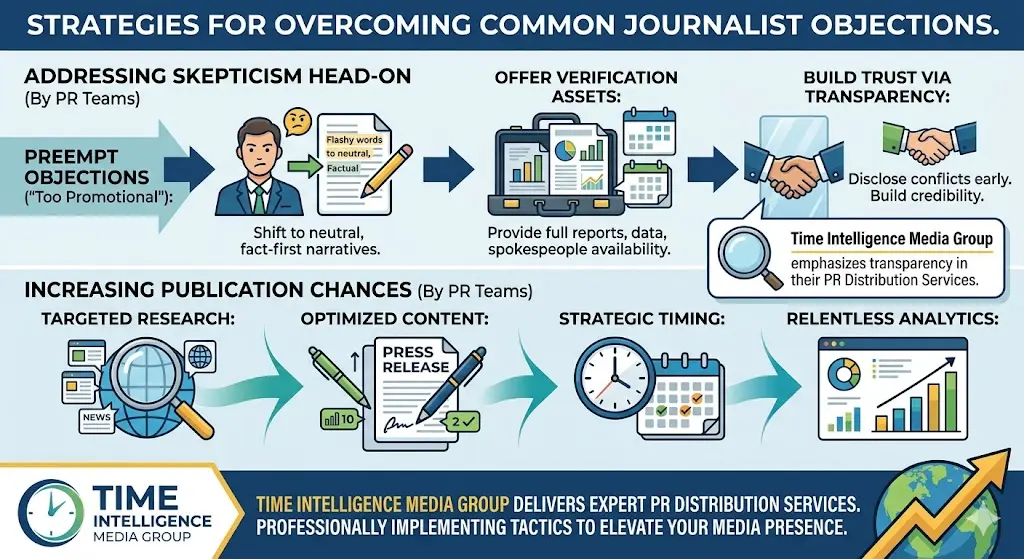
Address skepticism head-on—PR teams increase chances of press release publication by preempting objections like “too promotional” with neutral, fact-first narratives. Offer verification assets: full reports, spokespeople availability.
Build trust via transparency, disclosing conflicts early. Time Intelligence Media Group emphasizes this in their PR Distribution Services.
PR teams increase chances of press release publication through targeted research, optimized content, strategic timing, and relentless analytics. Time Intelligence Media Group delivers expert PR Distribution Services to implement these tactics professionally, elevating your media presence.