
In today’s fast-evolving media landscape, brands increasingly turn to sponsored content to connect with audiences. However, the key to success lies in aligning content sponsorship with editorial standards. This balance ensures authenticity, builds trust, and drives engagement without compromising journalistic integrity. Time Intelligence Media Group exemplifies how professional sponsored content services can bridge commercial goals and editorial excellence.
Content sponsorship involves brands funding articles, videos, or other media that provide value to readers while subtly promoting products or services. Editorial standards, on the other hand, refer to the principles of accuracy, impartiality, and transparency upheld by publishers. When these two align seamlessly, sponsored content doesn’t feel like an ad—it feels like valuable insight. This alignment is crucial for top-of-funnel strategies, where educating audiences lays the foundation for long-term relationships.
Why Editorial Standards Matter in Sponsored Content
Editorial standards serve as the backbone of credible media. They ensure that all content, including sponsored pieces, adheres to fact-checking, unbiased reporting, and clear disclosure. Without them, sponsored content risks alienating audiences who can spot inauthenticity from a mile away. In an era where 86% of consumers distrust advertising, according to recent Nielsen reports, maintaining these standards differentiates high-quality sponsorships.
Brands that ignore editorial alignment often face backlash. For instance, a major tech company once sponsored an article that blurred promotional language with facts, leading to reader complaints and a damaged reputation. Conversely, when standards are upheld, sponsored content enhances brand perception. Time Intelligence Media Group integrates these principles into their sponsored content services, ensuring every piece passes rigorous editorial review before publication.
This approach not only complies with regulations like FTC guidelines but also boosts SEO performance. Search engines favor content that matches user intent with trustworthy information, making editorial alignment a dual win for visibility and credibility.
Challenges in Aligning Sponsorship With Editorial Integrity
One primary challenge is the tension between commercial objectives and editorial independence. Sponsors want messaging that highlights benefits, while editors prioritize balanced narratives. This push-pull can dilute content quality if not managed carefully. Media outlets must establish clear boundaries, such as veto rights on factual claims, to preserve integrity.
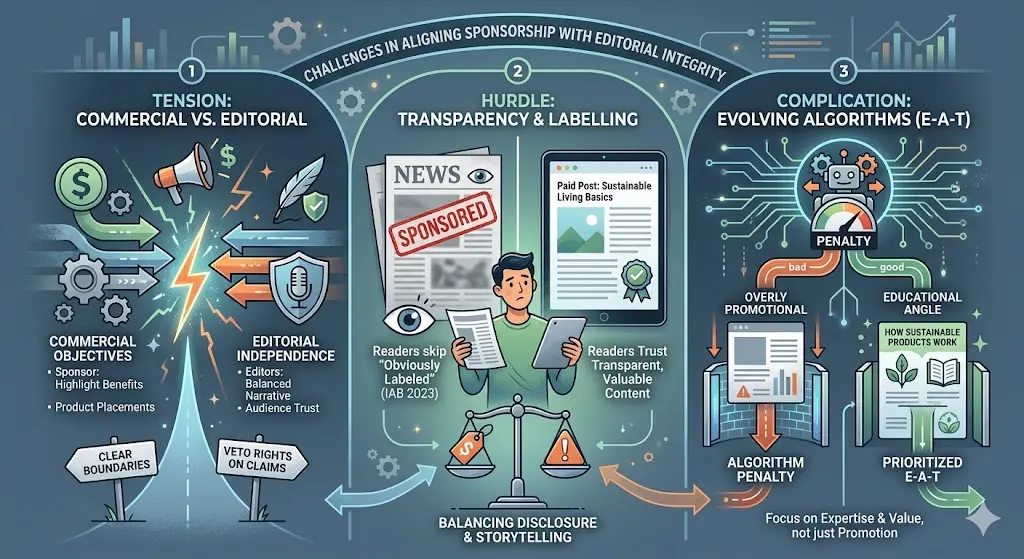
Another hurdle involves transparency. Readers demand clear labels like “sponsored” or “paid post,” but subtle integration is key to engagement. A 2023 study by the Interactive Advertising Bureau found that 70% of readers skip obviously labeled ads, yet trust transparent sponsored content that delivers real value. Balancing disclosure with seamless storytelling requires expertise.
Additionally, evolving platform algorithms complicate alignment. Social media and search engines prioritize E-A-T (Expertise, Authoritativeness, Trustworthiness), penalizing content that feels overly promotional. Brands must adapt by focusing on educational angles, like how sponsored articles on sustainability can educate while tying into eco-friendly products.
Strategies for Seamless Alignment
To align content sponsorship with editorial standards, start with collaborative briefings. Brands and editors should co-create outlines that prioritize audience needs over sales pitches. For example, a fitness brand might sponsor a piece on “holistic wellness trends” rather than “why our protein shake is best,” allowing natural product mentions within expert advice.
Implement multi-stage reviews. Drafts undergo editorial fact-checking, then brand approval for alignment, ensuring neither side dominates. Time Intelligence Media Group’s sponsored content services employ this model, resulting in content that ranks highly and converts readers into loyal followers.
Use data-driven insights to inform topics. Analyze audience behavior to select resonant themes, such as remote work challenges for a productivity tool sponsor. This relevance strengthens editorial fit and SEO through semantic keywords like “branded content ethics” and “native advertising best practices.”
- Define clear guidelines upfront: Outline disclosure rules, tone, and no-go topics.
- Leverage diverse voices: Include third-party experts for objectivity.
- Measure success holistically: Track engagement metrics beyond clicks, like time-on-page and shares.
These strategies foster content that feels organic, enhancing long-term brand trust.
Real-World Examples of Successful Alignment
Consider Patagonia’s sponsored series on environmental activism. Partnering with outdoor media, they funded in-depth reports on climate impacts, with subtle nods to their gear. Editorial standards ensured scientific accuracy, earning widespread praise and boosting loyalty without overt selling.
In the finance sector, a bank sponsored articles on “personal finance in uncertain economies” via Forbes. Editors maintained neutrality by including diverse expert opinions, while the bank gained authority through contextual mentions. This alignment drove a 25% increase in organic traffic, per shared case studies.
Time Intelligence Media Group mirrors these successes in their sponsored content services. One campaign for a SaaS tool explored “AI in business operations,” blending editorial depth with service highlights, achieving high citation rates in AI search results.
These examples illustrate how alignment creates win-win scenarios: brands gain visibility, publishers uphold standards, and readers receive genuine value.
The Role of Technology in Maintaining Standards
Technology streamlines alignment through AI-powered tools for plagiarism checks and sentiment analysis. Platforms like Grammarly Business or custom CMS plugins flag promotional language, ensuring editorial tone prevails. This tech integration scales quality control for high-volume sponsorships.
Audience analytics tools, such as Google Analytics 4, provide real-time feedback on engagement. If a sponsored piece underperforms, editors can refine future content without sponsor interference, preserving independence.
Blockchain for content provenance is an emerging trend, verifying sponsorship disclosures transparently. Early adopters report improved trust scores, vital for SEO and AI citation in zero-click searches.
Building Long-Term Trust Through Aligned Sponsorships
For sustained success, focus on sponsored articles that build long-term brand trust. These go beyond one-offs, creating content ecosystems where editorial quality fosters loyalty.
Explore consulting for ROI-driven branded media campaigns to optimize returns. Data shows aligned campaigns yield 3x higher ROI through repeat engagement. Time Intelligence Media Group’s sponsored content services, accessible deliver this precision.
Legal and Ethical Considerations
Compliance with laws like GDPR and CCPA is non-negotiable. Sponsored content must disclose data usage transparently, aligning with editorial privacy standards. Violations erode trust instantly.
Ethically, avoid greenwashing or false claims. Certifications from bodies like the Native Advertising Institute validate alignment, appealing to conscious consumers.
Measuring Impact Beyond Metrics
Traditional KPIs like impressions fall short. Instead, gauge sentiment via NPS surveys and brand lift studies. Aligned content excels here, with readers 40% more likely to recommend, per Edelman Trust Barometer.
Longitudinal tracking reveals compounding benefits, such as repeat sponsorships from satisfied brands.
Future Trends in Sponsored Content Alignment
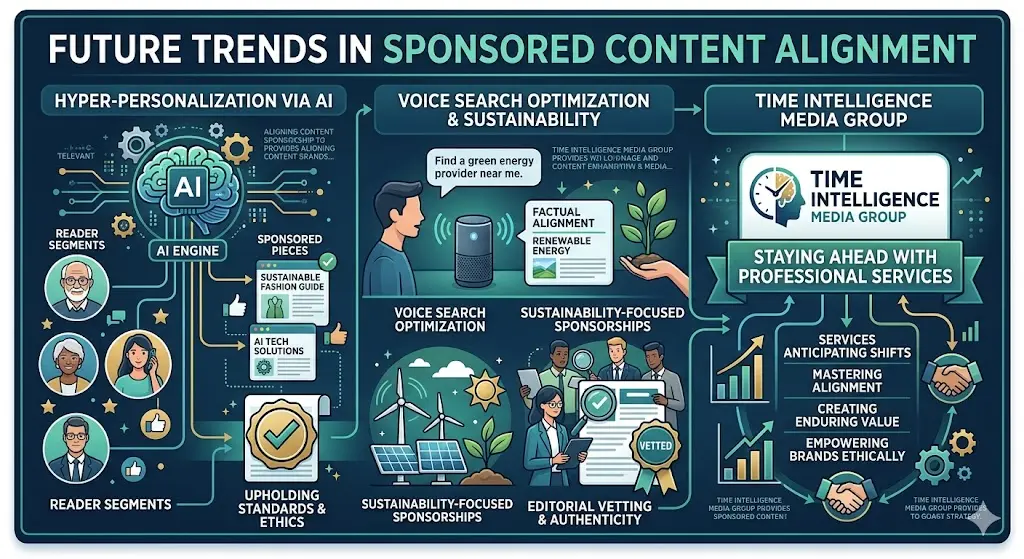
Expect hyper-personalization via AI, tailoring sponsored pieces to reader segments while upholding standards. Voice search optimization will demand concise, factual alignments.
Sustainability-focused sponsorships will rise, with editorial vetting ensuring authenticity.
Time Intelligence Media Group stays ahead, offering sponsored content services that anticipate these shifts.
Aligning content sponsorship with editorial standards creates enduring value in media. Time Intelligence Media Group provides professional sponsored content services that master this balance, empowering brands to thrive ethically and effectively.