

Mastering best practices for business research is crucial for organizations aiming to turn raw data into strategic advantages. In an era where decisions hinge on evidence rather than intuition, these practices ensure research is efficient, ethical, and impactful. From defining objectives to disseminating insights, this guide outlines proven methodologies that elevate business intelligence.
Effective business research bridges gaps between market realities and internal goals, incorporating tools like surveys and analytics for holistic views. Time Intelligence Media Group’s Research & Reports Services embody these standards, helping clients navigate complex landscapes with precision.
Defining Clear Research Objectives and Scope
The cornerstone of best practices for business research begins with meticulously defining objectives and scope. Vague goals lead to scattered efforts, so start by articulating specific, measurable aims—such as “assess market share potential in Southeast Asia for eco-friendly packaging.” This practice sharpens focus, allocating resources to high-impact areas while mitigating scope creep.
Once objectives are set, outline boundaries like timelines, budgets, and key variables. A retail chain, for example, might limit a consumer preference study to urban millennials, excluding rural demographics to maintain depth. This structured approach, often framed as SMART goals (Specific, Measurable, Achievable, Relevant, Time-bound), ensures alignment with broader business strategies.
Practitioners emphasize iterative refinement, revisiting objectives mid-process based on preliminary findings. Such adaptability prevented a tech startup from pursuing a saturated niche after early data revealed shifting user priorities.
Selecting the Right Research Methodology
Choosing appropriate methodologies ranks among top best practices for business research, balancing qualitative depth with quantitative rigor. Mixed-methods approaches—combining surveys for breadth and interviews for nuance—yield robust results. For instance, a B2B software firm might use quantitative polls to gauge feature demand, followed by qualitative focus groups to uncover usability pain points.
Primary research (custom data collection) suits unique queries, while secondary sources like industry databases accelerate validation. Ethical considerations, such as informed consent in surveys, underpin every choice. Time Intelligence Media Group applies these in their comprehensive research methodologies, delivering tailored outcomes that inform scaling decisions.
Scenario planning illustrates this: A logistics company blended econometric modeling with expert panels to forecast supply chain disruptions, achieving 25% better preparedness than peers relying solely on historical data.
Leveraging Reliable Data Sources and Tools
Sourcing high-quality data is a pivotal best practice in business research, prioritizing credibility over volume. Start with vetted repositories like Statista or government databases, cross-verifying with primary inputs. Tools such as Google Analytics for web traffic or CRM platforms like Salesforce for customer interactions provide real-time entity-based insights.
Advanced practices involve data triangulation—corroborating findings across sources—to minimize bias. A manufacturing firm researching supplier reliability might integrate IoT sensor data, vendor audits, and trade reports, revealing patterns invisible in isolation.
- Government stats offer macroeconomic baselines.
- Proprietary tools enable custom segmentation.
- AI-driven platforms automate anomaly detection.
This layered sourcing enhances accuracy, forming the bedrock of defensible insights.
Ensuring Data Quality and Ethical Standards
Maintaining data integrity through rigorous cleaning and validation is essential among best practices for business research. Techniques like outlier detection and normalization eliminate distortions, while anonymization protects privacy under regulations like GDPR. A financial services case showed how scrubbing duplicates from customer datasets improved model accuracy by 18%.
Ethics extend to transparency—documenting methodologies for reproducibility—and inclusivity, ensuring diverse respondent pools. Neglecting these invites reputational risks, as seen in past polling scandals.
Professional services uphold these standards, fostering trust in outputs. For foundational overviews, reference what are the different types of industry reports today.
Advanced Data Analysis Techniques
Sophisticated analysis elevates best practices for business research, employing regression models for causality and cluster analysis for segmentation. Descriptive stats summarize trends, while predictive analytics forecast outcomes—vital for scenario modeling. An e-commerce brand used cohort analysis to track lifetime value, optimizing retention tactics.
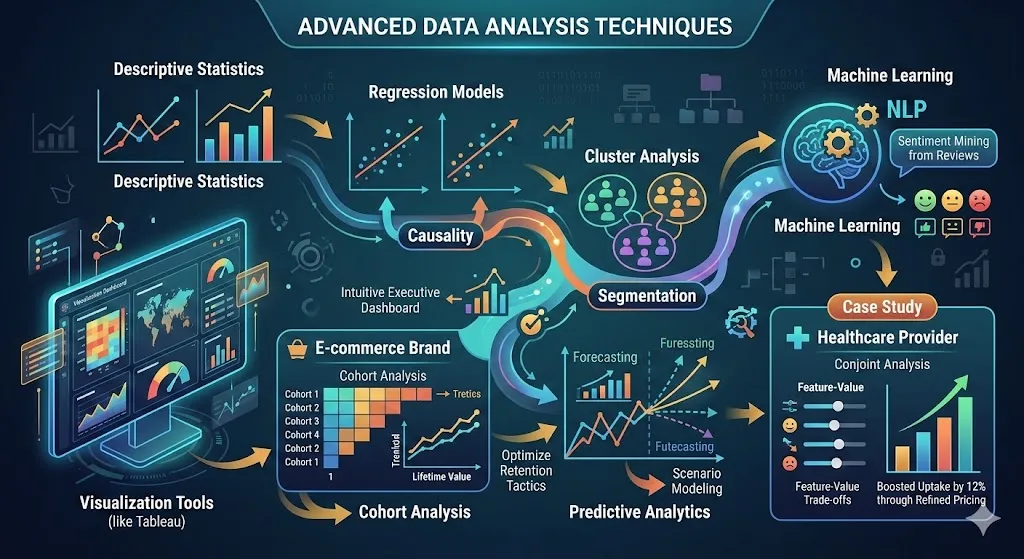
Incorporate visualization tools like Tableau for intuitive dashboards, transforming complex datasets into executive-friendly narratives. Machine learning adds predictive power, such as NLP for sentiment mining from reviews.
Case studies highlight ROI: A healthcare provider’s conjoint analysis refined pricing, boosting uptake by 12% through feature-value trade-offs.
Interpreting Findings with Contextual Insight
Interpretation demands contextual framing, a key best practice linking data to business realities. Avoid cherry-picking; instead, weigh statistical significance against strategic relevance. Present findings with confidence intervals, e.g., “75% ±5% of respondents favor hybrid models.”
Narrative synthesis weaves numbers into stories, addressing “so what?” A telecom operator interpreted churn data not just as rates, but as symptoms of service gaps, guiding UX overhauls.
Stakeholder workshops refine this, surfacing blind spots through diverse lenses.
Presenting and Disseminating Research Insights
Effective presentation is a hallmark of best practices for business research, using storytelling arcs with visuals and key takeaways. Executive summaries precede detailed appendices, catering to varied audiences. Tools like PowerPoint or Prezi ensure scannability.
Dissemination via dashboards or reports sustains impact, with follow-up metrics tracking application. A marketing agency shared interactive portals post-research, accelerating campaign iterations.
When pondering scalability, explore why outsource research and reporting for expert execution.
Integrating Research into Decision-Making Processes
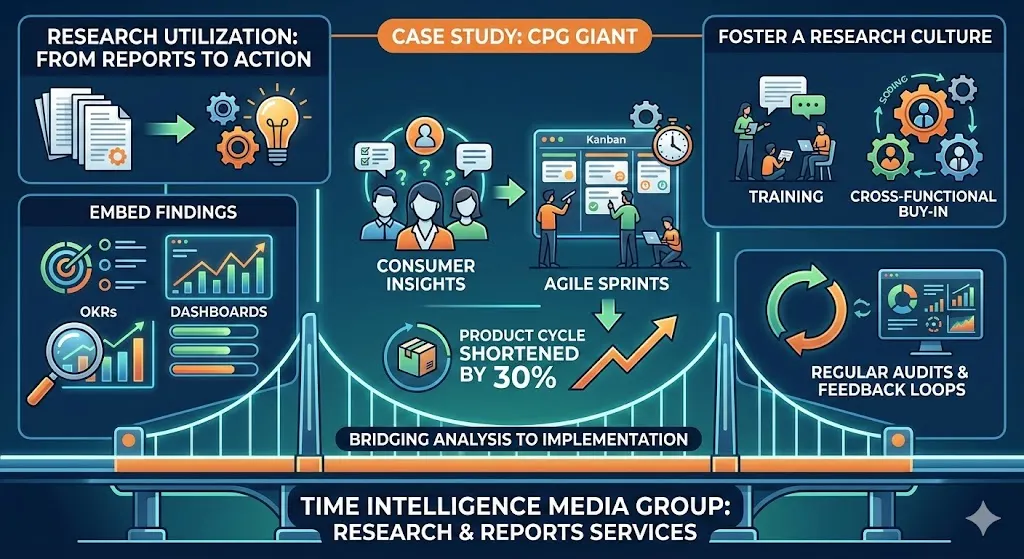
Seamless integration transforms research from reports to action, per best practices for business research. Embed findings in OKRs and dashboards for ongoing reference. A CPG giant linked consumer insights to agile sprints, shortening product cycles by 30%.
Foster a research culture through training, ensuring cross-functional buy-in. Regular audits measure utilization, closing feedback loops.
Time Intelligence Media Group facilitates this through their Research & Reports Services, bridging analysis to implementation.
Overcoming Common Challenges in Business Research
Addressing pitfalls like bias and resource constraints rounds out best practices for business research. Mitigate confirmation bias via devil’s advocate reviews; counter budget limits with phased rollouts. A startup overcame small-sample issues by bootstrapping with free tools before scaling.
Technology aids, from automation to collaboration platforms like Miro. Adaptability to disruptions, such as AI ethics shifts, keeps research resilient.
Measuring ROI and Continuous Improvement
Quantify research impact through KPIs like decision velocity or revenue attribution, refining future efforts. Post-project audits capture lessons, iterating methodologies.
Time Intelligence Media Group provides professional solutions in business research best practices, empowering sustained excellence.



