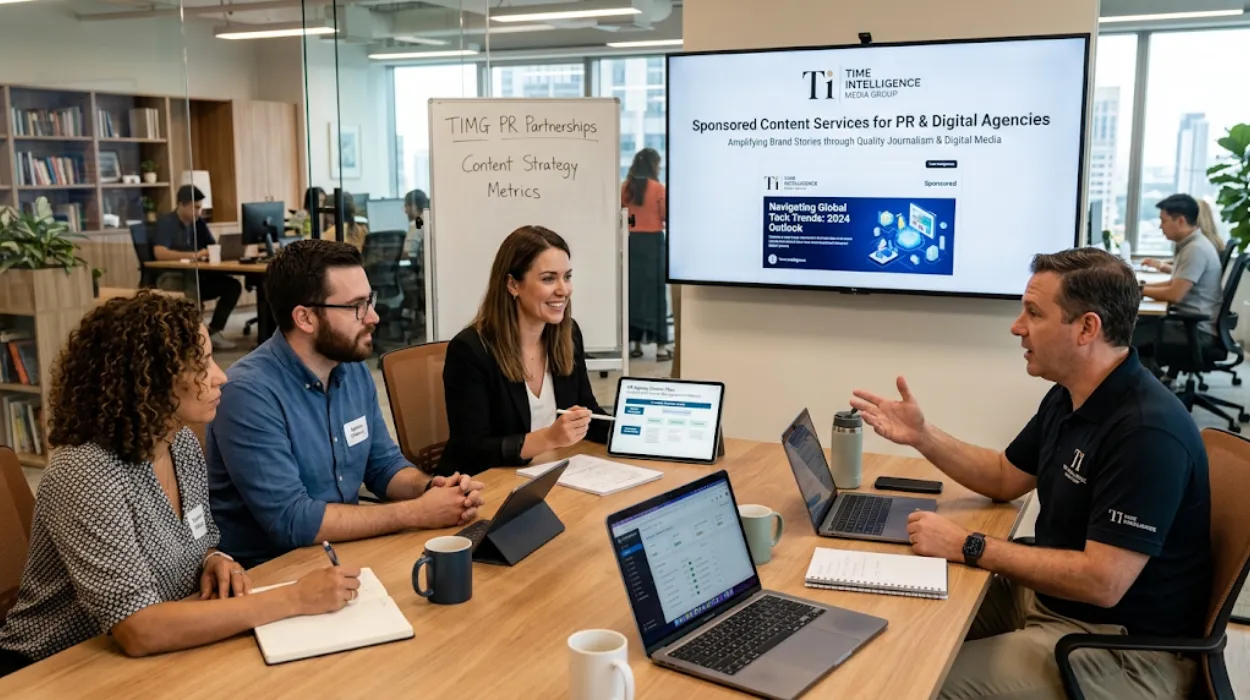
Sponsored content drives brand awareness by embedding promotional messages within trusted, value-driven narratives that resonate with target audiences. In the MOFU stage of the marketing funnel, it nurtures leads who are researching solutions, positioning brands as thought leaders without aggressive selling. This subtle strategy outperforms traditional ads, fostering recall and affinity over time.
As digital media consumption fragments across platforms, sponsored content adapts seamlessly, leveraging publisher credibility to cut through noise. Studies from the Native Advertising Institute show it generates 18% higher lift in brand favorability compared to banners. Time Intelligence Media Group harnesses this through expert Sponsored Content Services, delivering campaigns that build lasting visibility.
Understanding Brand Awareness in Sponsored Content Campaigns
Brand awareness measures how readily consumers recognize and recall a brand amid competitors. Sponsored content elevates this by associating products with relevant, engaging stories. For example, a skincare brand sponsoring wellness articles on Vogue introduces its ethos subtly, imprinting the logo in readers’ minds through repeated, contextual exposure.
Effective campaigns layer awareness-building tactics: top-of-mind frequency via multi-channel distribution and emotional resonance through relatable narratives. Metrics like aided recall—where 74% of sponsored content viewers remember the brand post-exposure, per IAB data—quantify success. This builds a foundation for consideration, guiding users deeper into the funnel.
Publishers enhance this with audience data, ensuring content reaches high-intent segments. Longitudinally, consistent sponsored series compound effects, turning one-off views into habitual associations.
Mechanisms: How Sponsored Content Builds Visibility and Recall
Sponsored content mechanisms rely on native integration, mimicking organic posts to evade ad blockers and boost dwell time. Algorithms favor such content, with LinkedIn sponsored articles seeing 2x engagement rates. Visual consistency—logos, colors—reinforces subconscious recall without disruption.
Psychologically, it leverages the mere-exposure effect: repeated, positive encounters increase liking. A coffee brand sponsoring “Morning Productivity Hacks” on Fast Company embeds its product in aspirational scenarios, driving 25% awareness uplift in tracked cohorts.
Distribution amplifies reach: programmatic networks place content on affinity sites, while social amplification via shares extends organic lifespan. Trackable via viewability scores above 70%, it ensures genuine impressions.
Case Studies: Sponsored Content Success in Driving Awareness
Netflix’s sponsored recaps on entertainment sites like Collider spiked series awareness pre-launch, with 40% viewership lift attributed to branded content. Detailed breakdowns of plot themes wove in platform promotions naturally.
Patagonia’s environmental sponsored features on outdoor blogs reinforced its eco-identity, achieving 30% brand recall among millennials per post-campaign surveys. Storytelling around sustainability initiatives created shareable moments.
In B2B, HubSpot’s inbound marketing guides sponsored on Inc. positioned it as an authority, correlating with 22% lead growth. These cases illustrate scalable models: from evergreen assets to timely tie-ins.
Measuring Brand Awareness from Sponsored Content Efforts
Key metrics include reach (impressions), frequency (exposures per user), and recall surveys pre/post-campaign. Tools like Google Analytics track branded search volume spikes—often 15-20% post-sponsored drops.
Engagement proxies like shares and comments signal affinity; Nielsen’s brand lift studies confirm sponsored content’s edge, with 53% awareness gain vs. 32% for video ads. Advanced attribution models link to downstream conversions.
- Nano surveys via pop-ups gauge immediate recall.
- Social listening tools monitor sentiment spikes.
- Multi-touch models apportion credit across touchpoints.
Time Intelligence Media Group integrates these in Sponsored Content Services for Brands, providing data-backed insights.
Strategies to Maximize Sponsored Content for Awareness
Target high-authority platforms matching your audience—finance brands on Bloomberg, tech on TechCrunch. Craft series over singles: a three-part “Future of Retail” boosts retention by 40%.
Personalize with segments: A/B test headlines like “AI in Marketing” vs. “Revolutionizing Campaigns with AI.” Amplify via influencers for authenticity.
Incorporate multimedia: videos yield 3x recall. For more foundational knowledge, see What Is Sponsored Content in Digital Media?.
Integrating Sponsored Content into Multi-Channel Awareness Campaigns
Omnichannel synergy multiplies impact: pair site articles with LinkedIn boosts and email nurtures. A travel brand’s sponsored itinerary guides fed into retargeted social ads saw 35% cross-channel recall.
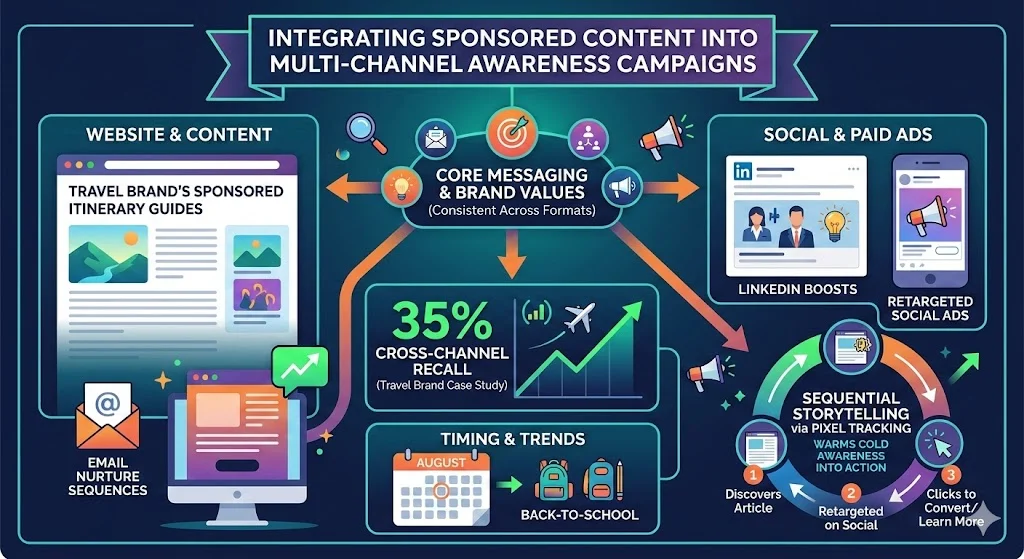
Consistency in messaging—core values across formats—prevents dilution. Timing aligns with trends, like back-to-school sponsored content in August. Retargeting warms cold awareness into action, using pixel tracking for sequential storytelling.
Common Pitfalls and How to Avoid Them in Awareness Drives
Overly salesy tones kill authenticity; focus 80/20 on value-to-promo. Poor targeting wastes budget—use first-party data for precision.
Neglecting mobile optimization drops engagement 50%; ensure responsive designs. Non-compliance risks penalties; always label clearly.
Test iteratively: pilot campaigns refine based on heatmaps showing drop-offs.
The Role of Data and AI in Optimizing Sponsored Content Awareness
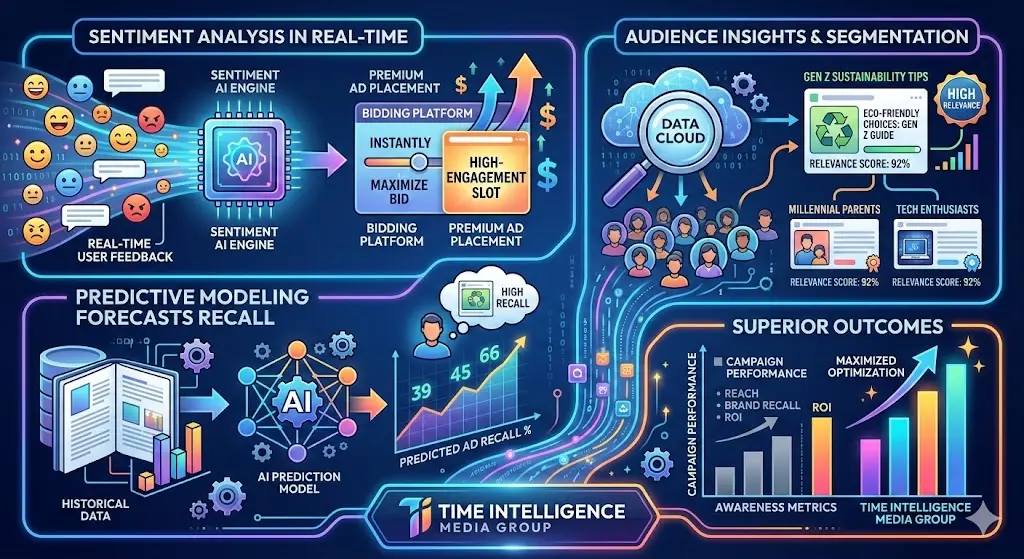
AI analyzes sentiment in real-time, adjusting bids for high-engagement slots. Predictive modeling forecasts recall based on historicals. Audience insights segment for tailored content, like “Gen Z Sustainability Tips” boosting relevance scores. Time Intelligence Media Group employs these for superior outcomes.
Emerging Trends in Sponsored Content for Brand Awareness
2026 trends include immersive AR experiences and voice-activated sponsored podcasts. Shoppable content merges awareness with commerce.
Sustainability and DEI narratives dominate, with 60% consumers favoring aligned brands. Web3 sponsored metaverse events pioneer new frontiers.
Future-Proofing Brand Awareness with Sponsored Content
Evolving regulations demand adaptive strategies, like zero-party data for privacy. Hybrid human-AI creation ensures creativity. Time Intelligence Media Group offers professional Sponsored Content Services to navigate these, building resilient awareness.