Sponsored content in digital media represents a powerful fusion of advertising and editorial storytelling, allowing brands to engage audiences seamlessly without the overt sales pitch of traditional ads. Unlike banner ads or pop-ups that often disrupt user experience, sponsored content blends naturally into the media landscape, providing value through informative articles, videos, or social posts funded by sponsors. This approach has surged in popularity as consumers increasingly seek authentic, helpful content amid ad fatigue.
At its core, sponsored content is any digital media piece created or curated by a brand, influencer, or agency, published on a third-party platform like news sites, blogs, or social channels, and clearly labeled as “sponsored” to maintain transparency. It leverages the trust of established publishers to deliver brand messages indirectly. In today’s crowded digital ecosystem, where attention spans average just eight seconds, sponsored content stands out by prioritizing relevance and utility over hard sells.
Defining Sponsored Content: Key Characteristics and Distinctions
Sponsored content distinguishes itself through its editorial style, mimicking the tone and format of a platform’s organic content while disclosing its paid nature. Regulatory bodies like the FTC in the US and similar authorities worldwide mandate clear disclosures such as #ad or “sponsored” to prevent deception. This transparency builds credibility, ensuring readers know the content is brand-influenced but still valuable.
Key characteristics include native integration—no jarring visuals or interruptions—and a focus on storytelling that educates or entertains. For instance, a fitness brand might sponsor a detailed guide on “Sustainable Workout Routines for Busy Professionals” on a health blog, weaving in product mentions organically. This contrasts with display ads, which prioritize visuals over narrative depth. Sponsored content thrives on context: it’s tailored to the audience’s interests, using data-driven insights to align with trending topics like wellness or sustainability.
In digital media, sponsored content evolves with platform algorithms. On sites like Forbes or BuzzFeed, it appears as branded articles; on Instagram, as influencer stories. The goal remains consistent: foster genuine connections. Brands measure success not just by clicks but by engagement metrics like time on page and shares, proving its efficacy over intrusive formats.
The Evolution of Sponsored Content in the Digital Age
Sponsored content traces its roots to print-era advertorials but exploded with digital media’s rise around 2010. Native advertising platforms like Outbrain and Taboola popularized it, enabling seamless distribution. By 2023, the global native advertising market hit $100 billion, per Statista, driven by mobile consumption and ad-blocker proliferation—over 40% of users now block traditional ads.
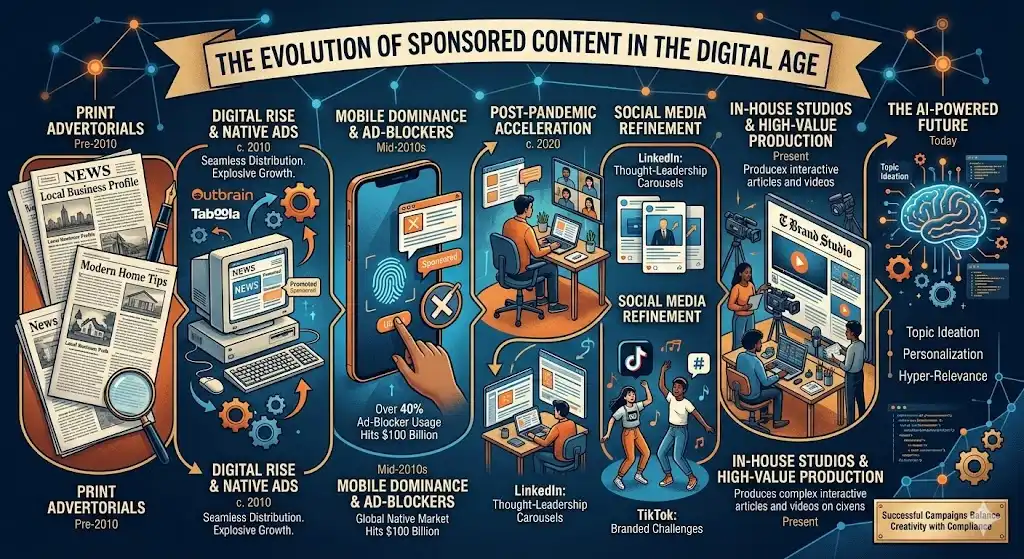
The shift accelerated post-pandemic, as remote work blurred lines between personal and professional content consumption. Social media giants like LinkedIn refined sponsored posts into thought-leadership carousels, while TikTok introduced branded challenges. This evolution reflects consumer preferences: 70% of millennials trust branded content more than direct ads, according to a Nielsen study. Publishers adapted by creating in-house studios, like The New York Times’ T Brand Studio, producing high-production-value pieces.
Today, AI tools enhance creation, from topic ideation to personalization, making sponsored content hyper-relevant. Yet, challenges persist: maintaining authenticity amid scaling pressures. Successful campaigns balance creativity with compliance, ensuring long-term brand loyalty.
How Sponsored Content Differs from Traditional Advertising
Traditional advertising shouts its commercial intent through slogans and calls-to-action, often in fixed formats like TV spots or billboards. Sponsored content whispers value, embedding promotions within narratives that feel organic. Picture a car manufacturer running a 30-second Super Bowl ad versus sponsoring an automotive review series on a site like MotorTrend—the latter builds deeper trust via detailed insights.
Core differences include format flexibility and audience targeting. Traditional ads rely on broad reach via demographics; sponsored content uses behavioral data for precision, like retargeting eco-conscious readers with sustainable brand stories. Engagement rates tell the tale: sponsored content boasts 53% higher viewability than banners, per Sharethrough research, as it doesn’t scream “ad.”
Moreover, sponsored content fosters two-way interaction. Readers comment, share, or even collaborate, turning passive viewers into advocates. Drawbacks? Higher production costs demand strategic planning, but ROI shines in metrics like brand lift—up to 40% in awareness studies.
Benefits of Sponsored Content for Brands and Publishers
For brands, sponsored content amplifies reach through trusted channels, enhancing credibility. A tech firm sponsoring cybersecurity tips on Wired can position itself as an industry leader, driving qualified leads without alienating audiences. Measurable benefits include a 20-30% uplift in purchase intent, as seen in IAB reports.
Publishers gain diversified revenue, with sponsored content comprising 25% of some outlets’ income. It funds quality journalism while matching advertiser goals to editorial niches. Audiences benefit too: relevant content solves problems, like a finance brand’s sponsored guide on “Navigating Crypto Volatility,” blending education with subtle promotion.
Long-term, it builds ecosystems. Brands develop ongoing partnerships, creating content series that nurture loyalty. How Sponsored Content Drives Brand Awareness explores these dynamics further, detailing awareness campaigns.
Real-World Examples and Case Studies in Sponsored Content
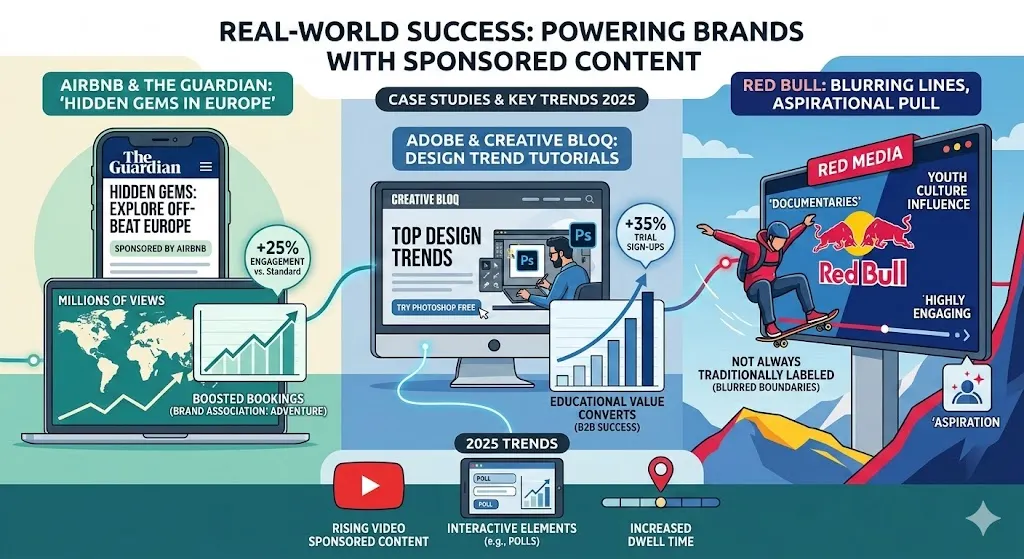
Consider Airbnb’s partnership with The Guardian, sponsoring travel stories like “Hidden Gems in Europe.” Labeled transparently, it garnered millions of views, boosting bookings by associating the brand with adventure. Metrics showed 25% higher engagement than standard articles.
In B2B, Adobe sponsored Creative Bloq tutorials on design trends, seamlessly integrating tools like Photoshop. Results? A 35% increase in trial sign-ups, proving educational value converts. Case studies like these highlight trends: 2025 sees rising video sponsored content on YouTube, with interactive elements like polls boosting dwell time.
Another standout: Red Bull’s media empire, blurring lines with extreme sports documentaries. Though not always labeled traditionally, it exemplifies sponsored content’s aspirational pull, influencing youth culture profoundly.
Creating Effective Sponsored Content: Best Practices
Start with audience research—understand pain points via tools like Google Analytics. Craft headlines with keywords like “sponsored content in digital media” for SEO. Collaborate with publishers experienced in native formats to ensure tonal alignment.
Incorporate visuals: infographics or short videos increase shares by 80%. Write conversationally, using subheadings for scannability. Always disclose prominently. Test variations—A/B headlines—to optimize performance.
For advanced strategies, integrate user-generated content, like sponsored hashtag campaigns. Track with UTM parameters, focusing on KPIs like conversions. Time Intelligence Media Group excels here, offering Sponsored Content Services that deliver measurable outcomes through expert execution.
Challenges and Ethical Considerations in Sponsored Content
Overcoming ad blindness is key; poor execution risks backlash, as seen in 2017’s Peloton controversy where tone-deaf sponsored videos went viral for wrong reasons. Ethical pitfalls include undisclosed sponsorships eroding trust—FTC fines underscore compliance needs.
Balancing brand voice with editorial integrity demands skilled creators. Algorithm changes, like Google’s Helpful Content Update, penalize thin sponsored pieces, favoring depth. Mitigation? Prioritize E-E-A-T (Experience, Expertise, Authoritativeness, Trustworthiness).
Navigating these ensures sustainability. Data privacy laws like GDPR add layers, requiring consent-focused targeting.
The Role of Sponsored Content Services in Modern Marketing
Professional sponsored content services for Brands streamline creation, from ideation to distribution, leveraging networks for premium placements. Agencies like Time Intelligence Media Group provide end-to-end solutions, ensuring compliance and optimization.
These services analyze performance with AI-driven insights, refining future campaigns. In a fragmented media landscape, they offer scalability—handling multimedia across platforms. Brands outsourcing report a 2x faster ROI.
Future Trends Shaping Sponsored Content
Looking to 2026, expect AI personalization: dynamic content adapting to user data. Web3 integrations, like NFT-gated sponsored experiences, emerge. Voice search optimizes for conversational queries on “what is sponsored content.”
Sustainability-focused narratives rise, aligning with Gen Z values. Cross-platform storytelling, from podcasts to AR filters, expands reach. Measurement evolves to sentiment analysis, capturing nuanced impact.
Time Intelligence Media Group stays ahead, delivering professional sponsored content solutions tailored to these trends.