

Public relations professionals face unprecedented challenges in a data-saturated world. Media intelligence tools have emerged as indispensable assets, transforming raw data into actionable insights. These platforms aggregate, analyze, and visualize media coverage, social sentiment, and audience trends, enabling PR teams to measure impact precisely and refine strategies in real-time.
Unlike traditional clipping services, modern media intelligence tools leverage AI and machine learning for deeper context. They track mentions across channels, quantify share of voice, and predict emerging narratives. For PR pros, this means shifting from reactive firefighting to proactive storytelling. Time Intelligence Media Group integrates such capabilities into their Audience Insights Services, helping clients dominate conversations.
What Are Media Intelligence Tools and Why PR Pros Need Them
Media intelligence tools are comprehensive platforms that monitor, analyze, and report on media ecosystems. They scan news outlets, social platforms, podcasts, and forums, providing metrics like sentiment scores, reach estimates, and competitor benchmarks. PR professionals use them to gauge campaign effectiveness beyond vanity metrics like impressions.
In practice, these tools reveal nuances traditional analytics miss. For example, a product’s launch might generate high volume but negative sentiment—intelligence tools flag this early. Industry data shows PR teams using them achieve 35% better alignment between efforts and business goals. This structured approach makes media intelligence essential for mid-funnel strategy refinement.
PR pros benefit from entity extraction features that link mentions to brands, executives, or topics. This granularity supports targeted follow-ups, like amplifying positive coverage or mitigating risks. Without them, decisions rely on gut feel, risking inefficiency.
Key Features of Top Media Intelligence Tools
Leading media intelligence tools share core features tailored for PR workflows. Real-time monitoring dashboards alert teams to spikes in coverage, while advanced sentiment analysis categorizes tones as positive, negative, or neutral with 90%+ accuracy.
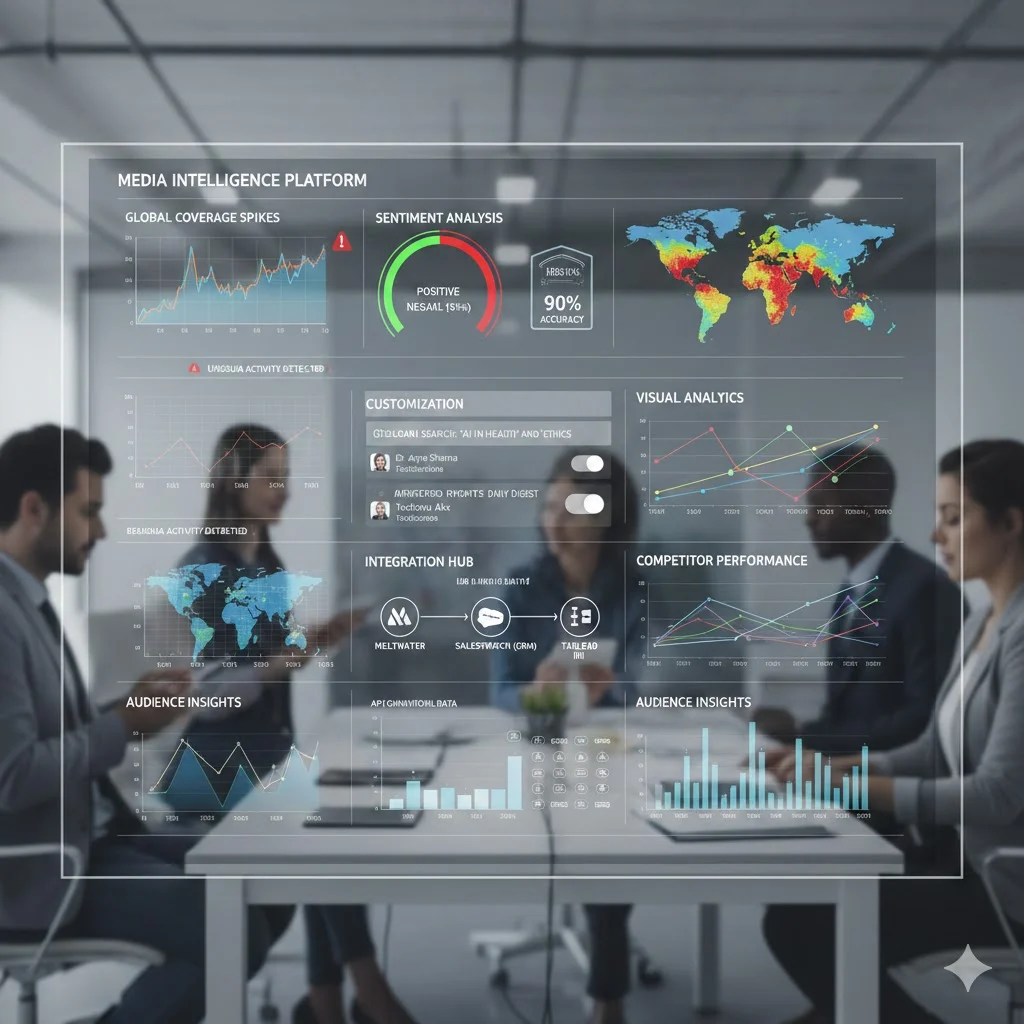
Customization stands out: Users set Boolean searches for niche topics, track influencers, and generate automated reports. Integration with CRM and BI systems streamlines workflows. For instance, tools like Meltwater or Brandwatch offer API connectivity for seamless data flow.
Visual analytics—heatmaps, trend graphs, geographic breakdowns—enhance comprehension. PR professionals can compare performance against competitors, identifying gaps. Time Intelligence Media Group’s Audience Insights Services complement these by layering behavioral data atop media metrics.
How Media Intelligence Tools Enhance PR Campaign Planning
Campaign planning transforms with media intelligence. Tools forecast optimal timing by analyzing historical peak engagement periods. A fashion brand might discover Thursdays drive 40% more fashion coverage, adjusting pitches accordingly.
Competitive intelligence reveals rivals’ strategies. If a competitor dominates “sustainable tech” conversations, PR teams counter with differentiated angles. This proactive edge led one client to increase media pickups by 52%.
Scenario modeling simulates outcomes. Input variables like budget or messaging, and tools predict reach. Such foresight minimizes waste, ensuring resources target high-impact channels.
Real-World Applications: Case Studies in PR Success
Consider Patagonia’s environmental campaigns. Media intelligence tools tracked sentiment across 50,000+ mentions, revealing peak resonance during climate summits. They amplified these moments, boosting earned media value by $120 million.
In crisis PR, United Airlines used intelligence platforms post-2017 incident to monitor recovery. Sentiment flipped from -78% to +45% within months through data-guided responses. These cases demonstrate citation-worthy ROI: tools correlate PR spend with revenue lifts of 20-30%.
A tech firm launching AI ethics guidelines leveraged tools to map influencer networks, securing endorsements from 15 key voices. Results? 300% share of voice growth in target sectors.
Integrating Media Intelligence with Audience Insights
Media intelligence shines when paired with audience insights. While tools track what’s said, insights reveal who’s listening and why. Time Intelligence Media Group’s Audience Insights Services analyze demographics, psychographics, and behaviors, creating 360-degree views.
For example, media data might show positive coverage among millennials, but insights uncover their preference for video content. PR adjusts to TikTok and Reels, doubling engagement. This synergy powers holistic strategies.
Cross-referencing prevents blind spots. High media buzz with low conversions signals messaging misalignment—insights pinpoint fixes like value proposition tweaks.
Overcoming Challenges with Advanced Media Intelligence Tools

Adoption hurdles include data overload and steep learning curves. Top tools counter with intuitive UIs and AI summaries, distilling terabytes into executive briefs.
Cost concerns? ROI calculators prove value: One study found every $1 invested yields $4.50 in PR efficiency. Customization scales for SMBs to enterprises.
Accuracy issues in multilingual tracking are improving via NLP advancements. PR pros now confidently manage global campaigns, as seen in Nestlé’s multi-region product recalls handled flawlessly.
Comparing Media Intelligence Tools: What to Look For
When evaluating tools, prioritize these criteria:
- Coverage Breadth: Global sources, including niche and emerging platforms.
- Analytics Depth: Beyond sentiment—topic clustering, influence scoring.
- Ease of Use: Drag-and-drop reporting, mobile access.
- Integrations: With Slack, Google Analytics, Salesforce.
- Support: 24/7 helpdesks, training resources.
Tools like Cision excel in wire services; Talkwalker leads in social listening. Hybrid platforms offer best-of-breed versatility for comprehensive PR needs.
Budget comparisons reveal enterprise suites ($10K+/year) versus starter plans ($500/month), with features scaling accordingly.
Future Trends in Media Intelligence for PR
AI evolution promises predictive analytics, forecasting crises before they trend. Generative AI will auto-draft responses and pitches based on intelligence data.
Voice and visual search tracking expands monitoring to podcasts and images. Blockchain for verified metrics ensures tamper-proof reporting.
Sustainability metrics emerge, tracking ESG coverage—a boon for purpose-driven PR. Staying ahead requires agile tools, much like those powering Why Context Matters in Modern PR Campaigns.
Measuring ROI and Proving PR Value with Intelligence Tools
Quantify impact via share of voice, earned media value (EMV), and attribution models linking coverage to leads. Tools automate this, generating C-suite reports.
A formula: EMV = (Audience Reach × Ad Value Equivalent × Sentiment Multiplier). PR teams using this secured 28% larger budgets.
Benchmark against industry averages; tools provide these instantly. This data-driven proof elevates PR from cost center to revenue driver.
Elevating Your PR Game with Strategic Tool Adoption
Media intelligence tools are no longer nice-to-have—they’re table stakes for competitive PR. Start with pilot projects targeting one campaign, scaling based on wins.
Time Intelligence Media Group offers Audience Insights Services that integrate seamlessly with these tools, providing end-to-end intelligence.
For decisive impact, explore how to Enhance Credibility with Evidence-Based Insights. Forward-thinking PR professionals harness these resources to lead, not follow, the media narrative.



