

A media-published report reaches 15 UK news sites through structured preparation, media distribution, publication workflows, editorial processing, and digital syndication. Each stage connects the research report with relevant UK news outlets and creates multiple opportunities for public visibility and discovery.
A media-published research report is a structured publication containing original findings, analysis, statistics, survey results, market data, or expert conclusions. When distributed through a professional media network, the report enters a publication process rather than appearing automatically on every website.
The 15-site model focuses on reaching multiple UK news destinations through one coordinated distribution process. The exact outlets depend on editorial relevance, publication requirements, distribution relationships, topic, and the report’s news value.
Readers seeking a broader understanding of this content format can explore:
Media-published research report for the underlying definition, structure, and purpose.
What determines whether a report is suitable for media distribution?
Media suitability depends on the report’s subject, evidence, timeliness, audience relevance, and presentation. A report about UK consumer spending, for example, contains stronger media value when it includes original statistics, a defined research methodology, and findings relevant to current business conditions.
A publication-ready report also requires accurate claims, identifiable sources, clear authorship, and accessible supporting information. These elements help editorial teams assess whether the material meets their publication standards.
What happens before a research report is distributed to UK news sites?
Before distribution, a research report is reviewed for news value, factual accuracy, structure, relevance, and technical readiness. Headlines, summaries, statistics, quotations, links, branding, and supporting information are organised into a format suitable for media publication.
Preparation creates the foundation for successful distribution. The report is converted from a research document into media-ready content without changing the substance of the research.
How is the report structured?
A typical media-ready report contains:
- A clear headline
- A concise introduction
- Key research findings
- Supporting statistics
- Methodology information
- Expert or executive commentary
- Relevant quotations
- Source information
- Organisation details
- Contact information
- Relevant website links
Each component serves a specific communication function. The headline establishes the primary news subject. The introduction explains why the findings matter. Statistics provide measurable evidence. Methodology establishes how the findings were produced.
Why does the headline matter?
The headline provides the first indication of the report’s news value. A specific headline such as “UK SME Investment Falls 18% in 2026 Research” communicates the subject, geography, audience, and principal finding immediately.
Specific headlines also support search visibility because they contain identifiable entities and topics. Generic headlines provide less contextual information for readers, search engines, and news platforms.
How is a report distributed across 15 UK news sites?
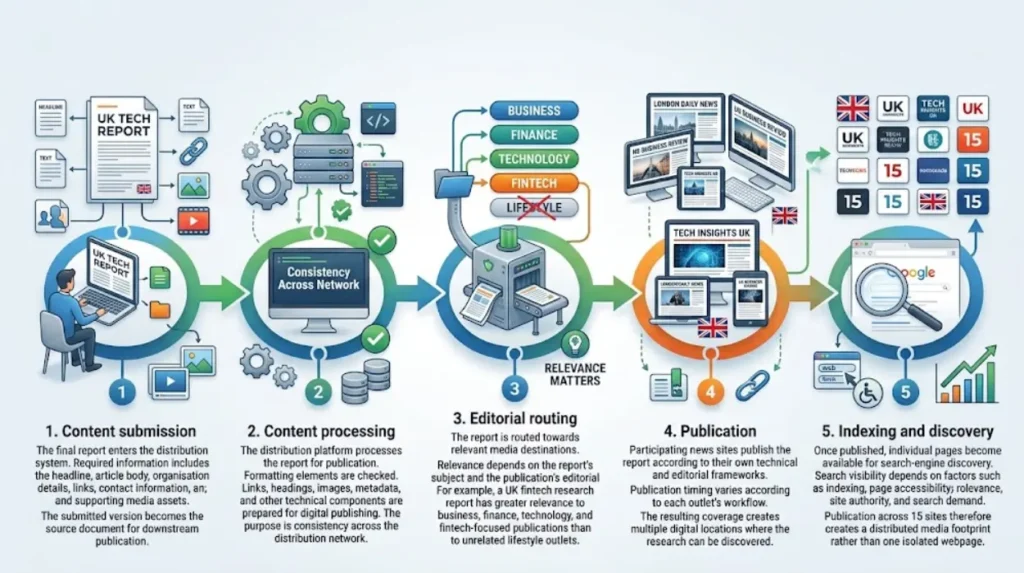
Distribution sends one approved research report through a media network that connects the content with multiple UK news publishing destinations. The process involves submission, technical processing, editorial handling, publication, indexing, and monitoring across participating outlets.
Distribution does not mean manually submitting the same report separately to 15 editorial teams. A coordinated media distribution system processes the content and delivers it through established publishing channels.
The workflow normally follows several connected stages.
1. Content submission
The final report enters the distribution system. Required information includes the headline, article body, organisation details, links, contact information, and supporting media assets.
The submitted version becomes the source document for downstream publication.
2. Content processing
The distribution platform processes the report for publication. Formatting elements are checked. Links, headings, images, metadata, and other technical components are prepared for digital publishing.
The purpose is consistency across the distribution network.
3. Editorial routing
The report is routed towards relevant media destinations. Relevance depends on the report’s subject and the publication’s editorial focus.
For example, a UK fintech research report has greater relevance to business, finance, technology, and fintech-focused publications than to unrelated lifestyle outlets.
4. Publication
Participating news sites publish the report according to their own technical and editorial frameworks. Publication timing varies according to each outlet’s workflow.
The resulting coverage creates multiple digital locations where the research can be discovered.
5. Indexing and discovery
Once published, individual pages become available for search-engine discovery. Search visibility depends on factors such as indexing, page accessibility, content relevance, site authority, and search demand.
Publication across 15 sites therefore creates a distributed media footprint rather than one isolated webpage.
What components help a report achieve wider UK media coverage?
The strongest distribution packages combine original research, clear statistics, news-focused headlines, credible methodology, relevant commentary, accurate metadata, and publication-ready formatting. These components give editors and digital platforms clear information about the report’s subject and relevance.
The content itself remains central to distribution performance. A technically perfect submission does not replace strong research.
Original findings
Original data provides a clear reason for publication. For example, a survey identifying that 62% of UK consumers changed purchasing behaviour during a defined period gives journalists a measurable finding to assess.
Defined methodology
Methodology explains how the research was conducted. It identifies the sample, research period, geographical scope, data source, and measurement approach.
A report based on 2,000 UK respondents has a clearer research definition than a report that simply states that “thousands of people” were surveyed.
Expert commentary
Commentary explains the significance of research findings. A finance report, for example, can include analysis from a chief executive, economist, researcher, or industry specialist.
The quotation must relate directly to the published findings.
Search-friendly language
Relevant entities and keywords improve contextual clarity. A report about UK property investment benefits from precise references to property investment, commercial property, residential property, regional markets, and relevant UK locations when those subjects form part of the research.
What benefits come from reaching 15 UK news sites?
Reaching 15 UK news sites creates broader digital distribution, multiple publication points, greater opportunities for audience discovery, stronger media presence, and a larger searchable footprint. It also gives organisations measurable coverage assets for reporting and future communications activity.
The value of multi-site distribution extends beyond the number of published pages. Each publication creates another digital location associated with the research.
How does multi-site publication increase visibility?
A report published across 15 sites has 15 potential publication locations rather than one. Each site serves its own audience, search environment, and editorial context.
For example, a construction market report can reach business readers, property professionals, investors, developers, and construction-sector audiences through relevant publications.
How does publication support brand visibility?
The organisation behind the research appears as the source or publisher of the findings. Repeated exposure across relevant media environments strengthens recognition of the organisation’s research activity.
This is particularly relevant for companies producing regular market studies, industry surveys, economic reports, or consumer research.
How does media coverage support SEO?
Published research creates indexable pages containing relevant entities, terminology, statistics, and references. Some publications also provide links to the organisation’s website.
The SEO value depends on the publication’s technical setup, link attributes, indexing status, topical relevance, and the quality of the resulting coverage. Distribution therefore supports SEO as part of a wider digital authority strategy rather than functioning as a standalone ranking mechanism.
How can organisations evaluate the performance of 15-site report distribution?
Organisations can evaluate distribution through publication count, confirmed URLs, indexed pages, referral traffic, search visibility, audience engagement, backlink data, and media reporting. These measurements show whether distribution produced discoverable coverage and meaningful digital outcomes.
Measurement converts media publication into trackable activity. A distribution report can record the outlets, publication dates, URLs, headlines, and other available coverage information.
Which metrics matter most?
Useful metrics include:
- Number of confirmed publications
- Number of live URLs
- Number of indexed pages
- Referral sessions
- Organic search impressions
- Search clicks
- Backlinks
- Referral domains
- Engagement with published content
- Leads attributed to media activity
Each metric answers a different question. Publication count measures distribution. Referral traffic measures visits. Search data measures discovery. Lead attribution measures commercial impact.
Why is URL-level tracking important?
URL-level tracking identifies where the report appeared. It also enables teams to distinguish between successful publication and unsuccessful distribution.
For example, a campaign with 15 confirmed URLs provides a verifiable coverage record. A campaign described only as “distributed widely” provides less measurable evidence.
When is 15-site media distribution useful for research reports?
Fifteen-site distribution is useful when research contains newsworthy findings that require broader UK visibility. It fits market reports, consumer surveys, industry studies, business research, economic findings, technology reports, and other evidence-led publications.
Different research categories create different media opportunities.
Market research
Market reports provide data about demand, pricing, investment, growth, competition, and consumer behaviour. These findings have direct relevance to business and sector publications.
Consumer research
Consumer surveys provide measurable findings about purchasing decisions, attitudes, preferences, and behavioural changes. Clear UK demographic data improves contextual relevance.
Industry research
Industry reports focus on defined sectors such as fintech, healthcare, property, construction, technology, or professional services. Specialist findings provide targeted media relevance.
Corporate research
Companies also publish research to demonstrate expertise in a specific market. A technology company, for example, can publish research about artificial intelligence adoption among UK businesses.
How should organisations choose between different media distribution approaches?
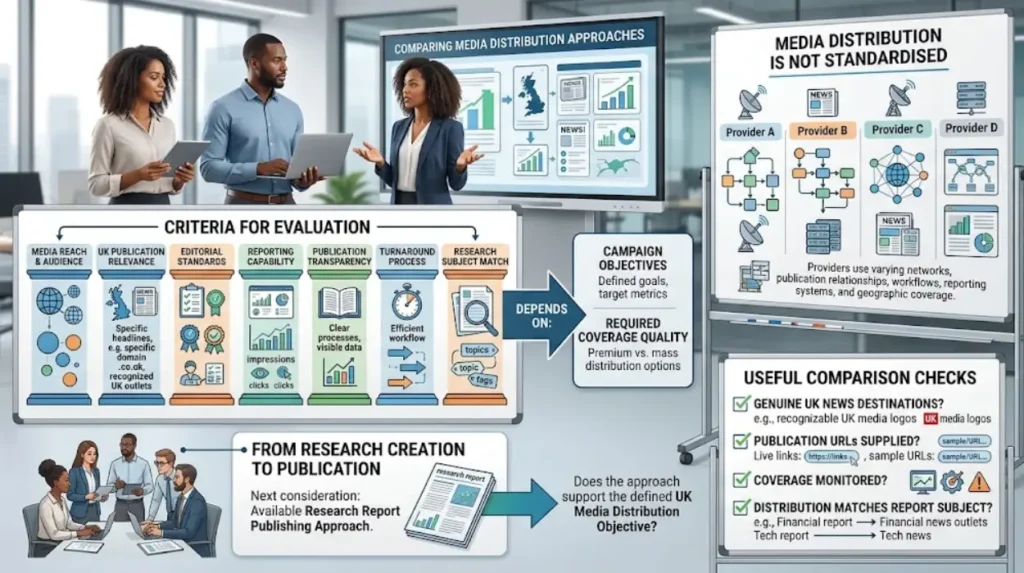
Organisations should compare distribution approaches by media reach, UK publication relevance, editorial standards, reporting capability, publication transparency, turnaround process, and the type of research being distributed. The appropriate option depends on campaign objectives and required coverage quality.
Media distribution is not a single standardised service. Providers use different networks, publication relationships, workflows, reporting systems, and geographic coverage.
A useful comparison examines whether the network provides genuine UK news destinations, whether publication URLs are supplied, whether coverage is monitored, and whether the distribution process matches the report’s subject.
For organisations moving from research creation to publication, the next consideration is the available:
Research report publishing approach and how it supports a defined UK media distribution objective.
What should organisations check after a report reaches 15 UK news sites?
After publication, organisations should verify every coverage URL, confirm the published content, record publication dates, check indexing status, monitor referral traffic, and preserve coverage evidence. Post-publication monitoring establishes whether the intended distribution produced measurable media assets.
Verification provides a complete record of the campaign. Teams can place confirmed URLs into a media coverage report and monitor performance over time.
A useful report separates confirmed publication from estimated reach. It also identifies publication dates and individual outlets.
Search performance can then be assessed through search impressions, clicks, rankings, and branded search activity. Referral analytics can identify visits originating from published media pages.
For research-led organisations, this information supports future distribution planning. It identifies which subjects generate coverage, which publications provide useful audiences, and which research formats create measurable engagement.
Explore More Expert Insights:
Writing an Executive Summary That Makes UK Journalists Cover Your Report
How to Promote a UK Research Report Across Earned, Owned and Paid Channels
A 15-site distribution strategy therefore combines research quality, media relevance, structured delivery, publication, and measurement. The number of sites provides a defined distribution target, while the quality of the research determines the substance available for publication.
The next stage is selecting a suitable publishing route and understanding how the research report moves from a completed document into a coordinated UK media campaign.



