

Sponsored content is paid editorial-style material created to inform a defined audience while supporting a commercial objective. It combines useful information with relevant brand messaging, giving readers a clear path from awareness to interest and measurable lead activity.
Sponsored content appears across digital publications, news websites, industry platforms, and specialist media channels. The content is paid for by an advertiser but presented in a format that resembles the publication’s standard editorial content.
The primary purpose is not simply to generate impressions. Effective sponsored content connects audience attention, relevant information, brand positioning, and a measurable next step.
A sponsored article can explain an industry problem, present research findings, discuss market developments, or answer a common customer question. The commercial element sits within this informational context.
How does sponsored content differ from traditional advertising?
Traditional display advertising relies on visual placements such as banners, native advertisements, and promotional graphics. Sponsored content uses longer-form information to engage readers.
For example, a financial technology company can publish an educational article about fraud prevention rather than displaying a banner that simply promotes its software.
This format gives the reader more context before a lead-generation action takes place.
How does sponsored content move a UK reader toward becoming a lead?
Sponsored content converts readers through a sequence of awareness, relevance, engagement, trust, interest, and action. Each stage reduces uncertainty and directs readers toward a defined conversion point, such as a form submission, enquiry, download, registration, or consultation request.
The conversion process begins before a reader interacts with a landing page. The article establishes the subject, identifies a relevant problem, and introduces information connected to the reader’s needs.
A typical journey contains six stages:
- Awareness – The reader discovers the content.
- Relevance – The topic matches a recognised need.
- Engagement – The reader consumes useful information.
- Interest – The reader explores a solution or related subject.
- Intent – The reader takes an identifiable action.
- Lead capture – Contact information or enquiry details enter a marketing or sales process.
Each stage has a different function. A reader who only views an article has demonstrated attention. A reader who completes a form has demonstrated identifiable interest.
Why does relevance matter?
Relevance determines whether the reader continues beyond the first interaction.
A UK property professional reading an article about commercial property investment has a stronger contextual connection to a property-related solution than a general internet user encountering an unrelated advertisement.
Topic selection therefore affects lead quality as well as traffic volume.
What components make sponsored content effective for lead generation?

Effective sponsored content combines a specific audience, relevant subject, useful information, credible evidence, clear positioning, appropriate calls to action, and measurable conversion points. These components work together to turn content consumption into identifiable commercial interest.
The first component is audience definition. Content needs a clear reader profile. Examples include UK financial services professionals, procurement managers, healthcare decision-makers, property investors, or technology buyers.
The second component is topic relevance. The subject needs a direct relationship with a recognised audience problem.
The third component is informational value. Readers receive facts, explanations, processes, statistics, or practical guidance.
The fourth component is commercial relevance. The content establishes a connection between the problem discussed and the category of solution available.
The fifth component is conversion architecture. The article includes an appropriate next step without disrupting the informational purpose.
What role does the headline play?
The headline establishes the initial relevance of the article.
A headline such as “How UK Businesses Can Improve Cybersecurity Awareness” communicates a specific topic and audience context. It attracts readers who already have an interest in the subject.
A vague headline provides less information about the article’s purpose and attracts less qualified attention.
Why is the introduction important?
The introduction confirms the reader’s decision to continue.
It identifies the problem, establishes the subject, and explains what information the article contains. A strong introduction avoids unnecessary background and moves directly into the reader’s area of interest.
How does useful information influence lead quality?
Useful information improves lead quality by attracting readers with genuine interest in a defined subject. When content answers specific questions, readers who continue engaging demonstrate stronger topical relevance than visitors generated through broad promotional exposure.
Information quality affects who remains engaged with the content.
For example, an article explaining UK payroll compliance requirements attracts readers with a specific professional interest. A reader who reaches the final section has demonstrated sustained attention to the topic.
This behavioural signal differs from a simple page impression.
What types of information work well?
Sponsored content can use several information formats:
- Industry statistics
- Regulatory explanations
- Step-by-step processes
- Expert interviews
- Research findings
- Market trends
- Practical checklists
- Common mistakes
- Frequently asked questions
- Case-based examples
Specific information gives readers a reason to continue reading.
For example, an article about procurement can explain supplier evaluation criteria, contract risks, documentation requirements, and compliance considerations before introducing a relevant next step.
How do calls to action convert sponsored content readers?
A call to action converts reader interest into measurable behaviour by giving the audience a defined next step. Common actions include downloading a resource, completing an enquiry form, registering for an event, requesting information, or visiting a relevant landing page.
A call to action, commonly abbreviated as CTA, is an instruction that directs a reader toward a specific action.
The CTA needs to match the reader’s level of interest.
An educational reader often responds to an informational next step. A reader with stronger commercial intent responds to an enquiry or consultation action.
What are examples of suitable CTAs?
Examples include:
- Download an industry report
- Read a related guide
- Register for a webinar
- Access a research paper
- Request further information
- Complete an enquiry form
- Explore a relevant solution
The CTA needs a clear relationship with the article topic.
An article about UK financial risk management can direct readers toward a detailed risk management resource. An unrelated CTA creates a break in the reader journey.
How does sponsored content build trust before a lead conversion?
Sponsored content supports trust by providing transparent, relevant information before asking readers to take action. Clear sourcing, accurate claims, subject expertise, publication context, and consistent messaging reduce uncertainty and help readers evaluate the information behind a commercial proposition.
Trust develops through the quality and clarity of the information presented.
Sponsored content needs to remain identifiable as sponsored material. Transparency distinguishes paid content from independent editorial coverage.
Credible information also requires accurate terminology and factual claims. For regulated industries, this includes precise references to applicable UK requirements and professional standards.
Why does publication context matter?
The publication provides an established environment for content discovery.
A reader already interested in business, finance, technology, healthcare, property, or another specialist subject encounters sponsored content within a relevant information environment.
Context helps explain why the article exists and who it addresses.
How does sponsored content generate measurable UK leads?
Sponsored content generates measurable UK leads when reader interactions connect to identifiable conversion mechanisms. Tracking links, landing pages, forms, downloads, registrations, and enquiry records allow marketers to connect content exposure with specific actions and subsequent lead-management activity.
Measurement begins with defining the conversion event.
A lead is a person or organisation that provides an identifiable indication of commercial interest. Depending on the campaign, this can involve submitting contact details, requesting information, registering for an event, or downloading a gated resource.
Which metrics indicate conversion performance?
Relevant metrics include:
- Article views
- Engaged reading time
- Click-through rate
- CTA interaction rate
- Landing-page visits
- Form completion rate
- Download volume
- Lead volume
- Qualified lead volume
- Cost per lead
- Lead-to-opportunity rate
These metrics describe different stages of the reader journey.
For example, a high number of article views with few conversions indicates strong exposure but weak progression toward action. A lower traffic volume with a higher qualified-lead rate indicates stronger audience relevance.
What makes sponsored content relevant to UK audiences?
UK-focused sponsored content uses local terminology, regulatory context, industry conditions, geographic relevance, and audience-specific concerns. This increases topical alignment because readers encounter information connected to the United Kingdom rather than generic international messaging.
UK audiences operate within specific commercial and regulatory environments.
For example, financial services content can reference UK regulatory institutions and market structures. Employment content can address UK workplace requirements. Property content can distinguish regional market conditions across London, Manchester, Birmingham, Edinburgh, and other locations.
Why does geographic specificity matter?
Geographic specificity helps identify the intended audience.
A campaign targeting UK business leaders has a different content context from one targeting a global audience. Regional examples also help readers assess whether the information applies to their operating environment.
For example, a sponsored article about UK construction procurement can discuss domestic procurement practices, contract structures, and market conditions rather than using general international examples.
How does sponsored content support the wider lead-generation journey?
Sponsored content functions as an upper-funnel entry point that introduces a subject, captures relevant attention, and directs interested readers toward deeper information. The subsequent journey connects content engagement with consideration, evaluation, and eventual commercial enquiry.
Sponsored content does not operate independently from the wider marketing funnel.
The reader can move from an educational article to a more detailed resource, then to a solution-focused page.
Readers seeking deeper information can explore:
Qualified leads as the next stage of understanding how sponsored content connects audience engagement with lead qualification.
At this stage, the objective changes from basic awareness to stronger evaluation of lead-generation approaches.
What happens after a reader becomes interested?
The next stage involves additional information.
A reader can review technical documentation, compare solutions, examine evidence, attend a webinar, download research, or submit an enquiry.
The marketing process then records the interaction and determines whether the contact meets the organisation’s qualification criteria.
Which industries use sponsored content to generate leads?
Sponsored content supports lead generation across industries where buyers require information before making decisions. Common examples include financial services, technology, healthcare, professional services, property, construction, education, recruitment, and business-to-business sectors.
The format is particularly relevant where purchasing decisions involve research.
What does this look like in practice?
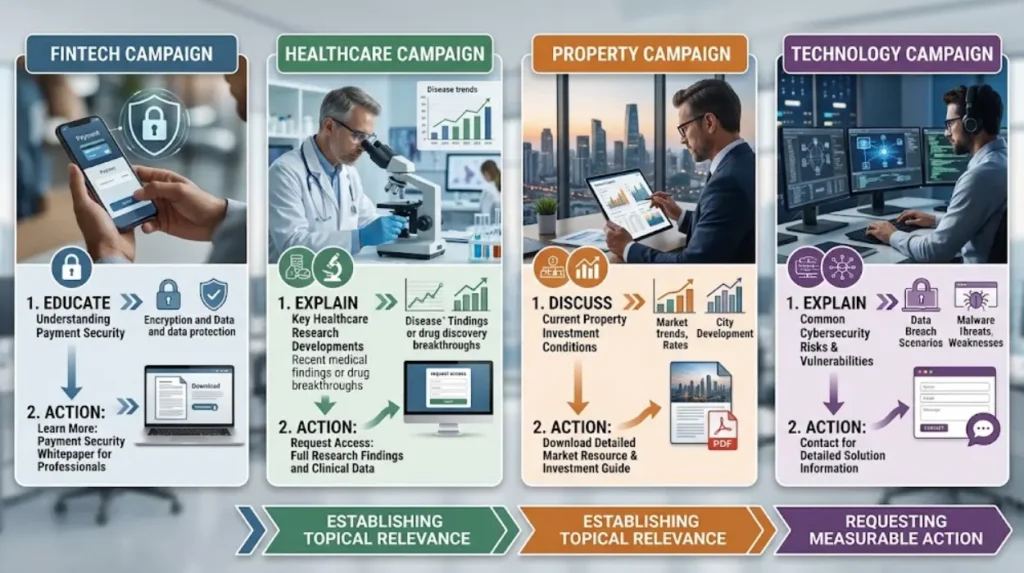
A fintech campaign can educate readers about payment security before directing interested professionals toward further information.
A healthcare campaign can explain developments in a defined healthcare area before providing access to research.
A property campaign can discuss investment conditions before directing readers toward a detailed market resource.
A technology campaign can explain cybersecurity risks before introducing further solution information.
In each case, the content establishes topical relevance before requesting a measurable action.
Explore More Expert Insights:
Why Recruitment Firms Publish UK Sponsored Content
What Makes Sponsored Content Outperform Display Ads
Why does sponsored content matter in the modern UK lead-generation funnel?
Sponsored content connects paid media exposure with educational engagement and measurable lead activity. Its value comes from combining audience targeting, useful information, contextual relevance, conversion paths, and performance measurement within one structured reader journey.
The fundamental process is straightforward: the right audience encounters relevant information, engages with the subject, develops interest, and receives a defined route toward further action.
Sponsored content therefore sits between awareness and deeper consideration. It provides information before conversion and creates measurable signals that help businesses understand audience interest.
For organisations developing a broader content strategy, understanding this progression provides the foundation for evaluating more advanced approaches to converting sponsored content engagement into qualified business opportunities.



