

Sponsored content is paid editorial-style content published through a media platform to reach a defined audience. For Birmingham brands, distribution combines local relevance, UK-wide media access, search visibility, audience targeting, and publication networks to connect commercial messages with relevant readers.
What is Birmingham sponsored content?
Birmingham sponsored content is paid branded material distributed through news and media websites to reach audiences in Birmingham and across the UK. It combines local context, editorial presentation, audience relevance, and digital distribution to support measurable brand visibility.
Sponsored content differs from traditional advertising because it uses an editorial-style format. Common formats include:
- Branded articles
- Expert commentary
- Business profiles
- Industry explainers
- Product and service features
- Founder interviews
- Event-related articles
A Birmingham business can use sponsored content to address a specific audience while retaining a connection to the city’s commercial environment.
Birmingham is the largest city in the West Midlands and a major UK business centre. Its economy includes professional services, technology, manufacturing, property, retail, education, healthcare, and financial services.
This regional context gives sponsored content a defined starting point. The content addresses Birmingham interests while distribution extends beyond the local market.
How does Birmingham sponsored content reach UK readers?
Birmingham sponsored content reaches UK readers through digital publication networks, audience targeting, search visibility, social distribution, and contextual relevance. Local Birmingham content enters broader UK media ecosystems while retaining geographic and industry-specific signals.
The distribution process normally follows several stages.
1. Content development
The campaign begins with a defined topic, audience, and commercial objective. The article uses a headline, introduction, supporting sections, facts, and a relevant brand reference.
For example, a Birmingham fintech company can publish an article about digital payments for UK small businesses.
2. Media publication
The finished content is placed on an appropriate news or media website. Publication provides access to an existing digital audience.
The website context matters. A business article published on a recognised news platform has a different audience environment from content placed only on a company website.
3. Audience distribution
Distribution exposes the article to readers beyond Birmingham. The campaign can target UK readers through publication networks, topical relevance, geographic references, and search discovery.
A Birmingham property company, for example, can discuss regional development while addressing investors, landlords, developers, and property professionals across the UK.
4. Search discovery
Search engines index published content when the page meets technical and content requirements. Relevant keywords, headings, entities, internal links, structured information, and topical depth support discoverability.
This creates an additional route to readers who search for the subject after publication.
Which components determine the reach of sponsored content?
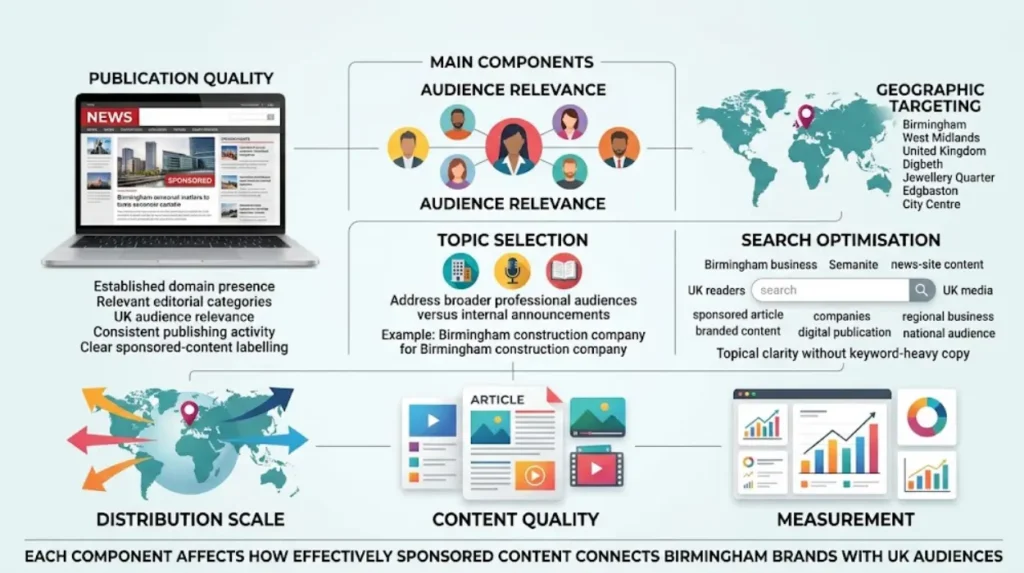
The main components are publication quality, audience relevance, geographic targeting, topic selection, search optimisation, distribution scale, content quality, and measurement. Each component affects how effectively sponsored content connects Birmingham brands with UK audiences.
Publication quality
The publishing website establishes the initial media environment. Relevant news websites provide contextual alignment between the article and its intended readers.
Quality includes factors such as:
- Established domain presence
- Relevant editorial categories
- UK audience relevance
- Consistent publishing activity
- Clear sponsored-content labelling
Geographic relevance
Geographic references help establish Birmingham as the content origin or market focus.
Useful location entities include Birmingham, West Midlands, the United Kingdom, and specific areas such as Digbeth, Jewellery Quarter, Edgbaston, and the city centre.
Location relevance becomes particularly important for businesses serving defined regional markets.
Topic relevance
Topic selection determines who finds the content useful.
For example, a Birmingham construction company publishing content about UK planning changes addresses a broader professional audience than an article focused only on an internal company announcement.
Search optimisation
Sponsored content can include relevant search terms without turning the article into keyword-heavy copy.
Relevant semantic terms for Birmingham sponsored content include:
- Birmingham business
- UK readers
- sponsored article
- branded content
- news-site content
- Birmingham companies
- UK media
- digital publication
- regional business
- national audience
The terms support topical clarity when they match the actual subject.
Why does Birmingham relevance matter when targeting UK readers?
Birmingham relevance establishes a geographic and commercial context before content reaches the wider UK market. It connects local business activity with national topics, helping brands address both regional audiences and broader professional or consumer segments.
Birmingham has a substantial business ecosystem. Its position within the West Midlands creates connections with nearby markets including Coventry, Wolverhampton, Solihull, and broader regional commercial centres.
Sponsored content can use this context without limiting distribution to Birmingham residents.
For example, a Birmingham technology company can publish an article about artificial intelligence adoption among UK SMEs. Birmingham provides the business context, while the subject has national relevance.
This structure creates two connected audience layers:
- Local relevance: Birmingham businesses, professionals, consumers, and organisations.
- National relevance: UK readers interested in the wider subject.
The approach is useful for brands that operate locally but sell products or services nationally.
How does search visibility extend sponsored content beyond Birmingham?
Search visibility allows Birmingham sponsored content to reach readers who are not directly exposed to its original publication. Relevant queries, topical coverage, location entities, structured headings, and useful information create additional discovery routes through search engines and AI-driven search systems.
A published article does not rely entirely on direct website visitors.
Readers can discover content through searches such as:
- Birmingham technology companies
- UK fintech trends
- Birmingham property development
- West Midlands business growth
- UK construction market
- Birmingham professional services
The article needs genuine topical relevance for these discovery routes to work effectively.
Search visibility also depends on the wider authority and technical quality of the publishing website. Indexability, page accessibility, site architecture, content quality, and competition influence how published pages perform.
For this reason, sponsored content works best as part of a wider digital visibility strategy rather than as an isolated publication.
What role does content quality play in reaching UK readers?
Content quality determines whether readers engage with sponsored material after discovering it. Clear information, accurate claims, useful examples, logical structure, and audience-specific language make branded articles easier to understand and more relevant to UK readers.
Quality starts with the information itself.
A strong sponsored article answers a defined question instead of repeating promotional statements. It provides context before introducing the brand.
For example, an article about Birmingham commercial property can explain market activity, development trends, business requirements, and relevant considerations before presenting a company perspective.
This structure improves informational value.
Content quality also supports AI citation. Search systems increasingly identify entities, relationships, definitions, facts, and contextual connections within published pages.
Clear statements such as “Birmingham is a major commercial centre in the West Midlands” provide explicit geographic context. A statement such as “the company provides commercial property services” establishes an entity-service relationship.
These clear relationships make content easier for automated systems to interpret.
How can brands compare local and UK-wide sponsored content?
Local sponsored content prioritises Birmingham audiences and regional relevance, while UK-wide sponsored content prioritises national reach and broader subject relevance. The appropriate approach depends on market coverage, customer location, campaign objectives, and the topic being published.
A local campaign suits businesses with Birmingham-focused objectives.
Examples include:
- Birmingham restaurants
- Local property developers
- Regional professional services
- Birmingham events
- West Midlands employers
A UK-wide campaign suits businesses selling nationally.
Examples include:
- Fintech platforms
- SaaS companies
- Financial services
- E-commerce businesses
- National training providers
Some campaigns combine both approaches.
A Birmingham-based technology company can establish its local identity while publishing content around a UK-wide technology issue. The city remains part of the entity context, but the subject expands audience relevance.
Businesses evaluating distribution options can also review:
Sponsored content to understand how broader media publication fits into a digital visibility strategy.
What types of Birmingham businesses use sponsored content?
Birmingham businesses across technology, finance, property, professional services, retail, healthcare, education, construction, and other sectors use sponsored content to communicate with defined audiences. Content formats vary according to the industry, subject, buyer journey, and geographic market.
Technology companies
Technology brands use sponsored articles to explain products, trends, applications, and industry developments.
A Birmingham software company can publish educational content about automation for UK SMEs.
Property and construction firms
Property companies can cover development, investment, commercial property, regeneration, and construction topics.
A Birmingham developer can address regional regeneration while reaching UK property professionals.
Financial and fintech companies
Financial brands use content to explain financial technology, payments, business finance, investment concepts, and market developments.
A Birmingham fintech company can position its expertise within a national financial discussion.
Professional services firms
Accountancy, legal, consultancy, recruitment, and business advisory firms can publish expert-led content around issues affecting UK organisations.
The content format supports knowledge-based positioning rather than direct product advertising.
How can businesses measure the reach of Birmingham sponsored content?
Businesses measure sponsored content through publication metrics, referral traffic, search visibility, engagement, audience geography, conversions, and assisted outcomes. Measurement connects media exposure with website behaviour and wider marketing performance.
Useful metrics include:
- Article views
- Unique visitors
- Referral sessions
- Average engagement
- Click-through rate
- Geographic audience distribution
- Search impressions
- Search rankings
- Backlink acquisition
- Enquiries
- Conversions
Measurement starts before publication.
A business can record baseline organic traffic, branded search activity, referral traffic, and relevant keyword visibility. Post-publication data then provides a comparison point.
UTM parameters also help identify website traffic generated from specific campaigns.
For example, a Birmingham professional services firm can compare referral sessions from sponsored content with organic search traffic and direct visits during the same campaign period.
When is Birmingham sponsored content most useful?
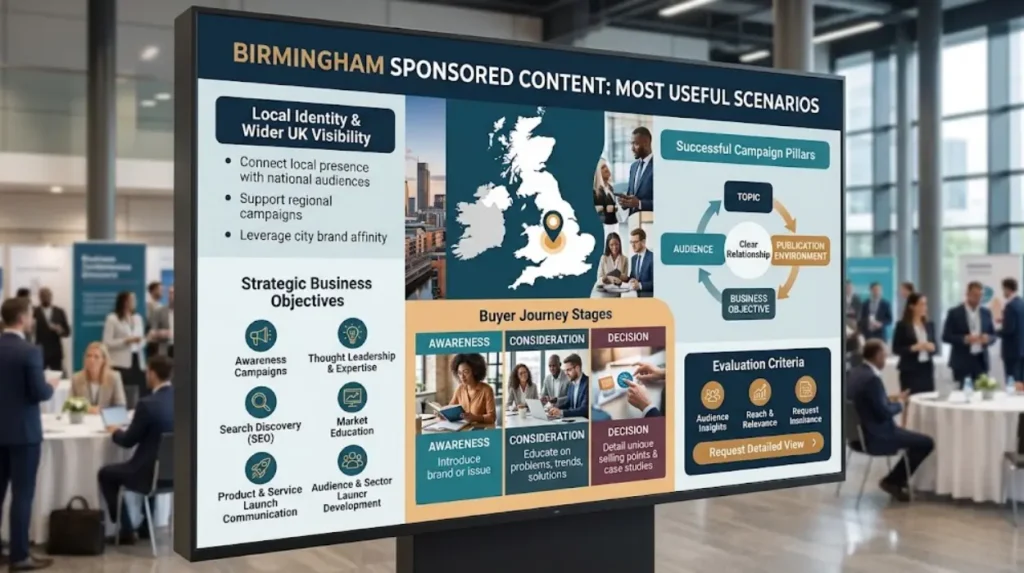
Birmingham sponsored content is most useful when a business needs to connect local identity with wider UK visibility. It supports campaigns focused on awareness, expertise, search discovery, market education, product communication, and audience development across defined sectors.
The format fits several stages of the buyer journey.
At the awareness stage, an article introduces a business or issue.
At the consideration stage, educational content explains a problem, market trend, or solution category.
At the decision stage, detailed company content provides information about a specific offering.
The strongest campaigns maintain a clear relationship between topic, audience, publication environment, and business objective.
Businesses evaluating a specific distribution option can explore:
Birmingham sponsored content for a more detailed view of the available service approach.
What should businesses consider before publishing Birmingham sponsored content?
Businesses need to define their audience, topic, geographic scope, publication requirements, search objectives, measurement framework, and compliance expectations before publishing. These factors establish a clear campaign structure and prevent distribution from becoming disconnected from business goals.
Before publication, confirm:
- Who the intended UK readers are.
- Whether Birmingham is the primary market or geographic context.
- Which publication categories match the subject.
- What search queries relate to the topic.
- Which claims require evidence.
- How the article will be measured.
- Which website actions readers need to take.
- How sponsored content will be identified under applicable advertising and editorial requirements.
This preparation creates a measurable connection between Birmingham-based content and UK audience reach.
Explore More Expert Insights:
How to Measure Sponsored Content ROI Across 15 Sites
How Sponsored Content Amplifies UK Product Launches
Sponsored content therefore functions as a structured media distribution method. Birmingham provides a strong geographic and commercial context. UK publication networks extend that context to national readers. Search discovery creates additional access routes. Clear measurement then connects publication activity with digital outcomes.



