

Sponsored content is paid media created with a brand but presented through a publisher’s content environment. For UK energy brands, it provides controlled access to defined audiences through relevant publications, editorial formats, search visibility, and measurable distribution channels across the energy sector.
Energy companies operate in a complex information environment. Their audiences include consumers, investors, procurement teams, policymakers, engineers, sustainability professionals, and business leaders. Each group searches for different information.
Sponsored content gives energy brands a structured method for presenting this information to relevant UK audiences. The content appears through established media channels while clearly identifying its commercial nature.
For readers who are still assessing why this approach matters:
Energy Brands Publish Sponsored Content provides the wider context behind the growing use of paid editorial formats.
What is energy sponsored content?
Energy sponsored content is paid media produced around an energy company, project, technology, or topic and distributed through relevant publishers to reach defined UK audiences with controlled messaging and measurable exposure.
The content focuses on an identifiable subject. Examples include renewable energy projects, energy efficiency technology, battery storage, electric vehicle infrastructure, smart grids, nuclear energy, and energy market developments.
Unlike a conventional display advertisement, sponsored content uses an editorial format. The publisher hosts the article, interview, case study, analysis, or other agreed content format.
The commercial relationship remains identifiable. UK audiences need to distinguish sponsored material from independent editorial reporting.
Which energy topics work well?
Energy sponsored content covers several established subject areas:
- Renewable energy and solar power
- Offshore wind development
- Energy storage and batteries
- Electricity networks and grid infrastructure
- Energy efficiency
- Smart energy technology
- Electric vehicle charging
- Nuclear energy
- Low-carbon heating
- Energy management
- Industrial decarbonisation
- Energy policy and market developments
A solar developer, for example, can publish a project case study explaining capacity, location, technology, delivery stages, and expected operational benefits.
How does sponsored content reach UK audiences?
Sponsored content reaches UK audiences through publisher selection, audience targeting, content production, digital distribution, search optimisation, social promotion, and performance measurement across relevant national, regional, business, and specialist media channels.
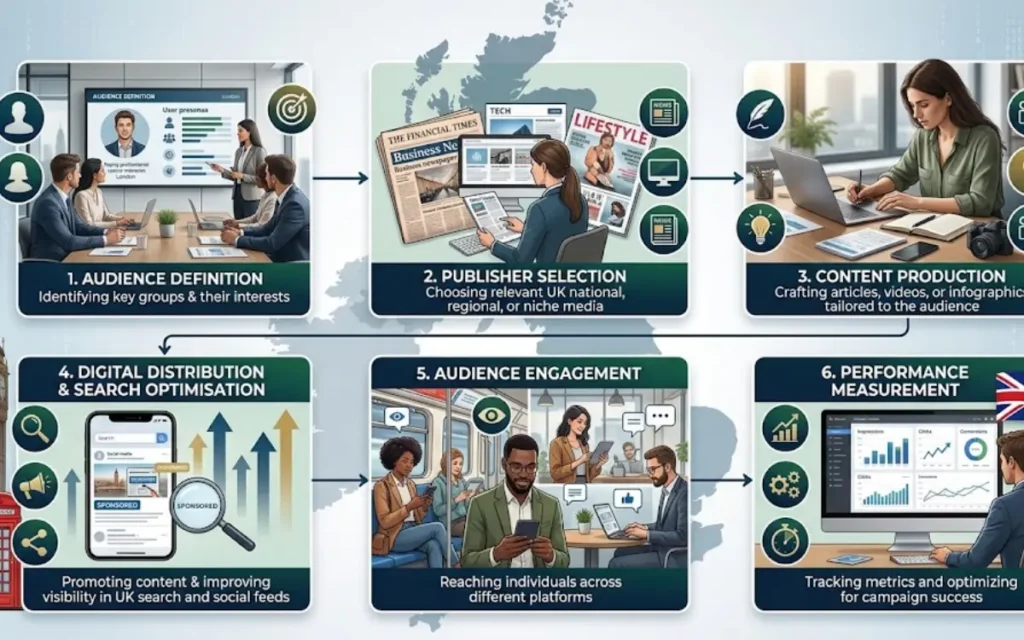
The process begins with audience definition. The energy brand identifies who needs to see the content and what information those people require.
The next stage involves publication selection. A business-focused energy story requires a different media environment from a consumer-focused energy efficiency article.
Content production follows the publication strategy. The format needs to match the information and audience. A technical subject often requires more detailed explanation than a general market announcement.
Distribution then places the content in front of the selected audience. Search visibility adds another discovery route when the article targets relevant energy terminology.
What makes energy sponsored content relevant to UK readers?
Relevant energy sponsored content answers a defined audience question, uses accurate sector terminology, provides evidence, explains its practical significance, and connects the subject with a recognisable UK market, organisation, project, regulation, or consumer need.
Relevance starts with the reader’s information requirement.
A business decision-maker needs commercial information. An engineer needs technical detail. A household audience needs practical information about energy costs, efficiency, or technology.
The content therefore needs a clear information purpose.
Why does localisation matter?
UK localisation improves contextual relevance. It includes British terminology, UK market conditions, local projects, relevant organisations, and appropriate regulatory references.
For example, a UK energy efficiency article can discuss British housing stock, energy performance, heat pumps, insulation, electricity pricing, and relevant government policy.
A global article with no UK-specific information provides weaker contextual signals for a UK audience.
What information increases credibility?
Useful evidence includes:
- Project capacity
- Installation numbers
- Geographic location
- Technology specifications
- Investment values
- Operational dates
- Efficiency measurements
- Case study results
- Customer numbers
- Independent data sources
Specific information allows readers to evaluate the subject rather than simply receiving promotional claims.
How is energy sponsored content produced?
Energy sponsored content is produced through topic selection, audience research, publisher requirements, content development, factual review, commercial disclosure, editorial formatting, publication approval, and final distribution across selected UK media channels.
Production starts with a defined content objective.
The brand then supplies factual information, expertise, data, project details, and approved messaging. The content team converts these inputs into a reader-focused format.
Publisher requirements influence the final structure. Different publications use different article lengths, formats, headlines, imagery, and disclosure standards.
How does search visibility support sponsored content?
Search visibility allows sponsored content to remain discoverable after publication by targeting relevant keywords, entities, questions, locations, and energy-sector terminology that UK audiences use when researching specific subjects online.
Search optimisation gives sponsored content an additional discovery channel.
The article needs a clear primary topic. Supporting terms then establish its wider semantic context.
For an article about battery storage, relevant concepts include grid balancing, electricity storage, renewable generation, battery capacity, energy flexibility, and grid infrastructure.
Which SEO elements matter?
Important elements include:
- Primary keyword
- Search-intent alignment
- Descriptive headline
- Clear headings
- Entity references
- Relevant supporting terminology
- Concise answers
- Internal links
- Author or company information
- Accurate metadata
- Appropriate images
The article also needs useful information depth. Repeating a keyword does not create topical relevance.
For example, an article targeting “UK battery storage” needs information about storage technology, applications, capacity, grid integration, and UK market context.
How does sponsored content differ from traditional advertising?
Sponsored content differs from traditional advertising because it uses an information-led format hosted within a publisher environment, while traditional advertising generally uses dedicated promotional placements such as banners, display units, paid search adverts, or direct promotional messages.
Traditional advertising focuses on immediate visibility around a defined advert.
Sponsored content provides a longer information format. The reader enters the content through a headline, topic, search result, publisher section, or distribution channel.
This distinction affects how brands structure their messaging.
When is sponsored content useful?
Sponsored content fits situations where the audience needs explanation before taking further action.
Examples include:
- Explaining new energy technology
- Introducing a renewable energy project
- Presenting research findings
- Explaining a complex energy issue
- Demonstrating project results
- Establishing subject-matter expertise
- Supporting a wider PR campaign
The format is particularly relevant to complex B2B energy subjects where the purchasing process involves research and multiple decision-makers.
What audiences can UK energy sponsored content reach?
UK energy sponsored content can reach consumer, business, technical, investor, procurement, sustainability, construction, engineering, and policy audiences when publication selection and content topics match each audience’s information needs.
Audience segmentation determines distribution priorities.
Consumer audiences
Consumer content covers subjects such as home energy efficiency, solar panels, heat pumps, electric vehicles, and energy-saving technology.
B2B audiences
Business audiences include procurement managers, operations directors, sustainability leaders, finance professionals, and senior executives.
Technical audiences
Technical readers include engineers, energy consultants, infrastructure specialists, and technology professionals.
Investment audiences
Investor-focused content addresses market developments, projects, capital investment, operational performance, and business models.
A single energy brand can therefore require several sponsored content strategies rather than one universal campaign.
How can brands measure sponsored content performance?
Sponsored content performance is measured through publication reach, page views, engagement, referral traffic, search visibility, clicks, conversions, audience characteristics, and downstream business actions linked to the published content.
Measurement starts with defined objectives.
If the objective is awareness, reach and impressions provide useful indicators. If the objective is website traffic, referral sessions and click-through activity become more important.
For lead generation, the measurement framework needs to extend beyond publication metrics.
Which metrics matter most?
Key metrics include:
- Published placements
- Estimated audience reach
- Page views
- Engagement time
- Referral traffic
- Click-through rate
- Search impressions
- Search rankings
- Branded search activity
- Lead submissions
- Conversion activity
The correct metric depends on the campaign objective.
A technical case study designed for B2B awareness does not require the same measurement framework as a sponsored article supporting a lead-generation campaign.
When should energy brands consider sponsored content?
Energy brands use sponsored content when they need controlled communication around complex subjects, defined audience access, extended explanations, specialist publication environments, search visibility, or measurable distribution across relevant UK media channels.
Sponsored content is most useful when information depth matters.
An energy company launching a new technology needs more space than a standard advert provides. A developer announcing a major project can use a case study to explain the project’s technical and commercial context.
A specialist energy supplier can also use sponsored content to explain an emerging market issue to procurement and business audiences.
For brands evaluating specific distribution options, energy sponsored content provides the next stage of information about how a specialist media solution addresses these requirements.
What does an effective UK energy sponsored content strategy include?
An effective strategy combines audience definition, topic selection, publisher relevance, factual evidence, compliant disclosure, search optimisation, distribution planning, performance measurement, and consistent messaging across the wider energy marketing and communications programme.
The strategy starts with the audience rather than the publication.
The brand identifies the information gap first. It then selects the format, topic, publication type, and distribution method that address that gap.
A strong strategy also separates awareness objectives from conversion objectives.
What should the planning process contain?
A practical planning sequence contains eight stages:
- Define the target UK audience.
- Identify the information requirement.
- Select the content topic.
- Choose the appropriate format.
- Identify relevant publishers.
- Produce and review the content.
- Distribute through selected media channels.
- Measure performance against defined objectives.
This process creates a controlled connection between content, audience, distribution, and measurable outcomes.
How can UK energy brands evaluate sponsored content providers?
Energy brands can evaluate sponsored content providers by reviewing publisher relevance, audience access, content quality, distribution processes, disclosure practices, reporting standards, search capabilities, sector experience, and the provider’s ability to match content with defined UK audiences.
Provider evaluation needs clear criteria.
Publisher quantity alone does not establish campaign quality. The publications need relevance to the intended audience.
Reporting also needs to provide usable information. Brands need to understand where content appeared, what audiences it reached, and which measurable actions followed.
A provider specialising in energy sponsored content can also offer sector-specific knowledge around energy terminology, audience segmentation, and relevant publication categories.
The final selection depends on the campaign objective, target audience, content format, publication requirements, and measurement framework.
For brands moving from evaluation to implementation:
Energy sponsored content offers a route into a more defined media distribution strategy while retaining the information-led structure required by UK audiences.
What is the main value of energy sponsored content for UK audiences?

The main value of energy sponsored content is controlled access to relevant UK audiences through informative media formats that explain complex energy subjects, support search discovery, provide measurable distribution, and connect brand expertise with specific reader information needs.
Energy is a technical and commercially significant sector. Its audiences require information about projects, technologies, markets, infrastructure, investment, efficiency, and sustainability.
Sponsored content provides a structured environment for that information.
Explore More Expert Insights:
How Sponsored Case Studies Convert UK B2B Readers
How Edinburgh Sponsored Content Reaches Scottish Readers
Its effectiveness depends on relevance, factual quality, publisher selection, audience definition, search visibility, distribution, and measurement.
For UK energy brands, the strongest approach connects every content decision to a specific audience and information requirement. This creates a measurable path from topic selection to publication, audience exposure, engagement, and business outcomes.



