

Sponsored case studies convert UK B2B readers by connecting a documented business problem with a specific solution, measurable results, and credible evidence. This format reduces uncertainty, demonstrates practical value, and gives decision-makers information they can use when evaluating suppliers.
A sponsored case study is paid content that presents a real business situation through a structured customer story. It combines commercial messaging with evidence-based editorial presentation. In B2B marketing, the format focuses on business challenges, implementation details, measurable outcomes, and customer experience.
UK B2B readers often evaluate products and services against operational requirements. They look for evidence about cost, efficiency, implementation, compliance, risk, and commercial outcomes. A case study addresses these requirements within one focused narrative.
Sponsored case studies also sit between advertising and traditional editorial content. The commercial relationship is disclosed, while the content provides useful information. This distinction matters for audience trust and regulatory transparency.
The conversion process begins with relevance. A reader first recognises a business problem. The case study then shows how another organisation addressed that problem. Evidence moves the reader from general interest towards solution consideration.
Brands can support this journey through:
sponsored case studies by presenting customer evidence in a format that answers practical B2B questions rather than relying on product claims alone.
How does a sponsored case study move a reader towards conversion?
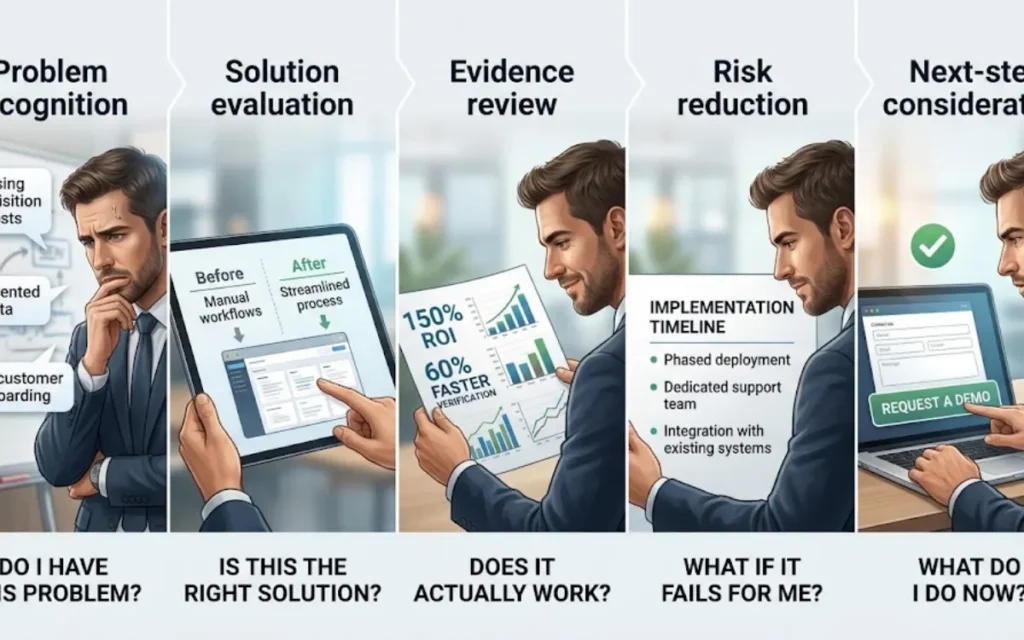
A sponsored case study moves readers towards conversion through five stages: problem recognition, solution evaluation, evidence review, risk reduction, and next-step consideration. Each stage answers a decision question and supplies information that supports stronger commercial evaluation.
1. Problem recognition
The opening establishes a specific business challenge. Examples include rising acquisition costs, fragmented data, inefficient workflows, regulatory pressure, or slow customer onboarding.
A specific problem creates immediate relevance. A UK fintech company facing customer verification delays has a different information need from a construction company managing procurement costs.
2. Solution evaluation
The case study identifies the solution used to address the problem. It explains what changed, how the solution was implemented, and which business functions were affected.
This section gives readers enough context to assess relevance without turning the article into a product catalogue.
3. Evidence review
Evidence demonstrates whether the solution delivered measurable improvement. Useful metrics include:
- 35% reduction in processing time
- 22% increase in qualified leads
- 18% reduction in operational costs
- 40% faster customer onboarding
- 3-month implementation period
Specific figures create stronger decision value than statements such as “significant growth” or “major efficiency gains”.
4. Risk reduction
B2B purchases involve financial, operational, technical, and reputational risks. A case study addresses these risks by showing how implementation occurred in an existing organisation.
Readers gain information about resources, timelines, integration requirements, staff adoption, and measurable outcomes.
5. Next-step consideration
The final section establishes what a reader can investigate next. This includes reviewing the solution category, comparing providers, requesting further information, or assessing internal requirements.
The article therefore supports consideration without forcing an immediate purchase decision.
Which components make a sponsored case study persuasive?
A converting sponsored case study contains a defined customer, measurable challenge, documented solution, implementation details, quantified outcomes, supporting evidence, and transparent sponsorship. These components provide the context B2B readers need to assess relevance, credibility, feasibility, and commercial value.
Customer context
The customer profile establishes relevance. It can include industry, organisation size, operating model, location, or business objective.
For example, a UK professional services firm with 250 employees provides a clear context for readers from similar organisations.
Business challenge
The challenge needs measurable dimensions. Instead of describing “inefficiency”, the case study can identify a process requiring 10 working days and involving four internal teams.
This detail defines the starting position.
Solution
The solution section explains what the organisation implemented. It covers the relevant service, technology, process, or strategic intervention.
A strong case study separates the solution from the outcome. Readers need to understand what action produced the reported result.
Implementation
Implementation details establish practical feasibility. Relevant information includes deployment time, team involvement, integration requirements, training, and operational changes.
A six-week implementation provides more useful information than a statement that the solution was “quick to deploy”.
Measurable outcomes
Results represent the strongest conversion component. The metrics need a defined baseline and measurement period.
For example, reducing average response time from 48 hours to 18 hours gives readers a measurable comparison.
Customer evidence
Customer quotations provide direct experience. The strongest quotations explain a business change rather than simply praising a supplier.
A statement about reducing administrative workload gives readers more decision value than generic satisfaction language.
Sponsorship disclosure
Sponsored content requires clear commercial transparency. Disclosure identifies the paid relationship while allowing the article to remain useful and evidence-led.
Transparency supports responsible B2B publishing and helps readers distinguish sponsored material from independent editorial content.
How do results and evidence influence UK B2B conversion?
Results influence B2B conversion because measurable evidence allows readers to compare expected value with business requirements. Quantified improvements, defined timeframes, customer statements, and implementation details reduce information gaps during supplier research and solution evaluation.
B2B buyers rarely evaluate a solution from one claim. They collect evidence across websites, media coverage, customer stories, reports, reviews, and supplier materials.
A sponsored case study becomes more useful when it contributes verifiable business information to this research process.
Quantified results
Percentages provide a simple measurement format, but absolute figures often provide additional context.
For example:
- Customer acquisition cost fell by £12,000 per quarter.
- Processing time decreased from 10 days to 6 days.
- Website enquiries increased from 120 to 175 per month.
- Manual reporting reduced from 20 hours to 8 hours per month.
These details establish a measurable relationship between the intervention and the result.
Time-based evidence
Timeframes also affect evaluation. A result achieved after three months represents a different implementation profile from one achieved after 18 months.
Case studies therefore benefit from specifying implementation periods, measurement periods, and reporting dates.
Comparative evidence
Before-and-after comparisons clarify performance changes. They establish the baseline, intervention, and resulting position.
For example, a B2B software provider can document a reduction in onboarding time from five business days to two business days following process automation.
This structure makes the outcome easier to assess.
Where do sponsored case studies fit within the B2B buying journey?
Sponsored case studies perform strongest during consideration because readers already understand a business problem and need evidence before comparing solutions. The format supports supplier research, internal discussions, commercial evaluation, and shortlisting before direct purchase conversations begin.
The B2B buying journey contains several information stages. Awareness establishes the problem. Consideration evaluates possible solutions. Decision focuses on supplier selection and commercial terms.
Sponsored case studies primarily support consideration.
A reader searching for ways to reduce customer onboarding time already understands the problem. The case study provides evidence about one approach and its implementation.
During supplier research
Readers compare providers based on capabilities, experience, outcomes, sector knowledge, and implementation requirements.
A case study supplies customer evidence within this comparison.
During internal approval
B2B purchases often involve multiple stakeholders. A marketing manager, procurement specialist, finance director, IT manager, and senior executive can assess different aspects of the same solution.
A structured case study provides shared evidence for these discussions.
During solution shortlisting
Once readers identify potential suppliers, customer examples help determine relevance.
A UK property company evaluating workflow software gains stronger context from another property organisation than from an unrelated consumer brand.
Before commercial contact
Case studies can answer basic questions before a prospect contacts a supplier. They establish what the solution does, where it fits, how it was implemented, and what outcomes were achieved.
This makes subsequent commercial conversations more informed.
Which UK B2B sectors benefit from sponsored case studies?
Sponsored case studies work across UK B2B sectors where purchasing decisions depend on evidence, implementation experience, and measurable outcomes. Strong applications include technology, financial services, professional services, healthcare, property, construction, manufacturing, education, and logistics.
Technology
Technology companies use case studies to explain implementation, integration, adoption, and performance outcomes.
A software provider can document how a 300-person organisation reduced manual reporting through workflow automation.
Financial services
Fintech and financial services brands can focus on onboarding, compliance processes, fraud prevention, payment efficiency, or customer experience.
Evidence is particularly important where operational and regulatory requirements influence purchasing decisions.
Professional services
Consultancies and specialist service providers can demonstrate improvements in productivity, governance, cost management, or project delivery.
The case study establishes how expertise translated into a measurable business result.
Property and construction
Property and construction organisations can document procurement improvements, project management, energy efficiency, compliance processes, or digital transformation.
Specific project information provides practical context for similar organisations.
Manufacturing and logistics
Manufacturers and logistics providers can highlight production efficiency, inventory management, delivery performance, automation, and operational cost reductions.
These sectors benefit from measurable operational metrics because efficiency is directly connected to commercial performance.
How should brands measure sponsored case study performance?
Brands measure sponsored case study performance through qualified traffic, engagement, referral activity, lead interactions, assisted conversions, and downstream commercial actions. Measurement works best when content metrics connect directly with defined B2B marketing and sales objectives.
Traffic provides the first performance indicator. It measures how many people reach the case study.
Engagement metrics provide additional context. These include average engagement time, scroll depth, return visits, and interactions with relevant links.
Lead indicators
Lead-related measurements include:
- Contact form submissions
- Demo requests
- Enquiry clicks
- Resource downloads
- Newsletter registrations
- Sales-qualified leads
These indicators connect content engagement with identifiable commercial activity.
Assisted conversion
A sponsored case study does not need to generate the final conversion to contribute commercial value.
A prospect can discover the case study through search, revisit the supplier website, attend a webinar, and later request a proposal.
Attribution therefore needs to account for assisted interactions rather than measuring only last-click activity.
Content-level reporting
Brands can track the case study URL separately from other campaign assets. This creates a defined measurement point for traffic, engagement, referrals, and conversions.
UTM parameters also help identify campaign sources and distribution channels.
How can sponsored case studies support long-term B2B marketing?
Sponsored case studies support long-term B2B marketing by creating reusable evidence for search, media distribution, sales enablement, social promotion, email campaigns, presentations, and supplier evaluation. One documented customer outcome can therefore support multiple stages of commercial communication.
The primary asset is the documented customer story. Its information can support several marketing activities without changing the underlying evidence.
Search visibility
A case study can target queries related to the customer problem, solution category, industry, and measurable outcome.
For example, a case study about reducing B2B onboarding time can naturally address terms such as “customer onboarding software UK”, “B2B onboarding process”, and “reduce onboarding time”.
Sales enablement
Sales teams can use case studies during prospect conversations. A relevant customer example provides evidence for claims made during supplier evaluation.
Media distribution
Sponsored case studies can also reach established B2B audiences through relevant media environments. Distribution expands exposure beyond a company-owned website and places the customer story in front of readers already consuming industry information.
For brands evaluating a managed publishing route, Sponsored Case Studies provide a structured way to assess how customer evidence can support B2B visibility and consideration.
Repurposing
A single case study can produce supporting assets such as sales slides, short social posts, email excerpts, website proof points, and presentation material.
The original evidence remains consistent across formats.
Explore More Expert Insights:
How Edinburgh Sponsored Content Reaches Scottish Readers
How Sponsored Interviews Get Published Across 15 Sites
What should UK B2B brands evaluate before publishing a sponsored case study?
UK B2B brands need to evaluate customer relevance, evidence quality, disclosure, publication environment, audience fit, distribution, measurement, and commercial objectives before publishing. These factors determine whether the case study supports genuine consideration rather than simply generating branded exposure.

A sponsored case study converts effectively when these elements work together. The format gives UK B2B readers evidence instead of unsupported claims. It explains the problem, documents the solution, presents measurable outcomes, and reduces uncertainty during consideration.
For organisations assessing publication and distribution options:
Sponsored Case Studies provide a practical route for turning customer evidence into a structured B2B marketing asset.



