

Automotive sponsored content is paid editorial-style content created to communicate a vehicle, automotive service, technology, or brand message through a relevant media publisher. It reaches defined audiences while combining brand control with the credibility and context of established UK media environments.
Sponsored content sits between traditional advertising and editorial communication. The advertiser pays for publication, while the content follows the publisher’s commercial-content requirements.
For automotive brands, formats include:
- Vehicle launch articles
- Electric vehicle explainers
- Product comparison features
- Automotive technology stories
- Road safety content
- Sustainability articles
- Dealer and retail features
- Executive commentary
- Ownership guides
The format changes the role of the content. A vehicle launch focuses on a specific model. An ownership guide addresses practical buyer questions. A technology feature explains developments such as battery systems, driver assistance, or connected vehicles.
This makes sponsored content relevant during the consideration stage of the automotive buying journey.
Brands already evaluating:
Automotive sponsored content can assess each format according to audience relevance, publication environment, message control, and measurable outcomes.
How does automotive sponsored content reach UK buyers?
Automotive sponsored content reaches UK buyers through selected publishers, relevant audience segments, search visibility, social distribution, and contextual placement. The process connects brand-created information with consumers researching vehicles, ownership costs, technology, financing, and purchase decisions.
The distribution process normally follows several stages.
1. Audience definition
The campaign begins with a defined buyer group. Automotive audiences include new-car buyers, used-car buyers, electric vehicle shoppers, fleet managers, business drivers, and automotive enthusiasts.
Each audience has different information requirements.
An electric vehicle campaign can focus on battery range, charging infrastructure, running costs, and charging locations. A fleet campaign can focus on total cost of ownership, tax considerations, vehicle availability, and operational efficiency.
2. Content development
The brand develops content around a specific subject and commercial objective.
The content contains factual information, product details, supporting evidence, imagery, and relevant calls to action. It also follows the publisher’s sponsored-content requirements.
3. Publisher selection
The content is placed with publications that attract relevant UK readers.
Publisher selection affects audience relevance, contextual authority, geographic reach, and content visibility. Automotive publications provide specialist audiences. Business publications provide access to decision-makers. Regional publications provide location-specific exposure.
4. Publication and distribution
The publisher publishes the sponsored article within its digital environment.
Distribution then extends the content’s visibility through the publisher’s website, search results, newsletters, social channels, or other available media placements.
Which UK audiences can automotive sponsored content reach?
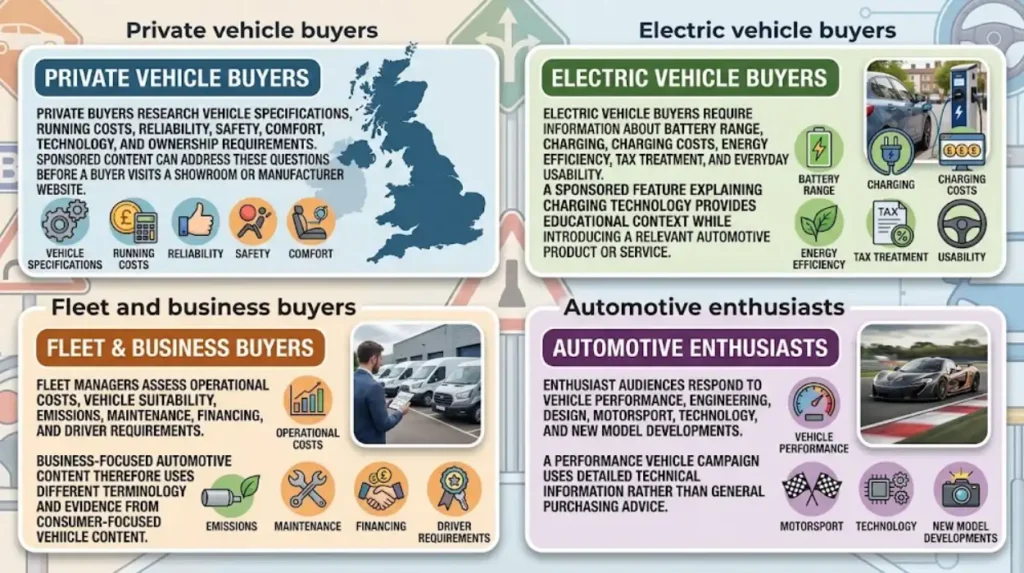
Automotive sponsored content can reach multiple UK buyer groups by matching content topics with audience interests, purchasing stages, and publication categories. The strongest alignment connects specific automotive information with readers actively researching relevant products, technologies, costs, or ownership decisions.
Private vehicle buyers
Private buyers research vehicle specifications, running costs, reliability, safety, comfort, technology, and ownership requirements.
Sponsored content can address these questions before a buyer visits a showroom or manufacturer website.
Electric vehicle buyers
Electric vehicle buyers require information about battery range, charging, charging costs, energy efficiency, tax treatment, and everyday usability.
A sponsored feature explaining charging technology provides educational context while introducing a relevant automotive product or service.
Fleet and business buyers
Fleet managers assess operational costs, vehicle suitability, emissions, maintenance, financing, and driver requirements.
Business-focused automotive content therefore uses different terminology and evidence from consumer-focused vehicle content.
Automotive enthusiasts
Enthusiast audiences respond to vehicle performance, engineering, design, motorsport, technology, and new model developments.
A performance vehicle campaign uses detailed technical information rather than general purchasing advice.
Why does publisher selection matter for automotive campaigns?
Publisher selection determines where automotive sponsored content appears, which audience encounters it, and how strongly the surrounding editorial context supports the campaign. Relevance, readership profile, subject authority, geographic coverage, content standards, and distribution channels all influence campaign performance.
A national automotive publication provides broad exposure across the UK. A specialist electric vehicle publication provides a narrower audience with strong topical relevance.
Publisher categories also affect content positioning.
| Publisher type | Relevant automotive use |
|---|---|
| Automotive media | Vehicle launches, reviews, technology |
| Business media | Fleet, finance, corporate mobility |
| Regional media | Local dealerships and regional campaigns |
| Technology media | Connected cars, software, EV technology |
| Lifestyle media | Consumer vehicle ownership and design |
| Trade media | Automotive professionals and industry buyers |
The correct publisher depends on the campaign objective.
A premium vehicle campaign targeting affluent consumers requires a different media environment from a fleet technology campaign targeting procurement professionals.
How does sponsored content influence buyers during the consideration stage?
Sponsored content influences consideration by supplying structured information when buyers compare products, technologies, costs, and brands. It gives automotive companies controlled space to explain differentiators while placing those messages within media environments relevant to the buyer’s research process.
The consideration stage involves information gathering.
Buyers compare vehicle dimensions, specifications, pricing structures, financing options, charging capabilities, safety systems, warranties, and ownership costs.
Sponsored content provides a format for explaining these factors in greater depth than a conventional display advertisement.
Information depth
Display advertising communicates a short message. Sponsored content provides room for supporting explanations.
For example, an electric vehicle article can explain charging performance, battery capacity, charging locations, and daily driving requirements within one structured piece.
Brand message control
The advertiser controls the core commercial message while complying with publisher disclosure and content standards.
This gives automotive brands greater control over how technical features, product positioning, and campaign themes are explained.
Contextual relevance
Content appearing beside automotive, business, technology, or consumer information creates contextual relevance.
A fleet-management article placed within business media addresses a different research environment from a new-car feature placed within a consumer automotive publication.
What content formats work best for automotive sponsored campaigns?
Effective automotive sponsored content uses formats that match the buyer’s information needs. Common formats include vehicle features, technology explainers, ownership guides, comparison articles, executive commentary, industry analysis, and launch stories designed around specific automotive search and research behaviours.
Vehicle launch features
Launch content introduces a new model, product line, or vehicle technology.
It can cover specifications, design changes, powertrain options, technology, safety systems, and target use cases.
Automotive technology explainers
Technology explainers simplify complex systems.
Examples include battery management, advanced driver assistance systems, connected-car platforms, charging technology, and vehicle software.
Ownership guides
Ownership guides address practical buyer questions.
Topics include maintenance, charging, insurance considerations, running costs, servicing, and everyday vehicle use.
Industry analysis
Industry-focused content addresses broader market developments.
Examples include electrification, vehicle manufacturing, charging infrastructure, autonomous technology, and changing consumer behaviour.
Product-led educational content
This format combines useful information with specific product relevance.
For example, a tyre manufacturer can publish content explaining tyre maintenance while introducing its product range within the article.
How does SEO support automotive sponsored content?
SEO supports automotive sponsored content by making useful campaign pages discoverable through relevant search queries. Topic alignment, clear headings, descriptive language, internal links, technical accessibility, and authoritative publication environments contribute to the content’s search visibility and long-term discoverability.
Search visibility depends on the relationship between the content and the searcher’s query.
Automotive search behaviour includes informational and commercial queries such as:
- Best electric vehicle charging options
- Electric car running costs UK
- New car technology
- Fleet vehicle management
- Vehicle safety technology
- EV battery technology
- Car maintenance advice
Sponsored content does not replace a brand’s organic search strategy. It forms part of a wider media and content ecosystem.
A well-structured article also creates opportunities for relevant internal links, branded searches, referral traffic, and repeated exposure across digital channels.
How can automotive brands measure sponsored content performance?
Automotive sponsored content performance is measured through defined exposure, engagement, traffic, search, and conversion indicators. Measurement starts with campaign objectives and connects publisher reporting with website analytics, referral activity, audience behaviour, and downstream commercial outcomes.
Common measurements include:
- Impressions
- Page views
- Unique users
- Engagement time
- Referral traffic
- Click-through rate
- Landing-page visits
- Lead submissions
- Enquiries
- Brand-search activity
Measurement requires consistent tracking.
A campaign designed for awareness uses exposure and engagement metrics. A campaign designed to generate website visits uses referral traffic and landing-page behaviour. A lead-generation campaign uses tracked enquiries and conversion events.
UTM parameters provide a practical method for identifying traffic generated from individual sponsored placements.
How does automotive sponsored content compare with traditional advertising?
Automotive sponsored content provides more space for explanation than conventional display advertising, while traditional advertising offers faster visual recognition and direct creative control. The two formats serve different communication purposes and can operate together within an integrated automotive media strategy.
Display advertising is designed for rapid recognition. Sponsored content is designed for information delivery.
A banner can communicate a vehicle name, promotional message, image, and destination URL within seconds. A sponsored article can explain why a vehicle matters, how a technology works, and which buyer requirements it addresses.
The distinction is therefore based on communication depth.
| Factor | Sponsored content | Display advertising |
| Information depth | High | Low |
| Format | Article or feature | Visual advertisement |
| Context | Publisher content environment | Ad placement |
| Message length | Extended | Short |
| Buyer education | Strong | Limited |
| Creative control | Shared with publisher standards | High |
Campaign objectives determine which format receives greater emphasis.
When is automotive sponsored content most useful for UK brands?
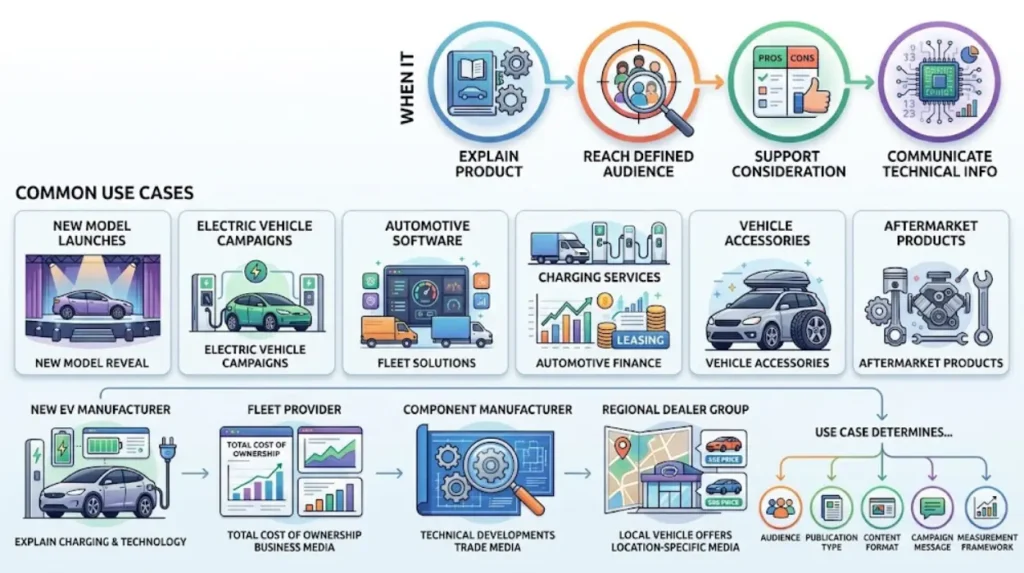
Automotive sponsored content is most useful when a UK brand needs to explain a product, reach a defined audience, support consideration, or communicate technical information within a trusted media environment. It works across launches, electrification, fleet services, technology, and ownership campaigns.
Common use cases include new model launches, electric vehicle campaigns, automotive software announcements, fleet solutions, charging services, automotive finance, vehicle accessories, and aftermarket products.
A new EV manufacturer can use sponsored content to explain charging and battery technology.
A fleet provider can use business media to explain total cost of ownership.
A component manufacturer can use trade media to communicate technical developments to automotive professionals.
A regional dealer group can use location-specific media to communicate local vehicle offers and dealership developments.
The use case determines the audience, publication type, content format, campaign message, and measurement framework.
For brands evaluating specific delivery options,
Automotive Sponsored Content provides the next stage for assessing a structured sponsored-content service.
What should automotive brands evaluate before choosing a sponsored content approach?
Automotive brands evaluating sponsored content need to assess audience relevance, publisher quality, geographic coverage, content format, disclosure requirements, distribution channels, reporting, tracking, and campaign objectives. These factors establish whether a sponsored-content programme matches the intended UK buyer journey.
A practical evaluation framework includes eight areas:
- Audience fit — Identify the exact buyer group.
- Publisher relevance — Match publications with automotive interests.
- Geographic coverage — Determine national, regional, or specialist reach.
- Content format — Select features, explainers, guides, or analysis.
- Message control — Define the commercial information the content must communicate.
- Distribution — Assess website, search, newsletter, and social exposure.
- Measurement — Establish traffic, engagement, lead, and conversion tracking.
- Compliance — Confirm clear sponsored-content disclosure and publisher requirements.
This framework separates media reach from content effectiveness.
Explore More Expert Insights:
Sponsored Content vs PR: Which Reaches UK Readers Better
How Education Sponsored Content Reaches UK Readers
A large audience does not automatically represent the correct automotive buyer. A smaller specialist publication can provide stronger relevance when its readership matches the campaign’s target market.
The central consideration is therefore alignment: the right automotive message, presented in the right content format, through the right UK media environment, for the right buyer group.



